The Forest King
In Germanic forests, particularly where black alders grow near ancient burial mounds, folklore places the Erlkönig—a figure who has appeared in European literature and oral tradition for centuries. Neither fully elf nor wholly demon, this spectral king embodies death itself, appearing as an omen to those whose time approaches and actively hunting children who stray too far from safety. The very name carries layers of confusion and transformation: a mistranslation from Danish that changed "Elf-King" to "Alder-King," forever binding this creature to the dark trees that mark the boundary between the living world and the realm of the dead.
The Erlkönig's story is one of evolution and cultural transmission—how a seductive female spirit of Danish folklore transformed through literary reinterpretation into the towering, bearded king of German Romanticism. What began as the Elf-King's Daughter luring adults to doom became, through the pen of Goethe, a male predator stalking children through midnight forests. This transformation reveals how folklore adapts to cultural anxieties, how written literature can reshape oral tradition, and how a mistranslation can birth an entirely new mythological figure. The Erlkönig we know today—the crowned giant draped in trailing mist—is both an authentic survival of ancient belief and a relatively modern creation, demonstrating folklore's living, changing nature.
A Mistranslation Creates a Legend
The name "Erlkönig" itself embodies a fascinating linguistic accident that fundamentally altered the figure's nature. The word derives from the Danish "Ellerkonge" or "Elverkonge," meaning "Elf-King"—a spirit associated with the hidden folk who dwelt in ancient burial mounds throughout Scandinavia. When Johann Gottfried Herder translated the Danish folk ballad "Hr. Oluf han rider" into German in 1778, he rendered this as "Erlkönig," apparently misunderstanding the Danish word "elle."1 In Danish, "elle" means both "elf" and "alder tree," leading Herder to create the "Alder King" rather than the "Elf King." Whether this was genuine error or deliberate poetic choice remains debated, but the result was profound: the creature became permanently associated with the black alder trees that grow in damp, forbidding places—exactly the kind of liminal spaces where the boundaries between worlds grow thin.
The proper German translation should have been "Elbkönig" or "Elfenkönig," and indeed Christoph Martin Wieland used "Elfenkönig" in his 1780 poem Oberon. But "Erlkönig" captured the imagination precisely because it rooted the figure in the physical landscape—the alder groves and forests that Germans knew and feared. Deeper etymology reveals even more connections: Jacob Grimm traced the figure back to proto-Germanic *erilaz*, which evolved into Old Norse *jarl* (nobleman) and Anglo-Saxon *earl*. This links the Erlkönig to King Herla of Anglo-Saxon legend, leader of the Wild Hunt, who may himself be another name for Odin/Woden. The linguistic web connecting Erlking, Herle King, and Herlequin suggests these are not separate beings but cultural variants of a single ancient figure—a lord of the dead whose hunt sweeps across the winter sky, claiming souls for the otherworld.
The Elf-King's Daughter: Original Danish Folklore
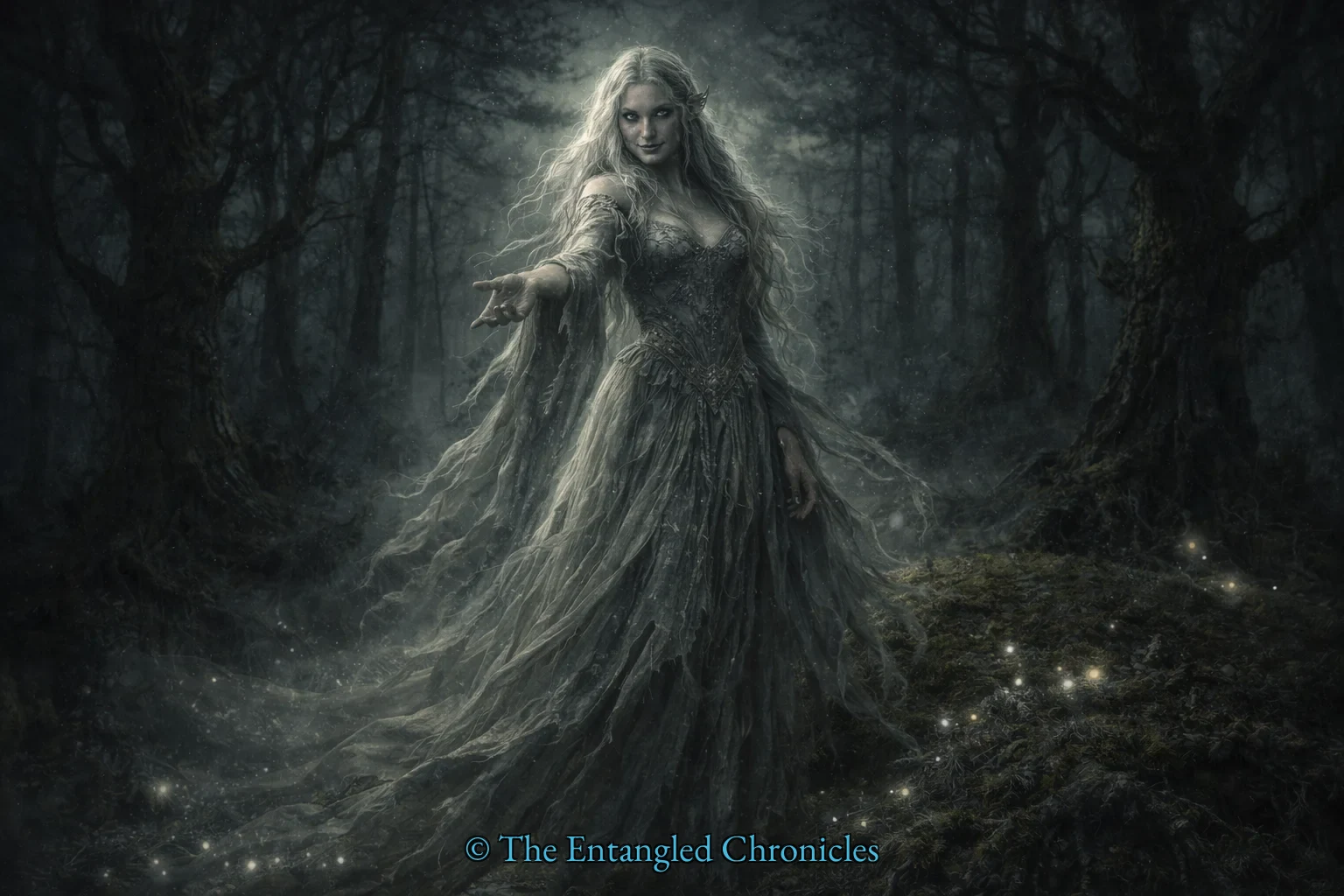
Before Goethe's poem immortalized the male Erlkönig, Scandinavian folklore told darker stories of the Elf-King's Daughter—*Elverkongens datter*—a seductive and deadly female spirit. The earliest recorded version appears in "Hr. Oluf han rider" ("Sir Oluf He Rides"), published in the 1739 edition of *Danske Kæmpeviser*. In this ballad, a knight named Sir Oluf rides to his wedding but becomes entranced by the music of elves dancing in the forest. The Elf-King's Daughter appears and invites him to dance with her. When he refuses, explaining he must attend his wedding, she strikes him with such force that he turns deathly pale. He returns home and dies the next day, his bride discovering him dead beneath a scarlet cloak.2
This original version reveals a fundamentally different creature from the later German adaptation. The Danish elf-maiden targets adults—specifically those on the threshold of major life transitions like marriage—and her method is seduction rather than predation. Similar stories throughout Scandinavian folklore describe *elverpige* (female elves) who ensnare human beings to satisfy desire, jealousy, or vengeance. According to Danish tradition, these spirits dwelt in ancient burial mounds, places where the dead rested and where the barrier between worlds was permeable. The elf-king and his daughters were not merely malevolent but embodied the dangerous allure of the otherworld itself—beautiful, enticing, and ultimately fatal to mortals who accepted their invitations.
Goethe's Dark Reimagining
Everything changed in 1782 when Johann Wolfgang von Goethe published his ballad "Der Erlkönig" as part of the Singspiel *Die Fischerin* (The Fisherwoman). Goethe's version fundamentally transformed the figure, creating what would become the definitive image of the Erlkönig in popular imagination. No longer the Elf-King's Daughter but the Erlkönig himself; no longer targeting adults but preying specifically on children; no longer using seduction alone but wielding the power of death itself. Goethe's poem depicts a father riding through the night with his feverish son, who claims to see and hear the Erlkönig promising gifts, games, and the company of his daughters. The father dismisses these visions as fever dreams and natural phenomena, but when they reach home, the child is dead in his arms.3
Goethe's Erlkönig is "much more akin to the Germanic portrayal of elves and valkyries—a force of death and a magical spirit" rather than merely a seductive fairy. His motives remain deliberately unclear, making him more terrifying than explicable. The poem's effectiveness stems from its ambiguity: is the child hallucinating from fever, or is he genuinely seeing a supernatural predator invisible to adult eyes? Germanic folklore often held that children possessed greater sensitivity to supernatural forces, suggesting the boy's visions were real and the father's inability to perceive them merely proved his adult blindness to the otherworld. The Erlkönig kills suddenly and grievously—not through gradual illness but through supernatural touch, claiming the child despite the father's desperate ride for safety.
Goethe set his poem in the Saale valley in Thuringia, near an actual alder quarry, grounding the supernatural in real geography. The poem became an instant cultural phenomenon, particularly after Franz Schubert set it to music in 1815 at age seventeen. Schubert's Lied (Op. 1, D. 328) brilliantly captures the galloping horse, the desperate father, the seductive Erlkönig, and the terrified child through distinct musical motifs. The piece launched Schubert to fame and cemented the Erlkönig's place in German cultural consciousness. Carl Loewe's 1817-18 setting also achieved popularity, and the poem has been translated countless times, including by Sir Walter Scott. Through these artistic renditions, Goethe's version overshadowed all previous traditions, becoming the "real" Erlkönig in popular imagination.
The Form of Death
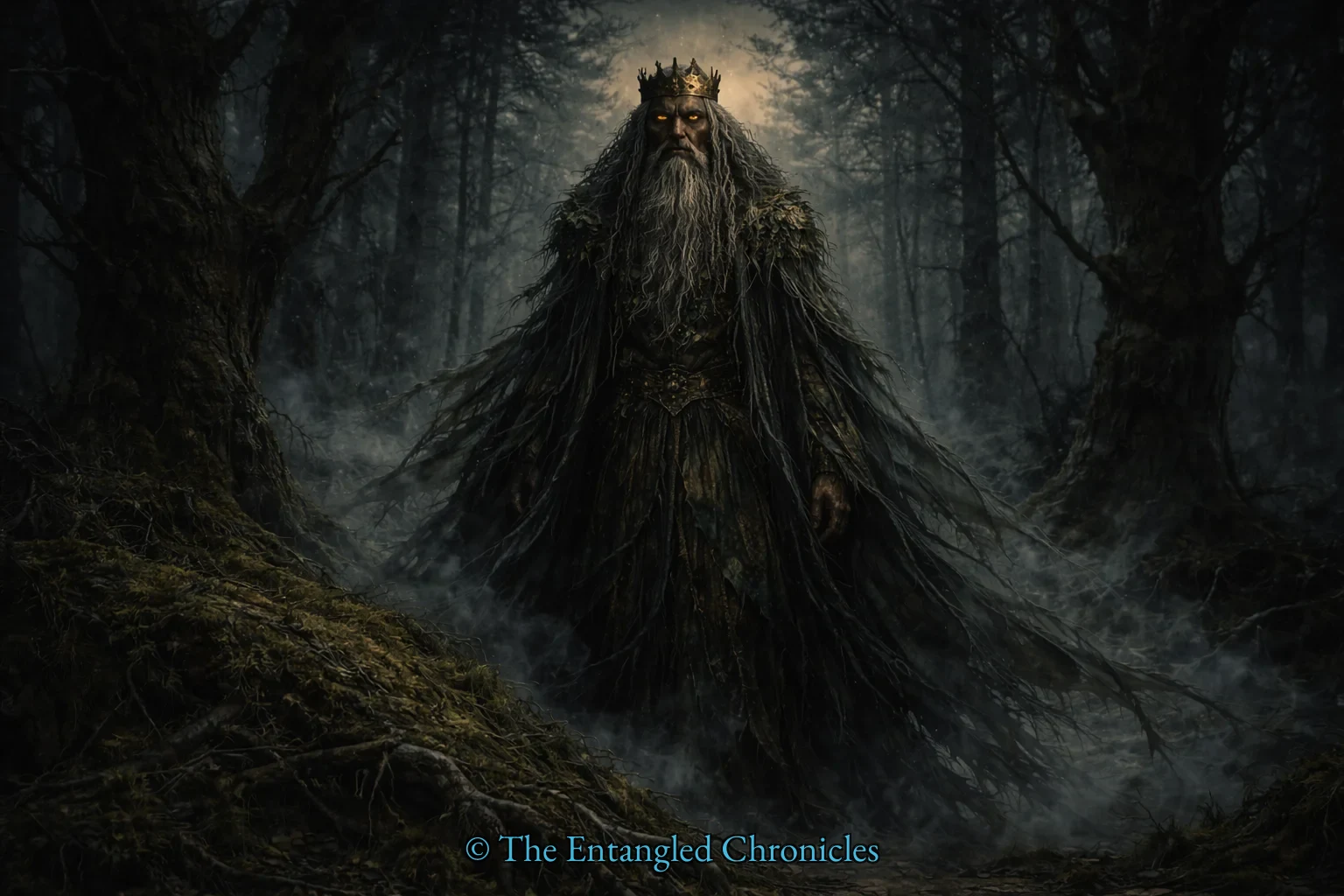
Folklore descriptions of the Erlkönig's appearance, while varying across regions and periods, converge on certain consistent features that mark him as both royal and terrifying. The *New Oxford American Dictionary* describes him as "a bearded giant or goblin who lures little children to the land of death"—emphasizing his imposing stature. Encyclopedic sources from the 19th century depict "a gigantic bearded man with a golden crown and trailing garments," an image that combines regal authority with otherworldly menace. His crown, often described as tarnished or ancient rather than gleaming, marks him as a king of lost and forgotten realms. His trailing robes or cloak seem to merge with forest mist, making it unclear where his physical form ends and the landscape begins—a visual expression of his liminal nature as a creature existing between life and death, solid and spectral.
His height is consistently emphasized—descriptions range from eight to nine feet tall or more, towering over mortal men. His beard is long, wild, and often grey-streaked, giving him the appearance of great age. Most chillingly, his eyes are frequently described as glowing with amber or golden light, an otherworldly luminescence that reveals his supernatural nature. Some accounts specify that his expression itself carries meaning: according to German and Danish folklore, the Erlkönig appears as an omen of death, and "his form and expression also tell the person what sort of death they will have: a pained expression means a painful death, a peaceful expression means a peaceful death."4 This transforms him from a random killer into a psychopomp—a guide and herald of death who reveals its nature to those who can see him.
The Erlkönig's association with black alder trees defines his habitat. Alders grow in wet, marshy ground—liminal spaces neither fully land nor water. These trees were associated with death across multiple European cultures, their wood bleeding red when cut (like blood), their groves marking boundaries and burial sites. He haunts not just any forest but specifically these alder groves, and especially the areas near ancient burial mounds where the elves or hidden folk were said to dwell. His appearance is neither solid flesh nor transparent ghost but something between—sometimes described as having a quality that makes him seem almost part of the forest itself, a condensation of shadows and mist that has taken vaguely human form. He is the woodland old man, the forest demon-king, death given shape and crown.
The Methods of the Hunter
The Erlkönig's power lies not in physical violence but in supernatural touch and psychological manipulation. According to widespread folklore, "he stalks children who stay in the woods for too long, and kills them with a single touch"—making him a creature of sudden, decisive death rather than gradual harm. His hunting grounds are the forest margins where children might play or travelers might seek shelter, particularly at twilight or night when the boundary between worlds grows permeable. Unlike many predatory spirits who must be invoked or who appear randomly, the Erlkönig actively hunts, seeking out vulnerable victims who have strayed from safety. His domain is specifically the liminal—not deep wilderness where no humans go, but the edges of civilization where forest meets field, where children might be playing just beyond sight of their homes.
His hunting method combines allure with menace. In Goethe's poem, he attempts to lure the child with promises: gold, games, beautiful flowers, and the company of his daughters who will dance and sing. He presents death not as terror but as enticement, offering a land of eternal play and beauty. When persuasion fails, he resorts to force: "And if you are not willing, I will use force!" Only when the child refuses to come willingly does the Erlkönig reveal his violent nature, seizing him and killing him through supernatural means. This pattern—seduction followed by violence—echoes the original Danish tales while adding the specific focus on children's desires as the method of temptation.5
Critically, the Erlkönig appears only to his intended victim, remaining invisible to others. In Goethe's poem, the father cannot see or hear what terrorizes his son, dismissing the child's pleas as fever and explaining away supernatural visions as natural phenomena: wisps of fog, rustling leaves, shimmering willows. This selective visibility marks the Erlkönig as a death omen—appearing only to those about to die, just as the Irish banshee wails only for certain families. Germanic folklore held that children possessed greater attunement to supernatural forces than adults, explaining why the boy sees clearly what his father cannot perceive. This creates the poem's central tragedy: the father's rational explanations and desperate ride for safety cannot save his son from a threat he cannot acknowledge exists. The Erlkönig operates beyond the reach of parental protection or adult rationality.
Rider of the Wild Hunt
The Erlkönig's deepest roots connect him to the Wild Hunt—that spectral procession of ghostly riders that sweeps across the winter sky, led by Odin/Woden and accompanied by the souls of the dead, valkyries, elves, and hunting dogs. The linguistic trail from Erlkönig back through King Herla to Odin himself suggests these are not separate figures but regional manifestations of a pan-Germanic death god. The Anglo-Saxon *Herla Cyning* led what the English called *Herlaþing* (Herla's assembly) or Woden's Hunt. The French called their version the *Mesnée d'Hellequin*, and from this developed both the term "Herlequin" and the broader Wild Hunt tradition. The name variants—Erlking, Herle King, Herlequin—form a linguistic chain connecting local folklore back to the chief god of the Germanic pantheon.
The Wild Hunt traditionally rides during the twelve nights of midwinter, the period between Yule and Epiphany when the boundary between worlds grows thinnest. In Germany it was called *Wuotanes Her* (Odin's Army) or *Wilde Jagd* (Wild Hunt), while in Scandinavia it was known as *Oskoreia* (Terrifying Ride) or *Odensjakt* (Odin's Hunt). The hunt swept through forests in the darkest, stormiest part of the year, accompanied by the baying of hounds, the cries of hunting horns, and the thunder of hooves. To witness it was an omen of catastrophe—war, plague, famine, or personal death. Those unfortunate enough to be caught outside when the hunt passed might be swept up into it, carried off to the otherworld or forced to join the eternal ride.
The Erlkönig shares essential characteristics with the Wild Hunt's leader: he is a lord of the dead; he rides or hunts at night; he claims souls for the otherworld; he is associated with specific sacred times and places (winter, burial mounds, sacred groves); and he appears as an omen of death. Some traditions explicitly named Holda or Perchta as leaders of the Wild Hunt in southern German regions, demonstrating that the hunt could be led by multiple divine or semi-divine figures depending on location. The Erlkönig represents a localized, forest-bound version of this ancient tradition—not the sky-riding army but the woodland king who guards burial mounds and claims those who trespass on the boundary between life and death. He is the Wild Hunt distilled to its essence: death personified as a crowned hunter in the dark forest.
From Folklore to Cultural Icon
Goethe's 1782 poem transformed the Erlkönig from a regional folktale into a pan-European cultural phenomenon. The work became one of the central texts of German Romanticism—that artistic movement that celebrated folklore, nature, the supernatural, and the sublime terror of forces beyond human control. The Romantic poets and artists saw in figures like the Erlkönig a way to explore the limits of reason, the power of nature, and humanity's fundamental vulnerability to forces beyond comprehension. The poem appealed precisely because it left key questions unanswered: Was the child fevered or seeing truly? Was the father's rationalism wisdom or dangerous blindness? Is death a seducer or a violent abductor?
Musical settings amplified the poem's reach and emotional power. Schubert's Lied became one of the most performed art songs in the classical repertoire, its galloping piano accompaniment and dramatic vocal shifts between narrator, father, child, and Erlkönig creating an immediate, visceral experience of terror. Carl Loewe's setting achieved similar acclaim. Composers continued returning to the text: Václav Tomášek (1815), Heinrich Wilhelm Ernst (who created a violin transcription of Schubert's version), Louis Spohr (1856), and many others through the 19th and 20th centuries. In the 21st century, the German Neue Deutsche Härte band Rammstein drew inspiration from the poem for their song "Dalai Lama," demonstrating its continuing cultural relevance.
Visual artists also responded to the Erlkönig's imagery. Paintings and illustrations by Albert Sterner, Moritz von Schwind, and others depicted the crowned figure threatening children in dark forests, contributing to the standardization of his appearance. The figure entered the broader cultural imagination, appearing in literature, film, and popular culture as an archetypal representation of supernatural child-predation. Modern fantasy writers have repeatedly returned to the Erlkönig as a model for fairy kings and otherworldly hunters. Jim Butcher's *Dresden Files* series features an Erlking who synthesizes Germanic forest king, Wild Hunt leader, and goblin lord. Angela Carter's "The Erl-King" reimagines the figure as a seductive but deadly male forest spirit encountered by a female protagonist. The figure has become one of those rare folklore creatures whose name itself evokes immediate recognition and dread.
Echoes Across Europe
While the Erlkönig is primarily a Germanic figure, related traditions exist throughout northern, western, and eastern Europe, demonstrating the widespread nature of beliefs about otherworldly hunters and death omens. The Welsh knew Gwyn ap Nudd, lord of the fairy realm Annwn and leader of his own Wild Hunt. The English had Herne the Hunter, an antlered figure said to haunt Windsor Great Park. The French spoke of the *Mesnée d'Hellequin*, the ghostly cavalcade that rode at night claiming souls. Even in areas without Germanic linguistic influence, similar figures appeared: the Spanish *estantigua* (old army), the Galician *Santa Compaña* (sacred company), the Slavic *Dziki Gon* (wild hunt).
These variations suggest either diffusion of the Germanic tradition or independent development of similar beliefs—communities throughout Europe developed concepts of supernatural hunters who claimed souls, appeared as death omens, and rode or hunted during liminal times. What distinguishes the Erlkönig is his specific association with forests, burial mounds, and especially children as victims. While most Wild Hunt traditions focused on claiming adults or appeared as generalized harbingers of catastrophe, the Erlkönig developed a specialized role as predator of children who strayed from safety. This may reflect particular Germanic anxieties about forest dangers—both natural (wolves, bears, getting lost) and supernatural—or it may represent Goethe's specific innovation that then influenced how the broader tradition developed.6
Within German-speaking regions, local variations proliferated. Some traditions emphasized his role as a death omen who appeared in different forms (pained or peaceful) to reveal the nature of approaching death. Others focused on his dwelling in burial mounds alongside the dead, suggesting he was a lord of the underworld or a guardian of ancestral spirits. Still other accounts connected him more explicitly to specific landmarks—particular alder groves, specific mountains, identified burial sites. The flexibility of the tradition allowed communities to adapt the Erlkönig to local landscapes and concerns, making him simultaneously a universal figure of Germanic folklore and a highly localized presence in specific forests and regions.
Death, Childhood, and the Dark Forest
The Erlkönig's continuing cultural significance relates to the psychological and symbolic dimensions he embodies. As a predator of children, he represents parental anxieties about protecting offspring from harm—particularly harms that parents cannot fully prevent or understand. The father in Goethe's poem does everything right: he holds his child, rides desperately for home, tries to reassure and comfort—yet the child dies anyway. This captures a fundamental terror: that parental love and effort might prove insufficient against forces beyond control. The Erlkönig thus symbolizes all the dangers that threaten children despite adult guardianship—disease, accident, the simple fact of mortality itself.
The forest setting carries profound symbolic weight. Throughout European tradition, forests represent wildness, danger, and the unknown—spaces beyond human control where supernatural forces operate freely. The forest is specifically the boundary space, the margin between civilization and wilderness, order and chaos, life and death. Children venturing into forests in fairy tales always encounter danger; the forest is where transformations occur, where the ordinary rules of reality cease to apply. The Erlkönig as forest king embodies all these associations: he IS the danger lurking just beyond safety, the supernatural force waiting in the wild places, death itself given form and dominion in the realm beyond civilization's protective boundaries.
The figure also explores the theme of seduction versus violence, persuasion versus force. The Erlkönig does not immediately attack but first attempts to lure with promises of pleasure and beauty. This reflects cultural understandings of how death and danger operate: they often come not as obvious threats but as enticements, making harm seem desirable. The child's temptation to go with the Erlkönig—despite terror—mirrors how danger can attract even as it repels. Only when persuasion fails does violence follow, suggesting that death claims us whether we go willingly or not. The Erlkönig's dual nature—seducer and destroyer—makes him more complex and therefore more disturbing than a simple monster. He is sophisticated evil, ancient intelligence, death that understands psychology as well as force.
The Erlkönig Today
In contemporary Germany and across German-speaking regions, the Erlkönig survives primarily through literature and music rather than active folk belief. Few modern Germans genuinely fear supernatural forest kings, yet the figure remains culturally significant. Every German schoolchild learns Goethe's poem; Schubert's Lied remains a staple of classical music performance; the name "Erlkönig" immediately evokes recognition and associations with supernatural child-predation. This represents folklore's transformation from living belief to cultural heritage—the Erlkönig no longer actively terrifies but remains embedded in German cultural identity, a touchstone of national literature and a symbol of Romantic artistic achievement.
Modern pagan and neopagan communities have shown renewed interest in Germanic folklore figures, including the Erlkönig. Some practitioners of Germanic reconstructionist traditions have attempted to understand the Erlkönig in his pre-Christian context, connecting him to Odin and the Wild Hunt, exploring him as a psychopomp rather than a simple villain. This represents an effort to reclaim and reinterpret folklore figures from Christian demonization, understanding them as elements of an older religious system rather than as cautionary tales. Such modern reconstructions, while not identical to historical belief, demonstrate the continuing vitality of Germanic folklore as a source of spiritual and cultural meaning.
The Erlkönig's influence extends into popular culture through fantasy literature, gaming, and media. Role-playing games draw on the Erlkönig archetype for fairy kings, wild hunt leaders, and otherworldly hunters. Fantasy novels invoke him as a model for dangerous, seductive beings who rule twilight kingdoms. Horror films occasionally reference the figure when depicting supernatural threats to children in forest settings. The name itself has become gaming shorthand for "supernatural forest king," appearing in various spellings and adaptations. This pop-culture survival ensures younger generations encounter the Erlkönig even if they never read Goethe, maintaining awareness of the figure across changing media landscapes and cultural contexts.