"Der Berggeist" is not a single creature but an umbrella term encompassing the diverse mountain and mine spirits of Germanic folklore. From the mist-shrouded peaks of the Bavarian Alps to the silver-rich tunnels of the Harz Mountains, these supernatural beings have guarded, aided, and sometimes tormented those who dared enter their domains for over a thousand years.[1]
Origins and Names
The figure known variously as Holda, Holle, Hulda, and Frau Holle represents one of the most ancient and enduring goddesses of Germanic tradition. Her name derives from the Old High German huldī, meaning "gracious, friendly, favorable"—a term that evolved into Middle High German hulde and connects to Proto-Germanic concepts of loyalty and benevolence. The linguistic roots extend across the Germanic world: Danish and Swedish huld ("fair, kindly"), Icelandic hollur ("faithful, loyal"), and Old English hold ("gracious, true, devoted").1
Yet this etymology of grace and favour tells only half the story. The same root that speaks of kindness also connects to concepts of hiddenness and mystery—the Danish hyld means "secret, hidden." This linguistic duality mirrors the folkloric figure herself, who folklore presents as existing between the seen and unseen worlds, between the benevolent spinner who rewards industrious maidens and the fearsome huntress who leads spirits through winter storms.
Jacob Grimm, who brought Holda to scholarly attention in his groundbreaking Deutsche Mythologie (1835), traced her presence throughout the Germanic regions. In northern Germany, she appeared as Frau Freke or Frau Gode, names that suggest connections to the Norse goddess Frigg and to Odin himself. In Middle Germany—particularly Hesse and Thuringia—she reigned as Holda or Frau Holle. Further south, in the Alpine regions where Holda's influence waned, her counterpart Perchta (also called Berchta or Berhta) held sway, sharing many of Holda's attributes but with a crueler, bloodier reputation.2
Medieval Christian sources identified Holda with the Roman Diana, a connection that appears repeatedly in church documents seeking to categorize pagan practices within familiar classical frameworks. Church documents from the eleventh century onward speak of nocturnal processions led by a goddess called variously Diana, Herodias, Habondia, and Holda—suggesting these were all local names for the same fundamental divine force. One thirteenth-century text records: "On the night of Christ's nativity, they set the table for the Queen of Heaven, whom the people call Frau Holda, that she might help them."
Some scholars have proposed even older roots. The name Hludana appears in five Roman-era inscriptions from the lower Rhine and Frisia, dating from 197-235 CE. While no definitive connection has been proven, many researchers see in Hludana a possible ancestral form of Holda. Others connect her to the Old Norse Hlóðyn, a byname for Earth itself and mother of Thor. According to folk tradition and the surviving evidence in place names, customs, and medieval church condemnations, reverence for Holda among Germanic peoples appears to stretch back centuries. Some scholars have speculatively argued she may represent an older stratum of belief predating the Norse pantheon familiar from the Icelandic sagas, though this remains debated and lacks definitive archaeological evidence. Such theories about pre-Norse Germanic religion are necessarily speculative given the limited written sources from this period.
The Dual Nature: Frau Holle and Holda
Holda's character encompasses a fundamentally dual nature—not as contradiction but as wholeness. She is simultaneously the nurturing domestic goddess who teaches women to spin and rewards their diligence, and the terrifying leader of the Wild Hunt who rides screaming through winter skies at the head of an army of the dead. Both aspects are authentic; both are essential to her character.
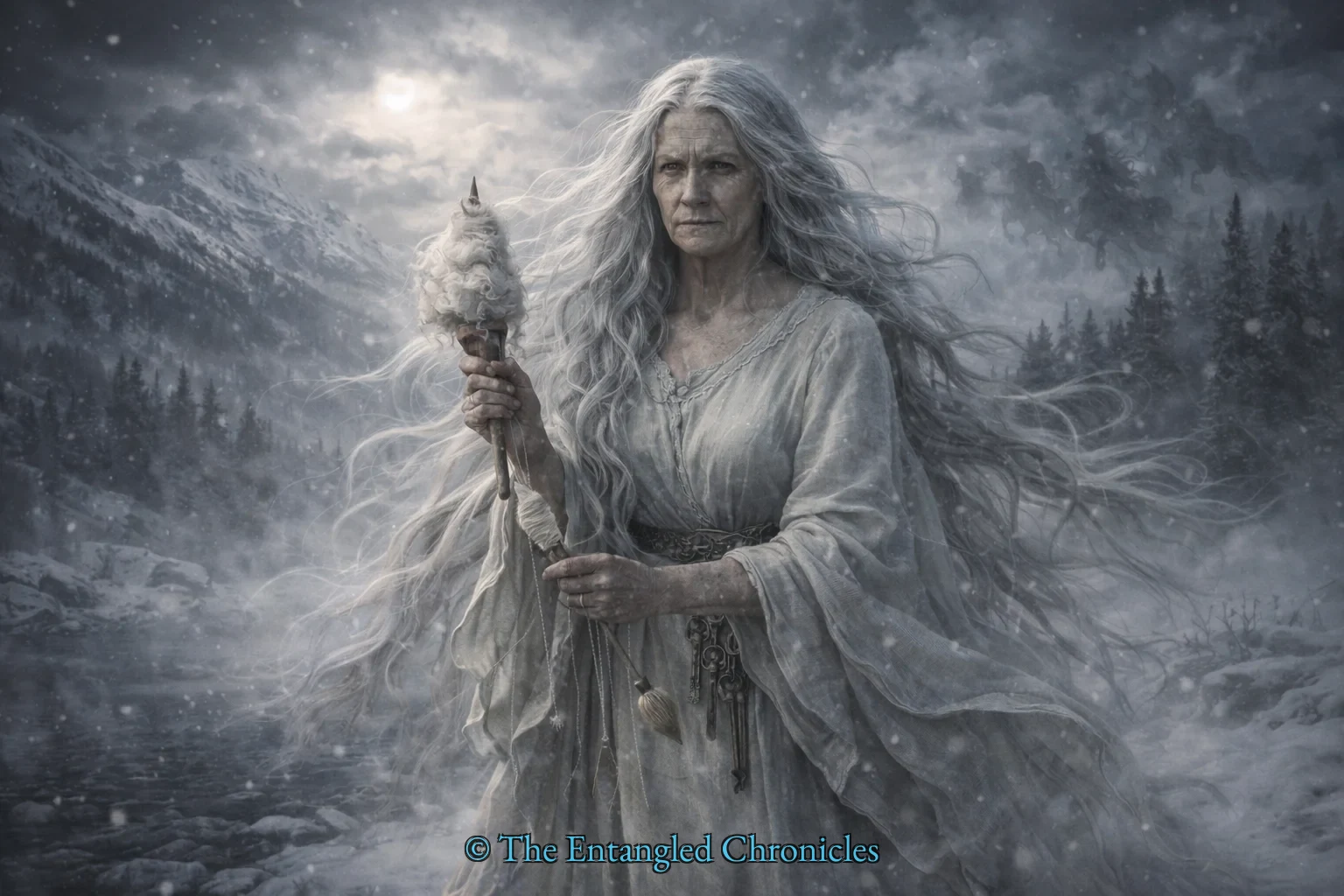
In her benevolent aspect as Frau Holle, she appears most often as an old woman dressed in white or wearing simple domestic garb, sometimes with one foot larger than the other from working the treadle of a spinning wheel. Keys hang at her belt, marking her as mistress of the household. This Frau Holle oversees all women's domestic work, particularly spinning and weaving. She taught humanity how to make linen from flax, a gift that transformed daily life in the cold northern regions.
The famous fairy tale collected by the Brothers Grimm captures this nurturing side perfectly. A young woman falls down a well (that ancient gateway to the Otherworld) and finds herself in a beautiful meadow where bread calls from the oven to be taken out before it burns, and apple trees beg to have their ripe fruit harvested. She helps willingly, and when she reaches the cottage of Frau Holle—described as having teeth so large they frighten the girl—she agrees to work as the old woman's servant, shaking out the feather beds each day until snow falls on the world above. Her reward for faithful service: a shower of gold that clings to her when she returns home.3
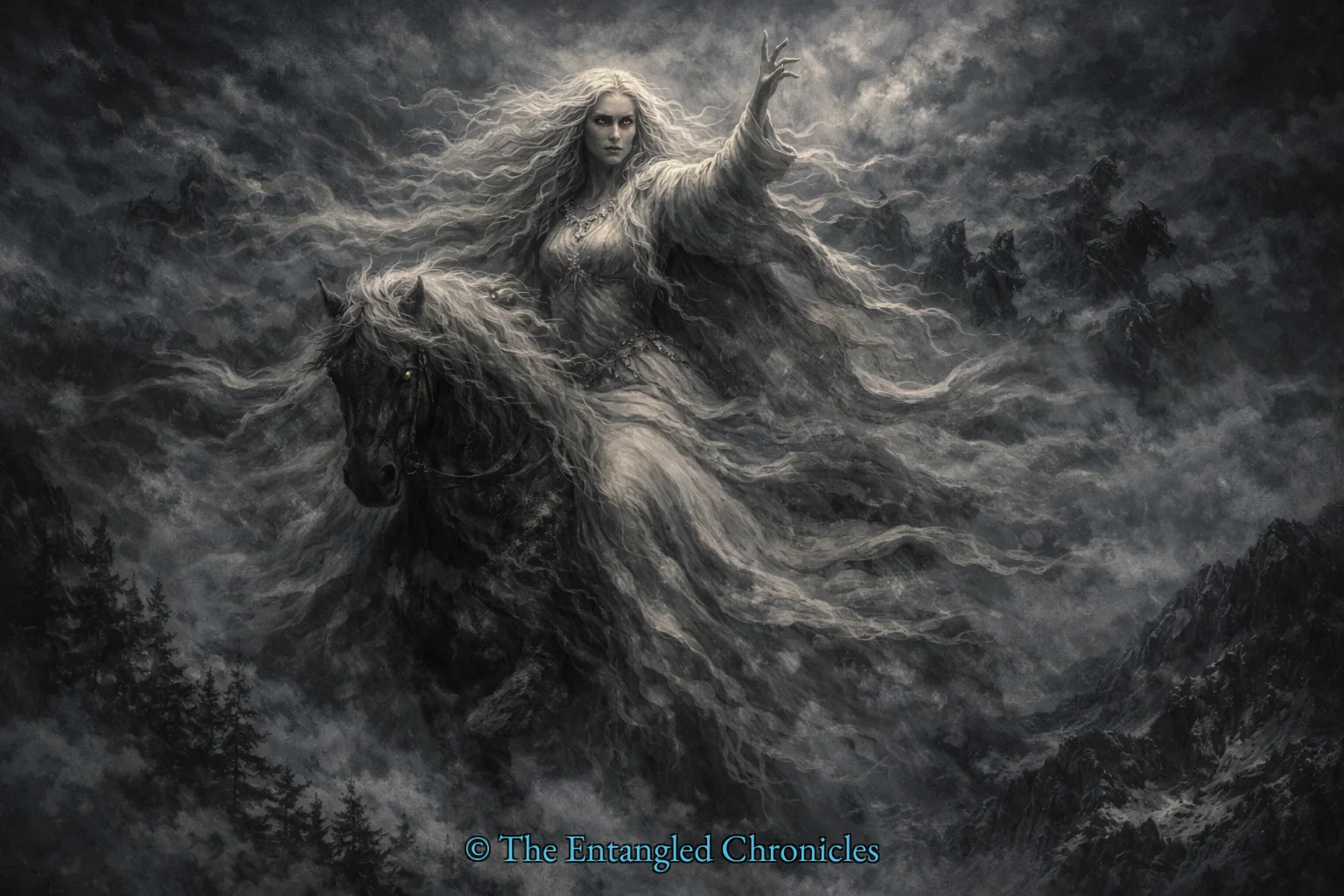
But Holda has another face. In her fierce aspect, she appears as the leader of the Wild Hunt, that terrifying nocturnal cavalcade that thunders through the sky during the darkest part of winter. Here she is no gentle domestic goddess but a white-robed specter riding at the head of an army that includes unbaptized infants, witches, and all those who died outside the Christian faith. Her wagon tears through the heavens, and to witness it meant either death or abduction into the supernatural realm. The faithful Eckhart, a legendary figure, was said to ride ahead of her procession, warning people to take shelter from the coming storm.
This Wild Hunt aspect connects Holda to Odin's own terrifying rides, and indeed some scholars believe she predates and influenced the later Norse concept. Unlike Odin's host of dead warriors, however, Holda's following includes primarily women—the souls of those who died in childbirth, women who practiced the old ways, female spirits who left their bodies at night to ride with her. Medieval texts speak of women who claimed to "ride with Holda," a phrase that became synonymous with witchcraft, with the distaffs used for spinning transforming in imagination into the broomsticks of witch-lore.
These two aspects are not separate beings but seasonal manifestations of the same goddess. In summer, she might appear as a beautiful young woman bathing in lakes—the radiant maiden. As autumn progresses to winter, she transforms into the crone, the winter goddess whose feather beds are the snow clouds, whose very breath is the north wind. And during the Twelve Days of Christmas, between the old year and the new, she rides forth in her most powerful and terrible form.
Winter, Weather, and the Shaking of Snow
Throughout Germanic lands, when snow begins to fall, people still say "Frau Holle is shaking out her feather beds" or "Mother Holda is making her bed." This enduring folk saying captures Holda's most visible role as goddess of winter weather and snow. She dwells somewhere above the earth—in the clouds, in mountain caves, in a realm accessed through deep wells—and from there she governs the winter season.
The snowflakes themselves are understood as loose feathers shaken from her bedding, falling gently down to earth. This imagery appears consistently across centuries of folklore, from medieval texts to modern children's songs. But folk tradition attributes power over rain, lightning, and fog to her as well. When it rains, Holda is doing her washing. When lightning flashes across the sky, she is scotching flax. When fog rises from the valleys, it is the smoke from her chimney. Every weather phenomenon bears her mark, revealing her presence in the natural world.
This mastery of weather identifies Holda as what scholars call a "sky goddess"—a deity associated not with the earth but with the heavens and the forces that descend from them. This overturns simplistic assumptions that all female deities must be "earth mothers." According to folk tradition, she controls sunshine, rain, and snow; she governs the seasonal transitions; she presides over the sky itself. Her role mirrors the later patriarchal sky gods like Zeus and Jupiter, suggesting she may represent a memory of even more ancient religious structures where female deities held supreme power over cosmic forces.4
Winter is particularly her season. The time when humans retreat indoors from the cold, when spinning and weaving become the central work, when the boundary between the living world and the realm of the dead grows thin—this is when Holda's power peaks. The Twelve Days of Christmas (originally the Zwölften in Germanic tradition) belonged especially to her, an intercalary period outside normal time when the supernatural walked freely and Holda's procession filled the skies.
Spinning, Flax, and Women's Work
If winter is Holda's season, spinning is her sacred craft. She taught humanity how to transform flax into linen thread, a skill that revolutionized Germanic life and provided protection against the bitter cold. Every girl learned to spin as soon as she could toddle, and women spent much of their time with a distaff tucked under one arm. The connection between spinning and Holda runs so deep that her very image became synonymous with the craft—she is portrayed with one foot flatter than the other from working the treadle, her hands perpetually engaged with spindle and wool.
Holda oversees all domestic spinning with strict attention to detail. She rewards industrious spinners by finishing their work overnight, transforming a half-full distaff into perfectly wound thread by morning. But lazy women faced her displeasure: she would burn their distaffs, tangle their thread, or spoil their flax. During her sacred season, the Twelve Days of Christmas, all spinning must cease. Any work in progress must be completed before Yule begins, and spindles and distaffs must be put away. Some regions forbade any activity involving a turning wheel during this period, understanding it as a time when Holda demands rest and respect for the holy days.5
In Thuringia near the Hörselberg, maidens placed new flax on their distaffs on Christmas Eve when Frau Holle began her inspection rounds, reciting: "So manches Haar, so manches gutes Jahr" ("For every thread, a good year shall be had"). But when she returned at Epiphany, any woman who had not finished faced her curse: "So manches Haar, so manches böses Jahr" ("For every thread, a bad year shall be had"). This practice reveals the goddess as both task-master and time-keeper, enforcing the rhythms of the agricultural year through the domestic work that filled winter's darkness.
Why always flax rather than wool? The answer may lie in flax's nature. Unlike wool, flax must be wetted before it can be spun, connecting it to Holda's association with springs, wells, and water. Throughout Germany, countless pools, fountains, and wells bear names connecting them to Holda—places where she might be glimpsed as a beautiful woman bathing before vanishing beneath the water. These water-bodies served dual purposes: as sources of flax-preparation and as gateways to the Otherworld where Holda dwells.
The spinning taboos and requirements that Holda enforces served practical purposes beyond religious observance. They ensured communities completed necessary work before winter's depths, maintained quality control over essential textile production, and provided rest during the most important festival season. But they also marked spinning itself as sacred work—not merely domestic drudgery but a craft taught by a goddess, imbued with spiritual significance, connecting women across generations through their shared labour.
The Wild Hunt and the Host of the Dead
During the Twelve Days of Christmas, when the old year dies and the new is born, Holda's true power manifests. She becomes leader of the Wild Hunt—that spectral procession of ghostly riders that thunders through storm-torn skies, bringing terror to any who witness it. In German legend, the Hörselberg in Thuringia served as her court, and from this mountain issued the Wild Hunt with Holda at its head, white-robed and terrible.
Her host differs markedly from Odin's company of dead warriors. Holda leads primarily the souls of unbaptized children—those infants who died before Christian rites could claim them, who remained therefore "heathen" and fell to the heathen goddess. Medieval Christian theology consigned such children to limbo; Germanic folk belief understood them as belonging to Holda, who gathered them to her and led them across the winter skies. Folk tradition held that newborn babies were drawn from "dame Holle's pond," and those who died in infancy simply returned to her keeping.
But children were not her only companions. Witches rode with her on distaffs that resembled broomsticks. Women who practiced magic, who kept the old ways, who refused to submit to the new Christian order—they too joined Holda's nocturnal flight. Medieval texts speak of women who claimed to leave their bodies in spirit form to follow the goddess, riding on beasts through the night sky. The phrase "to ride with Holda" became synonymous with witchcraft, and the Church condemned the practice in increasingly harsh terms.6
To encounter the Wild Hunt meant either death or abduction into the supernatural realm. The faithful Eckhart, a figure from German legend, was said to ride ahead of the procession warning travelers to flee, to take shelter, to hide themselves from the coming storm. Those who heeded him might survive with only the terror of witnessing that ghostly host streaming past. Those who did not, or could not, found themselves swept up in the hunt, carried away to Holda's realm never to return—or perhaps to return changed, marked forever by the experience of riding between the worlds.
Some scholars connect this Wild Hunt to even older practices. Could it represent a folk memory of actual nocturnal processions in honour of the goddess, later demonized and transformed into a supernatural phenomenon by Christian writers? The historian Carlo Ginzburg has identified similar beliefs across Europe spanning more than a thousand years, whereby men and women claimed to leave their bodies in spirit and follow a female deity called variously Holda, Diana, Herodias, Abundia, or Perchta. These accounts suggest a widespread cult of nocturnal goddess-worship that survived Christianization in hidden or transformed ways, preserved in folk belief even as official religion condemned it.
The Wild Hunt also served practical purposes in folk culture. Its chaos and danger reflected the genuine hazards of winter storms in pre-modern society, when being caught outside during a blizzard meant almost certain death. The requirement to have all household work completed before the Twelve Days began—enforced by threat of Holda's displeasure—ensured families were prepared for the most dangerous part of winter. The terror of the Wild Hunt encoded the terror of winter itself, while the possibility of Holda's protection offered hope that proper observance might grant survival.
Sacred Places and the Geography of the Goddess
Holda's presence permeates the Germanic landscape, written into mountains, springs, wells, and caves that bear her name and preserve her memory. These are not arbitrary associations but represent genuine sites of ancient worship and continuing folk tradition, places where the veil between worlds remains thin and the goddess's power can still be felt.
The Hörselberg in Thuringia stands as her most famous dwelling. This mountain, which also appears in legend as the Venusberg where the knight Tannhäuser was said to have been enthralled by the goddess (called Venus but identified with Holda), served as her court in German mythology from at least the tenth through fourteenth centuries. Jacob Grimm documented legends of "night-women" in Holda's service who would rove through the air on appointed nights, mounted on beasts. From this mountain issued the Wild Hunt, and into this mountain the faithful Eckhart would warn travelers not to venture when the goddess rode forth.
But the Hörselberg represents only one of many sacred sites. Throughout Germany, countless springs, wells, and pools bear names connecting them to Holda—places where she might be encountered as a beautiful woman bathing in the water before vanishing beneath the surface. These were not merely scenic spots but understood as portals to her realm, gateways through which one might pass (as in the fairy tale) into the Otherworld where she dwells. Young women would sometimes bathe in icy Alpine pools in hopes of becoming healthy, fertile mothers—seeking Holda's blessing through contact with her sacred waters.
The Hoher Meißner mountain in Hesse preserves another strong connection. The Hollenteich (Holda's pond) on this mountain has become a pilgrimage site for modern pagans seeking connection to the goddess. Local folklore speaks of Frau Holle dwelling in caves on the mountain, and numerous tales collected from the region feature her presence. One modern practitioner described experiencing a profound spiritual encounter at the frozen pond—the kind of numinous moment that suggests these sites retain folkloric significance across centuries.
Place names throughout the Germanic regions preserve her memory: areas called Hollenfeuer (Holda's fire), Hollental (Holda's valley), and countless variations on her name marking locations where she was worshipped or witnessed. In Scandinavia, where her influence extended under names like Huldr or Hulla, she became mistress of the huldrefolk—the mountain spirits or hidden folk who dwell under hills and in high places. The connection to mountains and high places reinforces her nature as a sky goddess, dwelling above the world while maintaining connections to the earth through caves, wells, and springs.
The elder tree (sambucus nigra) holds special association with Holda. In Old High German it was called holantar, and in Anglo-Saxon cneowholen—names clearly related to the goddess. Elder was considered sacred; in some regions it could not be cut without making a prayer first, and burning it brought ill-luck. The tree's association with figures who play similar roles in fairy tales—protective old women who guard boundaries—suggests deep connections between Holda and this particular plant. Like the elder tree, which provides medicine from its leaves, flowers, stems, and berries, Holda nurtures and heals while also maintaining necessary boundaries and enforcing proper behavior.
The Grimm Fairy Tale and Folk Memory
When Wilhelm and Jacob Grimm published their collection Kinder- und Hausmärchen (Children's and Household Tales) in 1812, they preserved one of the most complete portraits of Holda in the tale titled "Frau Holle." The story follows a young woman who falls down a well while attempting to retrieve her spindle after pricking her finger—blood on the spindle, descent through water into another world, all the classic elements of an Otherworld journey encoded in a seemingly simple folk tale.
In the world below, the girl encounters bread calling from an oven, asking to be taken out before it burns. She helps willingly. She finds an apple tree heavy with ripe fruit, begging to be harvested. Again she helps. Finally she reaches a cottage where an old woman with large teeth—Frau Holle herself—offers her work as a servant. The only requirement: shake the feather beds thoroughly each day, so that the feathers fly and snow falls on the world above. The girl performs her duties faithfully, and when the time comes to leave, Frau Holle rewards her with a shower of gold that clings to her forever.
Her lazy stepsister, hearing of this reward, throws herself down the well deliberately. She refuses to help the bread, ignores the apple tree's plea, and serves Frau Holle poorly, shaking the beds carelessly. Her reward: a rain of pitch that sticks to her as permanently as gold clung to her sister. The tale appears to be a simple moral story about the rewards of industry and punishment of laziness—and on one level, it is. But it encodes far deeper meanings.
The bloody spindle recalls ancient sacrifice and the tearing of veils between worlds. The descent through water mirrors shamanistic journeys to the underworld, death-and-rebirth initiations that appear across cultures. The bread and apples represent Holda's connection to fertility and abundance—these are the very foods depicted on Roman-era statues of the goddess Nehalennia from the Low Countries, suggesting continuity of worship across centuries. The feather beds that create snow when shaken preserve the folk belief about weather-working. The old woman with large teeth captures something of Holda's more frightening aspects while maintaining her essentially helpful nature towards those who show respect and diligence. Scholars interpret the tale as encoding far deeper meanings beneath its simple surface.
The Brothers Grimm collected and published this fairy tale in 1812, but they did not create Frau Holle—she already existed in living German folklore, in weather sayings, spinning customs, and local traditions centuries before their time. Medieval church documents from as early as the 11th century condemned women who claimed to ride with "striga Holdam," and farmers had long said "Frau Holle is shaking her feathers" when snow fell. What Jacob Grimm accomplished in his later work Teutonic Mythology (1835) was to become the first scholar to systematically argue that this folkloric figure preserved memories of an ancient pre-Christian goddess. His interpretation was pioneering and remains foundational to understanding Holda, though the goddess herself—and folk memory of her—predates his scholarship by more than a millennium.
Modern scholarship, particularly the work of German folklorist Erika Timm, suggests this tale may have Middle Eastern origins, part of a widespread Aarne-Thompson type that appears across cultures. But whether the basic story structure came from elsewhere matters less than what Germanic folk culture made of it. The tale became completely Germanized, incorporating specific elements of Holda worship and belief, transforming whatever its source into a vehicle for preserving authentic pre-Christian religious concepts long after official worship had been suppressed.
The tale likely served multiple functions. For children, it taught proper behavior and work ethics. For women, it preserved knowledge of spinning customs and seasonal observances. For the community, it maintained connection to an ancient goddess even as her name was forbidden in church. And for us today, it provides one of the clearest windows into pre-Christian Germanic religion, a story that survived because it appeared harmless while carrying profound religious truth within its simple narrative structure.
Holda, Perchta, and Regional Variations
Jacob Grimm observed that "Perchta or Berchta was known precisely in those Upper German regions where Holda leaves off, in Swabia, in Alsace, in Switzerland, in Bavaria and Austria." This geographical division reveals how Germanic religious practice adapted to local conditions while maintaining core concepts. Holda reigned in Middle Germany—particularly Hesse, Thuringia, and surrounding regions. Her counterpart Perchta dominated the southern Alpine regions. Both shared fundamental attributes: goddess of spinning, keeper of the Twelve Days, leader of nocturnal processions, punisher of lazy women, guardian of children and animals.
But Perchta earned a bloodier reputation. Where Holda might tangle a lazy woman's thread or burn her distaff, Perchta would slit open the belly of those who failed to honour her feast day by eating only fish and gruel, removing their stomach and guts and stuffing the cavity with straw and pebbles. Where Holda rewarded diligent spinners with silver coins in their shoes or pails, Perchta enforced her spinning requirements with violent punishment. Her name means "the bright one," yet her actions could be horrifyingly dark.
Scholars debate whether Holda and Perchta represent two distinct goddesses or regional variations of a single divine figure. Lotte Motz argued they are essentially equivalent—"Holda's southern cousin"—sharing role and attributes while adapting to different cultural contexts. The church certainly treated them as interchangeable, with documents characterizing both as synonymous with Diana, Herodias, and other "demon" goddesses. Some modern practitioners who work with these figures maintain they are separate entities with overlapping domains. Others see Perchta as Holda's fiercer aspect, the punitive side of the same goddess who could be nurturing or terrifying depending on circumstance.
Erika Timm suggests Perchta emerged from an amalgamation of Germanic and pre-Germanic (probably Celtic) traditions in the Alpine regions after the Migration Period of the Early Middle Ages. This would make Perchta a regional syncretic development, while Holda preserves more purely Germanic characteristics. The theory accounts for both similarities and differences, explaining how a single religious concept could develop distinct local expressions while maintaining core identity.
In Lower Germany and extending into Scandinavia, Holda appeared under additional names. She was called Frau Freke, Frau Gode, Frau Herke—names that connect her explicitly to Frigg (Norse Fricka) and to Odin/Woden (Frau Gode = "Lady Woden"). This has led some scholars, following Grimm, to identify Holda as possibly connected to Frigg, though other scholars see them as distinct figures who share similar domains. The connections run deep: both are associated with spinning, both have links to childbirth and children's souls, both appear as mistresses of domestic order while also commanding supernatural powers. Whether Holda represents a local preservation of Frigg's cult, a separate but related Germanic goddess, or an independent tradition that influenced Norse mythology remains a matter of scholarly debate.
Modern Alpine Christmas traditions preserve vivid memories of Perchta and her entourage. The Perchtenlauf—processions featuring elaborate wooden masks—continues in Austria, particularly in regions like Salzburg and the Pongau. Performers wear masks representing the Schönperchten (beautiful Perchten) who bring good fortune, and the Schiachperchten (ugly Perchten) who chase away evil spirits. These processions, loud and chaotic, echo memories of the Wild Hunt itself. They maintain continuity with pre-Christian practice in ways that are now celebrated as folk tradition rather than condemned as pagan heresy.7
Christianity's Response and Holda's Survival
The Christian church recognized Holda as a powerful rival from its earliest encounters with Germanic peoples. As Christianity spread northward, church authorities confronted a goddess who commanded genuine devotion, whose worship was woven into the fabric of daily life, whose feast days marked the turn of the year. Holda's association with domestic work and seasonal cycles may have contributed to the persistence of her cult—spinning, weather, children, and the turning of seasons were necessities that continued regardless of political or religious changes, ensuring her continued relevance to daily life even as other deities faded from practice.
The church's response evolved over centuries. The Canon Episcopi, first referenced in 904 CE, condemned belief in nocturnal flights with Diana or "Holda" as demonic delusion. Burchard of Worms, in his influential Decretum (ca. 1008-1012), devoted considerable attention to extirpating belief in the goddess. He described women who claimed to ride at night with a figure called "Diana" or "Holda," and prescribed penances for those who maintained such beliefs. Later texts refer to her as "Striga Holda"—Holda the witch—explicitly demonizing what had been venerated as divine.
Medieval sermons attacked Holda worship directly. Martin Luther himself employed Holda's image to personify what he saw as the shortcomings of hostile Reason in theological contexts. Johannes Geiler von Kaysersberg, preaching in the early sixteenth century, denounced Holda as a devilish entity luring women to sabbaths. Church councils banned processions in her honour, condemned leaving offerings for her, and punished those who continued the old practices. In Bavaria, the Thesaurus pauperum (1468) and Thomas Ebendorfer von Haselbach's De decem praeceptis (1439) specifically condemned the cult of "Fraw Percht," whose followers left food and drink hoping for wealth and abundance.
Yet Holda survived. Partly this happened through superficial Christianization—she became identified with the Virgin Mary as "Queen of Heaven," a title that allowed continued veneration under acceptable terms. The thirteenth-century text that records people setting tables for "the Queen of Heaven, whom the people call Frau Holda" on Christ's nativity shows this syncretic adaptation. People could honour the goddess while claiming to honour Mary, maintaining old practices under new names.
More significantly, Holda survived through her transformation into folklore. What could no longer be practiced as religion became children's stories, seasonal customs, weather sayings, and folk beliefs. The goddess descended from divine status to become a fairy tale character—but the fairy tale preserved her essential nature, taught her requirements, maintained knowledge of her power. Saying "Frau Holle is shaking her feathers" when snow falls seems innocent enough, yet it keeps her name alive and her presence acknowledged generation after generation.
The church never fully succeeded in erasing Holda from folk memory. Her association with necessary seasonal work, household customs, and natural phenomena meant she remained embedded in daily life. Priests could condemn worship, but they could not prevent spinning or control the weather or stop children from being born and dying. The work continued, the seasons turned, and Holda remained present in the patterns of daily life even when her temples were destroyed and her rites forbidden. She went underground—literally and figuratively—dwelling in caves and wells and hidden places, preserved in folk memory until times changed and she could emerge again.
Ironically, most of what we know about Holda comes from Christian-era sources. Medieval church documents meticulously recorded what they condemned—women riding with Holda, spinning taboos, nocturnal processions—precisely because they sought to eradicate these practices. The Brothers Grimm collected their folklore from Christian peasants who had preserved fragments of older traditions. Without Christianity's obsessive documentation of what it opposed, and without the folk memory that persisted despite suppression, far less would be known about this figure. The survival of Holda represents not pure continuity from pagan times, but rather the resilience of folk tradition that adapted, transformed, and endured through centuries of cultural change.
Modern Revival and Contemporary Practice
In recent decades, Holda has experienced revival among contemporary pagans, particularly those practicing Germanic reconstructionist traditions. The figure who survived centuries in folklore has now been reclaimed by contemporary practitioners as representing an ancient goddess, honored especially during winter and the Twelve Days. Feminist scholars have been particularly drawn to her as representing female divine power independent of male gods, and her association with domestic labor as sacred work. Modern practitioners visit sites like the Hollenteich on the Hoher Meißner in Hesse, where a modern statue was erected in 2004. While we cannot confirm organized pilgrimage to this site in pre-Christian or medieval times, the pond's name and persistent folklore suggest it held significance for centuries.
The persistence of Holda in folk culture extends beyond explicitly religious contexts. The Perchtenlauf—processions featuring elaborate wooden masks—continues in Alpine regions of Austria as celebrated cultural heritage, echoing memories of the Wild Hunt itself. Weather sayings invoking her name survive in rural areas throughout Germany. When snow falls, people still sometimes say "Frau Holle is shaking her feathers," keeping alive a connection spanning more than a millennium. Children still learn the Grimm fairy tale, though few recognize its pre-Christian religious origins. She remains embedded in the landscape, in seasonal customs, and in folk memory, demonstrating the resilience of tradition even when its original religious context has faded or transformed.
Notes & Variations
Sources & Further Reading
- Grimm, Jacob – Deutsche Mythologie (1835) / Teutonic Mythology, translated by James Steven Stallybrass (1880-1888)
- Grimm, Wilhelm and Jacob – Kinder- und Hausmärchen (Children's and Household Tales, 1812)
- Motz, Lotte – "The Winter Goddess: Percht, Holda, and Related Figures" in Folklore Vol. 95, No. 2 (1984)
- Timm, Erika – Frau Holle, Frau Percht und verwandte Gestalten (2003)
- Ginzburg, Carlo – Ecstasies: Deciphering the Witches' Sabbath (1991)
- Gimbutas, Marija – The Civilization of the Goddess (1991)
- Lecouteux, Claude – Encyclopedia of Norse and Germanic Folklore, Mythology and Magic (2016)
- Paxson, Diana L. – "Holda" in Hrafnar articles (2012)
- Gardenstone, Siegfried – Goddess Holle: In Search of a Germanic Goddess (2011)
- CELT: Corpus of Electronic Texts (University College Cork) – Germanic source materials