Overview
The Holzfräulein—literally "wood-maidens" or "wood-ladies"—are forest spirits documented in Germanic Central European folklore. According to recorded accounts, they are intimately bound to specific trees and forest groves.
Folklore describes them as guardian spirits encountered in old-growth forests. Medieval and early modern German sources characterize them as benevolent entities—healers who appeared during plague epidemics to teach herbal medicine, household spirits who assisted with domestic work, and forest guardians who rewarded humans showing proper respect for woodland.
The Holzfräulein belong to the broader category of moss people (Moosleute) or forest folk (Waldleute) documented throughout German-speaking regions. Wilhelm Mannhardt's 1875 research established the widespread distribution of Holzfräulein legends from the Bavarian Forest through Franconia and north to the Harz Mountains. Jacob Grimm, in his foundational work on Germanic mythology, interpreted them as possible remnants of pre-Christian belief—spirits who he theorized survived Christianization by retreating into wilderness areas, persisting in folklore after organized worship ceased.1
Names and Regional Variations
The term "Holzfräulein" itself reveals their essential nature: Holz meaning wood or forest, Fräulein meaning maiden or young woman. This naming pattern—designating supernatural beings by their element and gendered form—appears consistently across Germanic folklore. Alternative names proliferate by region: Holzweibchen (little wood-women) in Saxony, Buschweiblein (little bush-women) in Westphalia and Bohemia, Waldweibchen or Waldfräulein (forest-women, forest-maidens) in the Bohemian Forest and Upper Palatinate.
Less commonly, they are called Moosfräulein or Moosweiblein (moss-maidens, little moss-women), emphasizing their clothing of moss and lichen. These variants sometimes designate distinct types of forest spirits according to folkloric accounts, though more often they appear to reflect local dialect and tradition.
Regional folklore contains hundreds of specific names for individual Holzfräulein or particular groves they inhabit, though most such knowledge has been lost. What survives in documented accounts suggests that each spirit had her own identity, her own particular tree or grove, and her own relationship with nearby humans—not a generic category but distinct individuals bound to specific places.
Appearance and Nature
The Holzfräulein's appearance varies significantly between documented accounts. Two primary forms dominate the recorded folklore.2
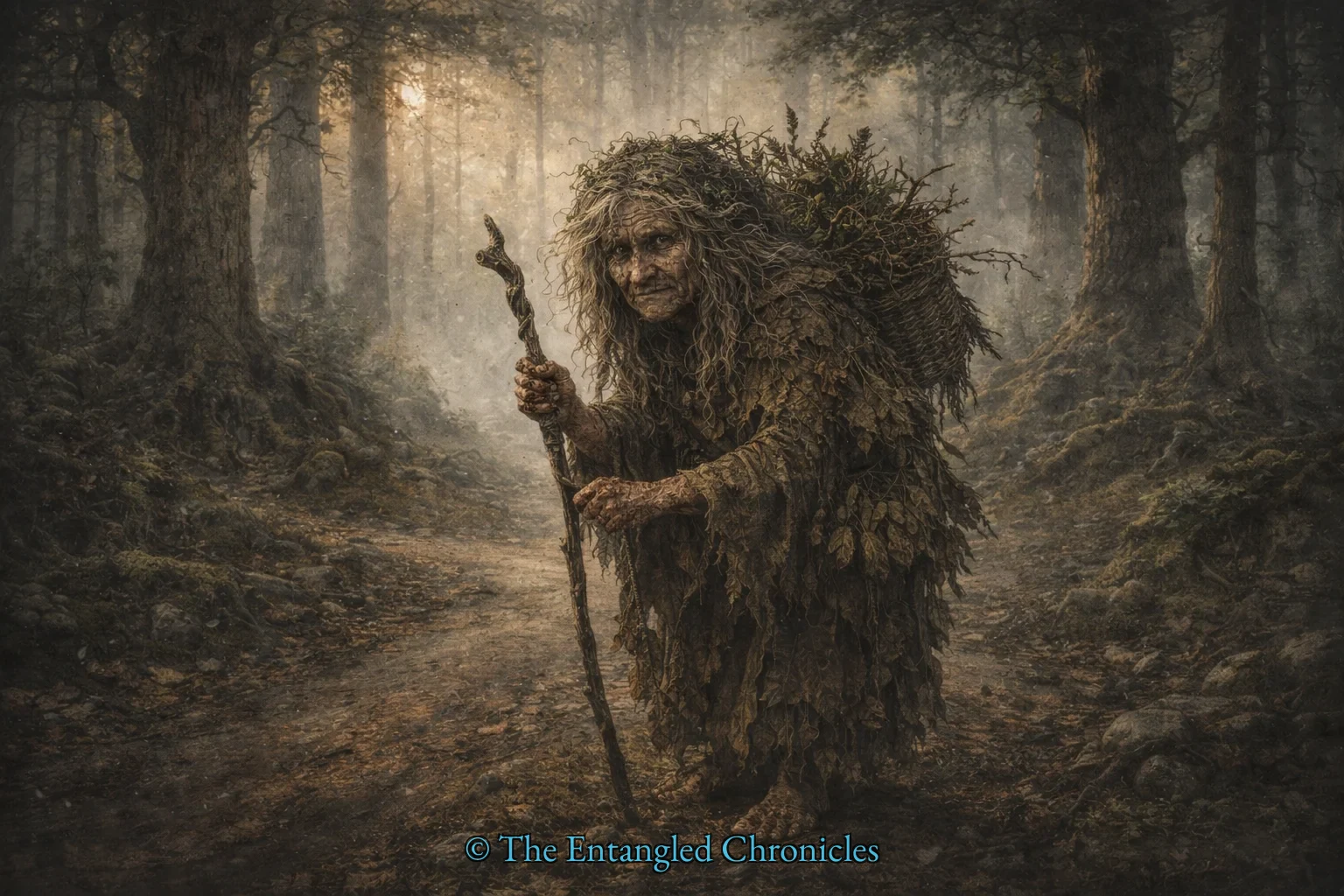
The first and most common description portrays them as small, wizened women—child-sized or smaller, bent with apparent age, faces deeply lined and weathered like old bark. They wear garments woven from moss, leaves, and bark; their hair grows wild with twigs and small vines caught in its tangles. Often they carry loads of wood or brushwood in baskets on their backs, walking with the aid of gnarled walking sticks. Some accounts describe them sitting at crossroads, spinning or knitting, looking for all the world like impoverished old peasant women except for their diminutive size and strange clothing.
The second form presents them as beautiful young maidens with long flowing hair, dressed not in moss but in garments of leaves that rustle with every movement. These versions appear in stories where Holzfräulein interact romantically or prophetically with hunters and woodsmen.
Both forms share certain consistent features: they are always female, always smaller than adult humans, always dressed in forest materials rather than woven cloth, and always bearing some mark of their woodland nature—skin with a greenish or greyish cast, eyes the color of bark or moss, movements that seem to rustle like leaves in wind. Scholars like Franz Xaver Schönwerth classified them alongside dwarves due to their size, though he noted their element was air rather than earth or stone—they move through treetops as easily as among roots.
Powers and Abilities
The Holzfräulein's most documented ability is their knowledge of medicinal herbs and forest lore. According to folk accounts, during plague epidemics the Holzfräulein emerged from forest areas to show humans which plants could cure or prevent disease. They taught the identification of healing herbs, the proper times and methods for gathering them, and the preparations that drew out curative properties.3
According to documented folklore, their lives are bound inseparably to their trees—damage the tree, and you damage its spirit. Grimm's Deutsche Mythologie states explicitly that "if any one causes by friction the inner bark to loosen, a Wood-woman dies." This connection parallels Greek hamadryads but appears specifically in Germanic contexts, with spirits bound to oak, beech, and fir rather than Mediterranean species.
According to folklore, many Holzfräulein entered human homes as household spirits, performing domestic work—spinning, weaving, baking, cleaning—always at night, always vanishing before household members woke. Folk accounts describe this as a mutually beneficial arrangement: families received assistance with labor-intensive work, particularly during harvest season or illness.
Folk accounts describe them moving silently through forests, appearing and disappearing among trees. Some traditions credit them with control over local weather phenomena—mists that protect groves from woodcutters, or mountain fog that villagers attributed to Holzweibel baking cake. According to these accounts, they would gift these cakes to polite humans encountered in the forest, the taste reportedly unlike anything found in the mortal world.
Relationship with Humans
The Holzfräulein were generally well-disposed toward humans who showed proper respect for the forest. Families who received their help as household spirits learned quickly the unwritten rules governing these relationships. They would leave offerings—specific foods varying by region: flour and water poured into the oven before baking, the first dumpling (Krapfen) from each batch, the first slice from a fresh loaf of bread. Some families left food scraps at the edges of plates and bowls, designating these remains specifically for the Holzfräulein.4
According to folk tradition, certain foods could never be counted during preparation—dumplings, pastries, bread loaves—lest the Holzfräulein lose her share. This taboo against counting appears in recorded accounts as essential to maintaining the spirits' assistance.
Folk accounts show contradictory relationships with Christian symbols. In Wondreb, tradition holds they urged humans to make the sign of the cross before meals—but in Bärnau, people believed Holzfräulein fed specifically on bread over which no cross had been made during baking. This contradiction likely reflects regional variation, different stages of Christian-pagan syncretism, or complex local adaptations of the folklore.
Inadvertent offenses could drive them away. The most common involved giving them new clothing or shoes—interpreted either as payment terminating their service (like the house-elf Dobby in later folklore), or as delaying their eventual redemption, for some traditions held that Holzfräulein were Arme Seelen (poor souls) condemned to serve until their garments fell to pieces. Cursing, crude speech, or vulgar behavior would also banish them, as would counting food or spurning their gifts. They particularly despised caraway bread, fleeing from it while crying the rhyme: "Kümmelbrot, unser Tod!" (Caraway bread, our death!).
Occasionally, families would hear their Holzfräulein called back to the deep forest by her kin, usually for reasons of urgency unknown to humans. She would depart without ceremony, and the household would lose her help. Some tales describe people following these summons deep into ancient groves, discovering gatherings of Holzfräulein in clearings beneath the oldest trees, engaged in rites or councils humans could not understand and were wise not to question.
The Wild Hunt Connection
The Holzfräulein's connection to the Wild Hunt (Wilde Jagd) adds a darker dimension to their folklore. They were often—though not always—counted among the quarry of this supernatural hunt, fleeing through winter forests from spectral huntsmen called Holzhetzer (wood-chasers). When pursued, they would seek refuge in marked trees—specifically, trees that woodsmen had blessed with "Gott wael's!" (God may prevail!) before making the first cut. These blessed trunks offered sanctuary; the Holzfräulein could rest within them, temporarily safe from the hunt.5
But trees where the blessing came last—where woodsmen said "Waels Gott!" only after beginning to cut—provided no protection. The positioning of the blessing mattered: God's name spoken first consecrated the space; spoken last offered only empty ritual. The Holzfräulein caught in such trees had to keep running, fleeing the relentless huntsmen through the winter dark.
Sometimes, in their desperation to escape the hunt, Holzfräulein would take refuge in human houses, thus becoming household spirits not by choice but by necessity. This involuntary transformation suggests the fluidity between different types of German forest spirits—categories that seemed distinct to human observers but perhaps reflected circumstances more than essential nature.
The Wild Hunt tradition in Germanic folklore is associated with Wotan/Odin and was later Christianized as demonic or as the ride of the damned. Scholars have interpreted the Holzfräulein's role as prey in these accounts in various ways: some see it as evidence of ancient conflicts between different categories of supernatural beings, while others interpret it as metaphor for winter's danger to life itself, with spirits of growing things fleeing death's huntsmen through the cold months.
Geographic Distribution
Holzfräulein legends concentrate in specific regions of German-speaking Central Europe, though with some spread beyond these core areas. The primary concentration lies in Franconia (Franken), particularly Upper Franconia (Oberfranken), where traditions remained strongest into the 19th century. From there, the folklore extends into the Egerland, the Upper Palatinate (Oberpfalz), and the Vogtland—all regions characterized by extensive old-growth forests and relatively isolated rural communities.
Wilhelm Mannhardt's comprehensive 1875 study demonstrated the legends' reach from the Bavarian Forest (Bayerischer Wald) in the south through central German regions to the Harz Mountains in the north, suggesting at minimum a shared cultural memory. Some folklorists have speculatively argued this distribution might follow the extent of Celtic settlement before Germanic expansion, proposing the Holzfräulein as Germanized versions of Celtic tree spirits, though this theory remains contentious and lacks definitive evidence. Other scholars see them as purely Germanic, pointing to linguistic connections and parallels with Scandinavian forest beings.
Notable specific locations preserve their memory: the Fichtelgebirge (Fichtel Mountains), the Thuringian Forest, various named groves and ancient woodland sites now largely lost to clearing and development. A few sacred groves survived into the 19th century as places locals refused to cut, maintained by superstition after belief itself had faded—the trees protected not by active worship but by lingering unease about what might still dwell within them.
Scholarly Documentation and Legacy
Jacob Grimm, in his monumental Deutsche Mythologie (German Mythology, 1835), devoted significant attention to the Holzfräulein and related forest spirits. He understood them as survivals of ancient Germanic religious belief, goddesses or divine attendants reduced to folklore by Christianization but retaining echoes of their original nature. Grimm collected numerous accounts, analyzed linguistic connections, and attempted to reconstruct the pre-Christian worldview that had produced such beings.6
Wilhelm Mannhardt continued Grimm's work with more rigorous methodology, surveying rural communities and documenting oral traditions before they vanished entirely. His 1875 research established systematic comparison between regional variants, demonstrating both the legends' consistency and their adaptation to local conditions. Franz Xaver Schönwerth, working primarily in Bavaria, collected hundreds of stories directly from peasants and woodsmen, preserving details that might otherwise have been lost.
These 19th-century folklorists worked urgently, recognizing that industrialization, urbanization, and universal education were rapidly eroding the oral traditions they sought to preserve. By the early 20th century, living belief in the Holzfräulein had largely ceased, surviving primarily as children's stories or quaint rural superstition. The scholars succeeded in recording the folklore but could not prevent its transformation from living tradition to historical curiosity.
Modern Germanic neopaganism has attempted revival, with some practitioners honoring the Holzfräulein as forest guardians. Environmental movements occasionally invoke them as symbols of ecological concerns and old-growth forest preservation. Contemporary engagement with these traditions operates in a fundamentally different context from the medieval and early modern periods in which the folklore was originally documented and practiced.
Notes & Variations
Sources & Further Reading
- Grimm, Jacob – Deutsche Mythologie (1835)
- Mannhardt, Wilhelm – Wald- und Feldkulte (1875-1877)
- Schönwerth, Franz Xaver – Aus der Oberpfalz: Sitten und Sagen (1857-1859)
- Bächtold-Stäubli, Hanns & Hoffmann-Krayer, Eduard – Handwörterbuch des Deutschen Aberglaubens (1927-1942)
- Lecouteux, Claude – The Tradition of Household Spirits (2013)
- Lecouteux, Claude – Encyclopedia of Norse and Germanic Folklore, Mythology, and Magic (2016)
- Grimm Brothers – Deutsche Sagen (German Legends, 1816-1818)
- DWDS: Digitales Wörterbuch der deutschen Sprache – Historical German language corpus