Names and Origins
The moss people appear in Germanic folklore under various regional names, all describing the same fundamental beings. The term Moosleute (moss folk) serves as the general designation, whilst specific forms include Moosweiblein and Moosweibchen (little moss women), Moosfräulein (moss maidens), and Holzweiblein or Holzweibchen (little wood wives). Related terms like Waldleute (forest folk) and wilde Leute (wild folk) appear interchangeably in regional texts from Thuringia, Saxony, and the Voigtland regions.1
Jacob Grimm first brought these beings to scholarly attention in his Deutsche Mythologie (1835), consolidating scattered references to "wild folk" from medieval sources into a unified conceptual framework. The Brothers Grimm documented them further in Deutsche Sagen (1816-1818), particularly in the legend "Der wilde Jäger jagt die Moosleute" (The Wild Hunter Hunts the Moss People), which describes how the spectral Wild Hunter pursues these delicate, moss‑cloaked beings through Silesian forests, forcing them to seek shelter in tree hollows during storms.
Wilhelm Mannhardt expanded upon Grimm's work in his studies of German vegetation cults, Wald- und Feldkulte (Forest and Field Cults, 1875-1877), interpreting moss people as embodiments of forest vitality in Thuringian and Saxon traditions. Mannhardt documented how they aided lost travellers but fled human encroachment, emphasising their role as guardians of woodland health. Ludwig Bechstein, in his Deutsches Sagenbuch (German Book of Legends, 1852), preserved numerous regional tales, including detailed accounts of their queen, the Buschgroßmutter.
Early medieval sources provide hints at even older traditions. The 6th‑century Roman historian Jordanes described "wood people" amongst Germanic tribes, whilst the 11th‑century Rhenish bishop Burchard of Worms condemned belief in "wild women" (wilde Frauen) who dwelt in forests and were linked to nature spirits. Grimm recorded medieval German terms including wildiu wīp, wildero wībo, and wilde fröuwelīn (wild maiden), suggesting these forest beings had been recognised in Germanic culture for centuries before systematic documentation began.
Appearance and Nature
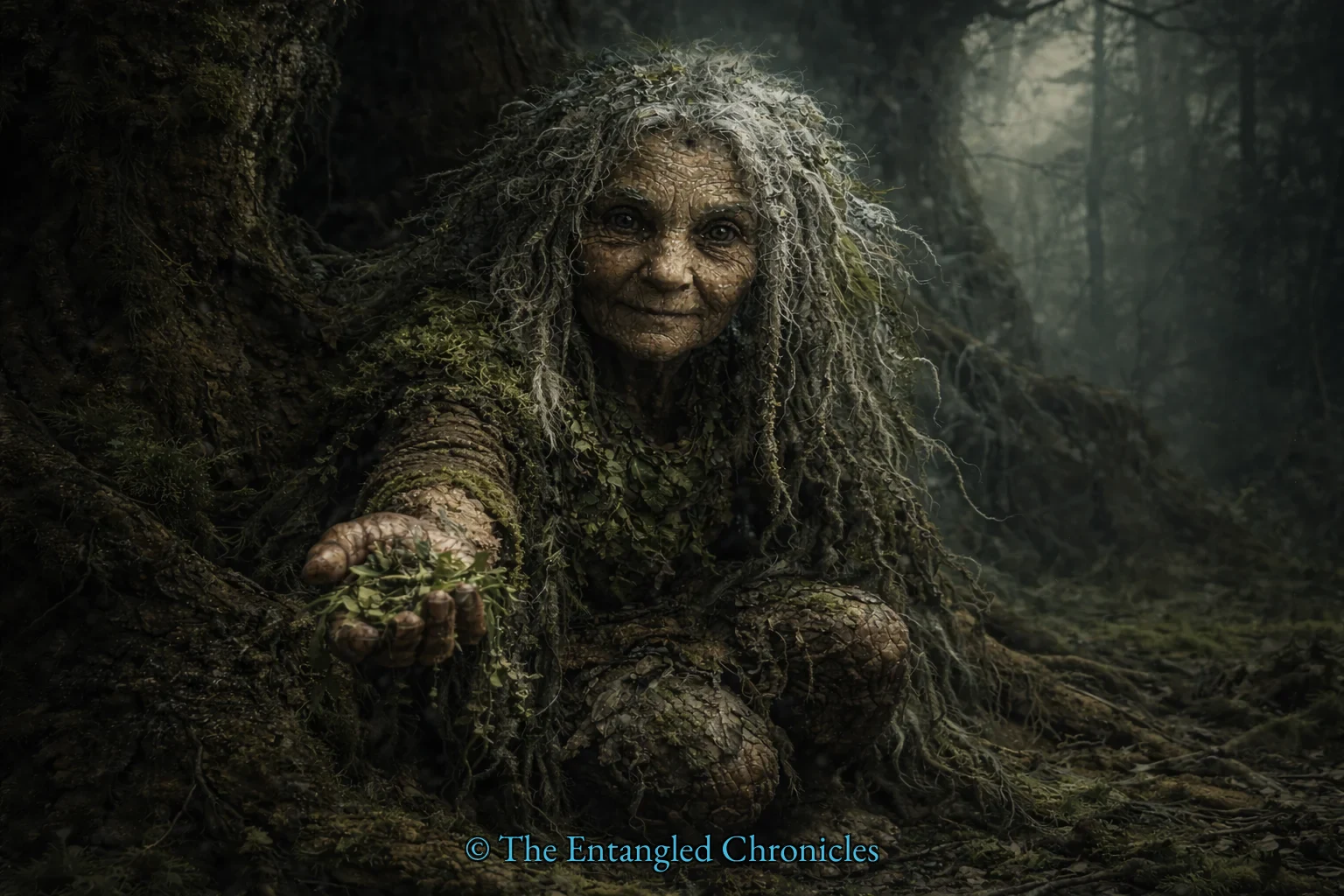
Folk tradition describes the moss people as small beings, typically no taller than three‑year‑old children, though accounts vary. The Brothers Grimm characterised them as "little men and little women clad in green moss round and round," found in heath or woods at dark places, dwelling in subterranean holes and lying on green moss. Their most distinctive feature remains the living moss and lichen that covers their bodies—not merely clothing but seemingly part of their very nature.
Their appearance bridges the boundary between human and forest. Descriptions consistently mention grey‑white hair resembling the lichen that grows on tree branches, skin with the texture and colour of weathered bark, and limbs like gnarled maple branches. In Saxony, the Holzweibchen (little wood woman) appeared as a small, shrivelled old woman with a wrinkly face, carrying wood in a basket on her back or brushwood in her apron, walking propped on a stick or cane, or sitting in a shrub spinning or knitting.
Yet not all accounts present them as uniformly aged or ugly. Some regional traditions describe them as comely, even beautiful, with butterfly‑like wings. This variation suggests that folk memory preserved multiple aspects or perhaps different types within the broader category of moss folk. What remains consistent across descriptions is their fundamental connection to the forest—they appear simultaneously as people and as manifestations of the woodland itself.
Their intimate bond with trees forms the core of their nature. Folk tradition presents them as similar to hamadryads from Classical mythology—their lives attached to specific trees. As Grimm documented: "If any one causes by friction the inner bark to loosen, a Wood‑woman dies." This vulnerability made them dependent on human respect for the forest. The destruction of trees meant the destruction of their kind, linking the moss people's fate directly to the health and preservation of Germanic woodlands.
Dwellings and Social Structure
The moss people make their homes in the deep forest, dwelling primarily in hollow trees. In the Upper Palatinate region, married Holzleute (wood people) lived in hollow trees as couples, whilst young unmarried individuals slept on little beds of moss beneath supporting beams. Married pairs could bear children, and folk tradition describes moss people bedding their infants on moss or in bark cradles to foster harmony with the trees. This custom, noted by Mannhardt, formed part of their intimate bond with vegetation, where the wellbeing of offspring mirrored the health of surrounding flora.
According to Thuringian belief, wood people and moss people represent distinct creatures, though both flee from the Wild Hunt. The Holzleute wear clothes, whilst the Moosleute appear shaggy and fuzzy with their moss covering. Regional traditions sometimes describe them dwelling in groups, sometimes as solitary beings. Jacob Grimm recorded that in the Wetterau region, between Leidhecken and Dauernheim, stood a high mountain with a stone called der welle fra gestoil (the wild woman's chair), bearing impressions "as of the limbs of human sitters," where local tradition maintained the wild folk once lived "whilst the stones were still soft."
The female moss people, the Moosfräulein, have a matriarchal structure with a queen called the Buschgroßmutter (Shrub Grandmother or Bush Grandmother). Ludwig Bechstein describes her in his folktale 551: "According to certain tales of the peasantry, a demonic creature dwells near Leutenberg and on the left bank of river Saale, called the Buschgroßmutter. She has many daughters, called Moosfräuleins, with whom she roves around the country at certain times and upon certain holy nights."2
The Buschgroßmutter appears as ancient beyond measure, small and wrinkled, with wild staring eyes and unkempt white hair as long as snow. She holds a gnarled stick and walks in a wavering manner, her feet overgrown with moss. She travels in a little cart or waggon during holy nights, and people wisely stay out of her way. Children particularly fear this "hooded bogey," yet she is "essentially the same spirit as Hulda or Bertha, the Wild Huntress," according to 19th‑century mythologists who saw her as a leader or queen of the moss people, similar to an elf queen.
Character and Interactions with Humans
Folk tradition presents the moss people as fundamentally shy, unassuming, and gentle beings. They avoid human contact when possible, appearing only at rare intervals to the lonely cabin of the woodsman or forester. When they do approach humans, it is typically to borrow some article of domestic use or to beg a little of the food being prepared for the family meal. They would also appear to labourers in fields that lay on the outskirts of forests for similar purposes.
The moss people's shyness should not be mistaken for inability to act. They possess the capacity to be both helpful and harmful, depending on how they are treated. A loan or gift to the moss‑people was always repaid manifold. Folk tales record them leaving generous gifts in return for assistance—often in the form of good advice, bread, or wood chips that transformed into gold after the recipient left the forest. They compensated owners generously for borrowed items, demonstrating their understanding of reciprocal obligation.
However, it remained easy to anger these woodland spirits. Spurning their gifts or giving them caraway bread—which they particularly hated—would provoke them. Folk tradition records them uttering the doggerel rhyme "Kümmelbrot, unser Tod!" (Caraway bread, our death!) when offered this food. The reason for this specific aversion remains unclear in the surviving sources, though it may relate to caraway's use in clearing land for agriculture, symbolising the destruction of their forest homes.
Above all other mortal gifts, the moss people prized and eagerly coveted a draught from the maternal breast for their own little ones. Folk tradition held this to be a sovereign remedy for all the ills to which their natures were subject. Tales record moss people approaching nursing mothers to request milk for their children, and those who gave freely received abundant blessings in return. This detail suggests the moss people, despite their connection to the forest, shared vulnerabilities and needs similar to humans—their children suffered illnesses that required specifically human remedies.
In certain myths, the moss folk would even steal little human children, though whether as replacement for their own or for other purposes remains ambiguous in the sources. This changeling motif appears across Germanic folklore, connecting the moss people to broader fairy traditions where the boundary between human and supernatural children could be crossed, usually with troubling consequences.
Healing Powers and Medicinal Knowledge
The moss people, particularly the female Moosfräulein, possess ambivalent healing powers. According to folklore documented by the Brothers Grimm and other 19th‑century collectors, on one hand, they can send plagues upon communities; on the other, they alone can heal the victims of such afflictions. During epidemics, the Holzfräulein (wood ladies) would emerge from the forest to show people which medicinal herbs could cure or ward off plague. This knowledge made them invaluable to pre‑modern communities that depended on herbal medicine for survival.
Folk tradition presents this dual nature—the ability to both cause and cure disease—as two aspects of the same power rather than contradiction. The moss people's deep connection to forest plants gave them understanding of botanical properties unknown to humans. They could withhold or share this knowledge depending on how humans treated the forest and its spirits. A community that respected the woods might find moss people emerging during pestilence to save lives; one that destroyed trees recklessly might find themselves afflicted without hope of supernatural aid.
This role as bearers of herbal wisdom positioned them as essential mediators between the forest and human settlements. Whilst doctors and wise women might possess healing knowledge, the moss people represented a deeper source—beings who existed as part of the forest itself, who understood plant properties through direct participation in woodland life rather than learned study. Their willingness to share such knowledge during plagues demonstrated their fundamentally benevolent nature towards humans who showed proper respect.
The Wild Hunt and Vulnerability
Despite their woodland powers, the moss people live under constant threat from the Wild Hunt. They were often, though not always, the object of this terrifying supernatural phenomenon. According to folklore, when the Wild Hunt rides—that spectral procession of ghostly hunters thundering through storm‑torn skies—the moss people flee in terror, seeking refuge in the only place that offers sanctuary: trees that woodsmen have marked with a cross as destined for felling.
This creates a paradoxical situation. The marked trees represent impending destruction—soon they will be cut down, destroying the moss people's homes and, potentially, the moss people themselves given their hamadryad‑like connection to trees. Yet during the Wild Hunt, these doomed trees become places of safety, protected by the Christian cross from the pagan hunt. The moss people must choose between two threats: the immediate danger of the Wild Hunt or the slower destruction of tree‑felling.
Folk tradition records that woodsmen, understanding this plight, would take down trees as needed but leave large stumps behind on which they carved crosses. In this way, they helped protect the forest spirits they loved. This practice demonstrates a complex relationship between forest workers and woodland beings—humans who made their living from tree‑felling could still act as protectors of forest spirits through conscious choices about how they marked and harvested timber.
The Brothers Grimm documented regional variations of this tradition, particularly the legend of the Rüttelweiber (shaking women) in the Giant Mountains of Silesia—little women clad in moss whom the local wild huntsman, known as the Nachtjäger (night hunter), would chase through the forests. Des Knaben Wunderhorn, the folk song collection, records verses where "the huntsman in the wood start a dark‑brown maid, and hail her: 'whither away, wild beast?'"—though the huntsman's mother did not approve of the bride, suggesting the hunt might sometimes result in capture rather than mere pursuit.
This vulnerability to the Wild Hunt marks the moss people as liminal beings—neither fully of the supernatural world that the Hunt represents, nor entirely safe in the natural forest that is their home. They exist in between, requiring protection from both human and supernatural forces, their survival dependent on the goodwill and conscious choices of those who hold power over trees and crosses.
Connection to Holda and Germanic Goddess Traditions
Ludwig Bechstein and other 19th‑century mythologists explicitly identified the Buschgroßmutter, queen of the moss maidens, with Holda (also called Frau Holle) and Bertha—figures interpreted as ancient goddesses. According to Bechstein's account, the Buschgroßmutter is "essentially the same spirit as Hulda or Bertha, the Wild Huntress," to whom local tales ascribe a following of children under the guise of the Heimchen (dwarves, pixies, brownies, hobgoblins) who constitute her attendants in the regions she frequents.
This connection places the moss people within the broader context of Germanic goddess worship and its survival in folklore. If the Buschgroßmutter represents a regional manifestation of Holda—as Grimm, Mannhardt, and Bechstein believed—then the moss people become part of her entourage, lesser spirits associated with a major deity. Their processions during "certain times and upon certain holy nights" echo Holda's own rides during the Twelve Days of Christmas, that liminal period between old year and new when supernatural forces held sway.
However, later folklore scholarship documented a shift in interpretation. Some early 20th‑century sources describe the Buschgroßmutter and Buschweibchen as "forest demons of the most primitive kind" rather than goddesses, separating them from the more exalted figures of Holda and Perchta. This reclassification reflects changing scholarly approaches to folklore—earlier researchers sought to identify remnants of pre‑Christian pantheons, whilst later scholars preferred to categorise different types of supernatural beings without necessarily connecting them to supposed ancient religious structures.
Whether viewed as attendants of a goddess or as independent forest spirits, the moss people occupy a significant place in Germanic supernatural taxonomy. They represent the forest itself made manifest—not as a single powerful deity but as a community of smaller beings whose collective existence maintains woodland health and who serve as intermediaries between human communities and the deeper powers of nature.
Survival in Modern Tradition
Unlike figures such as Holda, who experienced deliberate revival amongst contemporary pagans, the moss people remained primarily as folklore curiosities rather than objects of modern worship. They appear in regional collections, scholarly works, and occasional fantasy literature, but have not been widely reclaimed as figures for contemporary spiritual practice. This may be precisely why their folk character remains relatively undiluted by modern reinterpretation—they persist as the shy, moss‑covered forest beings of Germanic tradition rather than being transformed by modern spiritual movements.
Their preservation in 19th‑century folklore collections by the Brothers Grimm, Ludwig Bechstein, and Wilhelm Mannhardt proved crucial for maintaining knowledge of these beings. Without systematic documentation during that period, when oral tradition still preserved medieval and early modern folk beliefs, awareness of the moss people might have vanished entirely. The academic interest in German mythology and folklore that characterised the Romantic period rescued these figures from obscurity even as industrialisation and deforestation were destroying the ancient woodlands that had sustained belief in forest spirits.
In regions of Germany where forest traditions remain strong, particularly in Bavaria and Thuringia, awareness of the moss people persists in local folklore, though often in simplified form. They appear in regional story collections, children's books, and tourist literature about Germanic mythology. Some environmental movements have adopted forest spirits like the moss people as symbols for woodland conservation, using their folklore to emphasise the importance of preserving old‑growth forests—a use that aligns with their traditional role as woodland guardians.
The moss people's emphasis on reciprocity, respect for nature, and the dangers of environmental destruction resonates with contemporary ecological concerns. Their requirement that humans show respect for the forest or face consequences, their role as healers who share medicinal plant knowledge with respectful communities, and their vulnerability to both tree‑felling and supernatural persecution make them particularly relevant to modern discussions about humanity's relationship with wilderness. These traditions reflect an understanding of forests not as resources to be exploited but as homes to beings who demanded recognition and respect.
Notes & Variations
Sources & Further Reading
- Grimm, Jacob – Deutsche Mythologie (1835) / Teutonic Mythology, translated by James Steven Stallybrass (1880-1888)
- Grimm, Wilhelm and Jacob – Deutsche Sagen (German Legends, 1816-1818)
- Bechstein, Ludwig – Deutsches Sagenbuch (German Book of Legends, 1852)
- Mannhardt, Wilhelm – Wald- und Feldkulte (Forest and Field Cults, 1875-1877)
- Lecouteux, Claude – Encyclopedia of Norse and Germanic Folklore, Mythology and Magic (2016)
- Arnim, Achim von and Brentano, Clemens – Des Knaben Wunderhorn (The Boy's Magic Horn, 1805-1808)