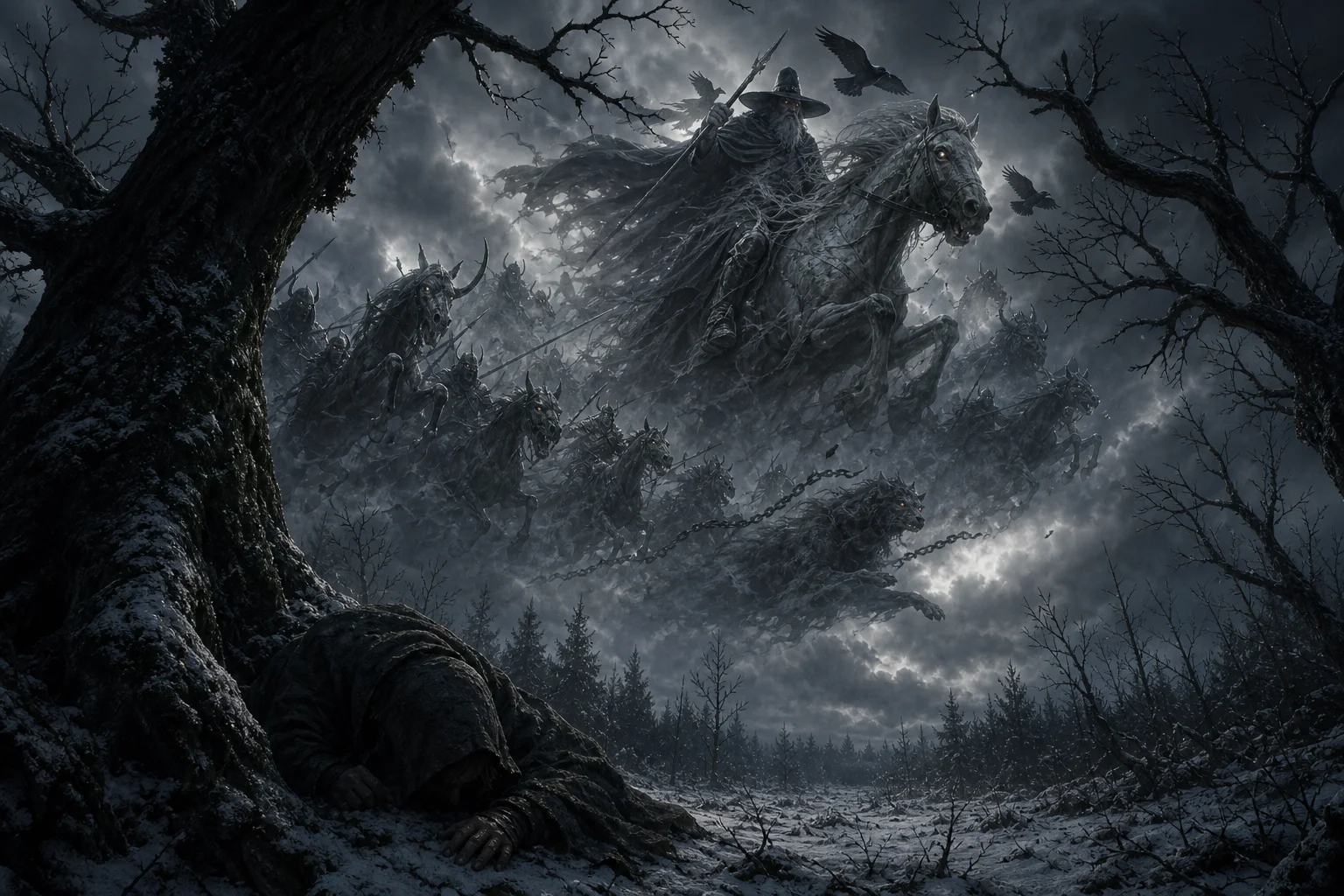
The Furious Host
On the darkest nights of winter — when storms tear at the thatch and wolves howl from the treeline — Germanic peoples heard something else beneath the wind. Hoofbeats. Horns. The baying of enormous hounds and the shrieking of souls carried unwilling through the sky. This was the Wilde Jagd: the Wild Hunt, the Furious Host, the army of the dead on the move.1
No single creature of Germanic folklore casts quite the same shadow. The Wild Hunt was not merely a ghost story but a cosmological event — a moment when the boundary between the living world and the realm of the dead dissolved entirely, when the dead rode openly through the air and the living had to take shelter or face being swept into eternity. Its traces run through a thousand years of recorded tradition: in court documents condemning women who claimed to ride with the host, in rural customs designed to protect houses from its passage, in weather sayings still murmured by old farmers when the November gales pick up.
The Hunt is simultaneously intensely Germanic and surprisingly widespread. Cognate traditions appear in England as Herne the Hunter and the Gabriel Ratchets, in Scandinavia as Odin's Oskoreia, in France as the Chasse Sauvage, and even in distant corners of the Iberian Peninsula. But the richest, most detailed, and most extensively documented tradition belongs to the German-speaking lands, where it survived — in folk memory, in church condemnations, and in regional custom — from the early medieval period through to the twentieth century.
What the Hunt Was
The core of the Wild Hunt tradition is consistent across regional variations: a vast company of riders sweeps through the night sky, usually during the winter months between November and Epiphany, led by a powerful supernatural figure and accompanied by spectral hounds, horses, and the souls of the dead. They travel with tremendous noise — the howl of winds, the thunder of hooves on the clouds, the wail of horn-blasts — and their passage brings danger to anyone caught outside.2
German sources give the Hunt many names. Wilde Jagd (Wild Hunt) and Wildes Heer (Wild Army) are the most widespread. Wütendes Heer or Wütende Heer — the Furious Host or Raging Army — appears frequently in central German sources. In Westphalia and the north it was the Wode or Wod, a name that links directly to Wotan himself. In some regions it was simply das Heer, the Army, as though no further explanation were needed. In others, it was known by the name of its leader: Frau Holle's Heer, Hackelberg's Hunt, or the Berggeist's Procession.
The composition of the Hunt varied by region, but several elements recur with striking consistency. The riders themselves are the dead — soldiers who fell in battle, those who died unbaptised, women who died in childbirth, suicides, and those who had sinned against the old ways. In some traditions the company also includes the living souls of witches and cunning folk who left their bodies behind to join the procession. The dogs are enormous, often described as headless or fire-eyed, and their baying is the sound of the storm wind in the trees. The horses run faster than any earthly mount, their hooves striking sparks from the clouds.
"They ride through the air at night with a great multitude of phantoms, and great crowds of women believe they ride in her company — believe this so firmly and are so bewitched by it that they regard it as entirely real."
— Canon Episcopi, c. 906 CE
The dangers of encountering the Hunt were well-catalogued in folk tradition. To stand in its path meant being trampled or swept along with the procession, possibly never to return. To mock or challenge the riders invited terrible retribution — being pelted with the bones of the dead, struck blind, or carried off to spend years in the Otherworld. Even to witness the Hunt from safety was considered dangerous; some accounts say that merely seeing it guaranteed death within the year. The prescribed response was to throw oneself face-down on the ground and lie still until the noise passed.3
But the relationship between the living and the Hunt was not always simply one of terror. In some traditions, a person who called out the right words could receive gifts from the passing host — game, food, sometimes gold. Hunters and foresters sometimes claimed a special relationship with the Hunt, seeing in it a mirror of their own nocturnal activities. The boundary between the hunters and the hunted, between the living and the dead, could be surprisingly permeable.
Who Led the Hunt
The identity of the Hunt's leader is the most variable element of the tradition, shifting with time, geography, and religious context. In the oldest recoverable layers of Germanic belief, the leader appears to have been the great god himself — Wotan, the Germanic form of the Norse Odin. As Christianity took hold, the leader was reinterpreted first as a condemned sinner and then, in many sources, as the Devil outright. Regional figures, local legends, and condemned historical persons also accumulated the role over the centuries.4
Wotan / Wodan
The oldest and most fundamental leader of the Wild Hunt in Germanic tradition is Wotan — known in Old High German as Wuotan, in Old Saxon as Uuôden, and in Old Norse as Odin. The connection between Wotan and the Hunt appears to be genuinely ancient, pre-dating Christianity and preserved in the very word for the phenomenon in some regions: the Westphalian Wode names the Hunt directly after him.
Wotan's nature made him the natural leader of such a procession. He was the god of the dead, the god of battle-slain warriors, the master of seiðr and shamanistic travel between worlds. He was also the god of storms and wind — the Sturmgott — and his passage through the sky in winter was synonymous with the howling of the gale. His two ravens, Huginn and Muninn, flew across the world each day and returned with news of the living; his eight-legged horse Sleipnir could travel between the world of the living and the realm of the dead. He was, in every sense, a lord of liminality and transition — precisely what a leader of the Hunt needed to be.
Jacob Grimm, who first systematically analyzed the Wild Hunt in his Deutsche Mythologie (1835), argued convincingly that the core tradition preserved memories of actual Wotan worship. The many local names that referenced Wode, the timing of the Hunt during Wotan's sacred days, the specific behaviour prescribed to avoid the Hunt's wrath — all pointed back to the same divine figure. Even after conversion, the memory of Wotan's nocturnal rides persisted so powerfully that Christian authorities struggled for centuries to suppress them.
Holda and Perchta
In central and southern German tradition, the Hunt was not always led by a male figure. Holda — the ancient winter goddess also known as Frau Holle — appears as leader of the Hunt in a substantial body of sources, particularly from Hesse, Thuringia, and the Rhineland. Her Hunt was composed primarily of women: the souls of those who died in childbirth, women who had practiced the old ways, and the spirits of unbaptised infants she gathered to her and cared for in her realm beneath the earth or behind the mountains.5
The church documents that condemned nocturnal processions — including the influential Canon Episcopi of around 906 CE — describe women riding at night with a goddess. Though the documents use the Roman name Diana, later medieval sources make clear that in German-speaking regions this goddess was understood as Holda or Holle. Women who claimed to participate in these rides spoke of travelling to feasts, of dancing, of being taught secrets of herbs and healing. Inquisitors treated such claims as evidence of witchcraft; historians now read them as evidence of a living folk tradition connecting human practitioners to the ancient goddess of the Hunt.
In Alpine regions, Perchta — Holda's close cognate and possible twin — led her own procession during the Twelve Nights. The Perchten, her followers, gave their name to the elaborate masked processions that still take place in Austria and Bavaria today, maintaining a living, if transformed, connection to these ancient winter rides.
Condemned Sinners and Local Legends
As Christianity reshaped the tradition, the leader of the Hunt increasingly became a condemned sinner rather than a deity — a figure punished for his sins in life by being forced to hunt eternally through the skies. This shift allowed the tradition to survive within a Christian framework: rather than honouring a pagan god, folk belief now warned of the fate awaiting those who violated sacred days, mistreated the poor, or refused hospitality.
The most famous of these condemned hunters is Hackelberg (also Hackelnberg or von Hackelberend), a forester or nobleman of the Harz region who allegedly swore on his deathbed that he would rather hunt forever than go to Heaven. He is condemned accordingly, leading the Hunt through the forests of the Harz and the heath country of northern Germany until the Day of Judgment. Similar figures appear across German-speaking lands: the Wild Huntsman of the Black Forest, the Count of the Hessian uplands, a nameless lord of every region who hunted on Sundays or blasphemed God and paid the eternal price. The specifics change; the structure remains constant.
Historical figures also accumulated the Hunt's leadership over time. Dietrich von Bern — the legendary version of the Ostrogothic king Theodoric the Great — became leader of the Hunt in a number of traditions, his historical fame transformed into supernatural dread. Emperor Frederick Barbarossa, sleeping in the Kyffhäuser mountain awaiting Germany's hour of need, was sometimes associated with the Hunt in later folklore. The Hunt had an almost gravitational pull, drawing powerful or transgressive figures into its orbit.
Season, Territory, and the Twelve Nights
The Wild Hunt was emphatically a winter phenomenon. Its season ran from late autumn — roughly from Martinmas on the 11th of November — through to Epiphany on the 6th of January, with the peak of its activity concentrated in the Twelve Nights between Christmas Eve and Epiphany. This period, the Zwölfte or Twelve Nights, was understood in Germanic folk belief as a time set apart from ordinary time — an intercalary period when the calendar was suspended, when supernatural forces walked freely, and when the boundary between the living and the dead was at its most permeable.6
The correlation between the Hunt and winter storms was intimate and explicit. When the gale howled through the forest and drove snow horizontally across the fields, that was the Hunt riding. When the wind shrieked in the chimney and the dogs whimpered beneath the table and the candles guttered in some unfelt draught, the Hunt was passing close. Folk meteorology and supernatural belief were inseparable: the storm was the Hunt, the Hunt was the storm. Some accounts describe the Hunt as literally causing the bad weather; others say the Hunt merely used the storm as its cover, riding where human senses were already overwhelmed by natural violence.
Geographically, the Hunt tradition concentrated in the German-speaking heartlands — the Harz Mountains, the forests of Thuringia and Hesse, the heathlands of Lower Saxony and Westphalia, the Rhine valley, the Black Forest, and the Alpine foothills of Bavaria and Austria. But it extended north into Scandinavia and Denmark, west into the Low Countries and France, east into Bohemia and Silesia, and across the Channel into England, where Herne the Hunter and the Wild Hunt of the moors preserved cognate beliefs. The tradition's distribution maps almost exactly onto the spread of Germanic peoples across Europe — a remarkable piece of cultural continuity across centuries of migration and change.
Certain landscapes were particularly associated with the Hunt's passage. Mountain passes and lonely heaths were obvious danger zones. Crossroads — already liminal spaces in folk belief across many cultures — were especially feared. Rivers and streams offered some protection; the Hunt could not cross running water in many traditions. Churchyards, paradoxically, could be either dangerous or safe depending on regional tradition: the Hunt might gather the dead from the churchyard, but the consecrated ground might also repel the riders. The distinction mattered greatly to the people who had to navigate these spaces on winter nights.
Living Alongside the Hunt
Germanic folk tradition developed an elaborate body of protective practice to guard against the Hunt during its season. Some of these were straightforwardly practical: stay indoors after dark during the Twelve Nights, keep the doors barred, and ensure that no light or warmth was visible from outside that might attract the riders. Others were more specifically ritualistic: scatter grain on the threshold as an offering to the passing host, leave food and drink out for the riders so they would pass the house without stopping, or invoke specific protective formulas to turn the Hunt aside.7
The role of the Faithful Eckhart — a mysterious figure who rode ahead of the Hunt to warn the living to take shelter — speaks to the tradition's ambivalence. The Hunt was dangerous, but it was not entirely malicious. It had its own logic and its own rules; it could be propitiated, negotiated with, even benefited from. A hunter who threw himself to the ground and addressed the passing host correctly might find a portion of their spectral prey tossed at his feet. A midwife who treated the Hunt's leader with respect might be rewarded with coins that remained real gold after the riders had passed. The Hunt operated as a kind of supernatural mirror of the living world's economy of gift and obligation.
Women occupied a particularly complex relationship with the Hunt in folk belief. On one hand, they were at special risk — particularly women who had died in childbirth, who were thought to join Holda's procession whether they willed it or not, and women whose souls rode out with the goddess during the Twelve Nights. On the other hand, women who participated in the Hunt through ecstatic or visionary experience claimed access to knowledge: knowledge of healing plants, of hidden things, of the future. The Inquisition treated such claims as confessions of witchcraft; modern historians read them as evidence of a living spiritual practice connecting the living with the dead through the vehicle of the Hunt tradition.
The Hunt also served a social function in the communities that believed in it. It embodied communal anxieties about the dead — about those who had died badly, unreconciled, or outside the church's rituals of safe passage. The dead who rode with the Hunt were precisely those who fell outside the church's categories of proper death: suicides, the unbaptised, those killed in violence without last rites. The Hunt gave these dangerous dead a place in the cosmological order — not saved, not damned in the conventional sense, but occupied, riding, contained within the Hunt's procession rather than wandering freely and malevolently through the community.
The Church, the Devil, and Survival
Christianity's encounter with the Wild Hunt tradition produced one of the most interesting and complex transformations in the history of European folk belief. The church could not simply ignore a tradition this pervasive and this deeply embedded in the seasonal rhythms of rural life. Instead, it engaged with it — condemning some aspects, reinterpreting others, and inadvertently preserving still others through the very documents that sought to suppress them.
The earliest major document to address the Hunt tradition is the Canon Episcopi, a church canon of uncertain origin (possibly as early as the late ninth century, certainly in wide circulation by the tenth). It addressed women who claimed to ride at night with Diana — understood by German audiences as Holda — and directed that such claims should be treated as delusion rather than reality. The important thing, the Canon argued, was not that these women were actually flying through the night sky, but that they believed they were; the belief itself was the problem, evidence of the Devil's power to deceive the mind. This framework — treating Hunt experiences as diabolical illusion rather than genuine contact with supernatural power — became the standard ecclesiastical position for several centuries.
As the witch-hunting period intensified from the late fifteenth century onward, however, this position shifted. What had been called delusion began to be treated as genuine diabolical contact. Women who claimed to ride with Holda or Diana found their experiences reinterpreted as sabbaths attended in person, meetings with the Devil disguised as a goddess. The Hunt tradition, which had survived for centuries by being dismissed as mere superstition, now became dangerous evidence of diabolical conspiracy. This shift contributed to the deaths of thousands in the witch trials of the sixteenth and seventeenth centuries, as inquisitors reinterpreted traditional Hunt beliefs through the lens of diabolism.8
Yet the tradition survived. Folk memory is tenacious in ways that formal religious structures are not, and the Wild Hunt proved remarkably durable. By the nineteenth century, when Romantic scholars like Jacob Grimm began systematically documenting German folk traditions, the Hunt was still vividly present in rural memory — in weather sayings, in cautionary tales about going out after dark, in the names given to certain storms and certain gales. Grimm's documentation was itself an act of preservation, rescuing traditions that were beginning to fade as industrialisation transformed the rural landscape in which they had thrived.
Echoes in the Modern World
The Wild Hunt never entirely disappeared. It retreated — from the level of lived supernatural experience to the level of folk memory, from folk memory to literary reference, from literary reference to the broader cultural lexicon of European mythology — but at each stage it retained a recognisable form. The nineteenth-century Romantic movement, with its hunger for authentic national mythology, seized on the Hunt as one of the most vivid expressions of the Germanic spirit: primordial, untameable, existing outside Christian categories of sin and redemption.
Richard Wagner drew on the tradition in his operas, particularly in the flying Valkyries of the Ring cycle, who preserve something of the same energy as the Hunt's riders. The German Romantic painters depicted stormy landscapes haunted by spectral riders. Poets from Goethe onward returned repeatedly to the Hunt's imagery. The tradition had passed from folk belief into high culture, and through high culture it reached the world.
The Perchtenlauf processions of Austria and Bavaria — elaborate midwinter parades featuring the beautiful and the monstrous Perchten, masked figures representing the good and evil aspects of the season — preserve a living, if transformed, memory of the Hunt's passage. The timing, the noise, the costumes meant to frighten away malevolent forces: all echo the ancient belief in midwinter processions of supernatural riders. These are now celebrated as cultural heritage rather than practised as genuine supernatural appeasement, but the continuity is real.
In English-speaking culture, the Hunt's influence runs through folk traditions of Herne the Hunter in Windsor Forest, through the Hell Hounds of Devon, through the black dogs that haunt English lanes on winter nights. Tolkien's Nazgûl preserve something of its imagery. Neil Gaiman has written about it directly. The phrase "to ride with the Wild Hunt" remains intelligible — carries weight — in a way that most thousand-year-old folk traditions do not. There is something in the Hunt that speaks to something permanent: the knowledge that winter is dangerous, that the dead are not entirely gone, and that on the darkest nights of the year, the boundary between the living and the dead grows thin enough that something might come through.
Notes & Variations
Sources & Further Reading
- Grimm, Jacob – Deutsche Mythologie (1835) / Teutonic Mythology, translated by James Steven Stallybrass (1880–1888)
- Ginzburg, Carlo – Ecstasies: Deciphering the Witches' Sabbath (1991)
- Lecouteux, Claude – Phantom Armies of the Night: The Wild Hunt and the Ghostly Processions of the Undead (2011)
- Davidson, Hilda Ellis – The Road to Hel: A Study of the Conception of the Dead in Old Norse Literature (1943)
- Motz, Lotte – "The Winter Goddess: Percht, Holda, and Related Figures" in Folklore Vol. 95, No. 2 (1984)
- Timm, Erika – Frau Holle, Frau Percht und verwandte Gestalten (2003)
- Hutton, Ronald – The Triumph of the Moon: A History of Modern Pagan Witchcraft (1999)
- Lecouteux, Claude – Encyclopedia of Norse and Germanic Folklore, Mythology and Magic (2016)
- Oinas, Felix J. – "The Wild Hunt in Estonia and Neighboring Areas" in Folklore Studies in the Twentieth Century (1980)
- Schnyder, Mireille – "Wilde Jagd" in Enzyklopädie des Märchens, Vol. 14 (2014)
- Canon Episcopi, c. 906 CE — Latin text with analysis in Kors, Alan C. and Peters, Edward (eds.), Witchcraft in Europe 400–1700: A Documentary History (2000)