Etymology and Names
The name Bean Sídhe derives from Old Irish ben síde, translating literally as "woman of the fairy mound" or "woman of the sídhe." The term sídhe (pronounced "shee") carries dual meaning in Irish—it refers both to the ancient burial mounds that dot Ireland's landscape and to the Otherworld itself, that parallel realm inhabited by the Aos Sí, the people of the mounds. These earthwork tumuli, raised over thousands of years by Ireland's earliest inhabitants, were understood not as mere graves but as gateways, threshold places where the veil between worlds remained perpetually thin.
The anglicized "Banshee" emerged in the 18th century as English speakers attempted to render the Irish pronunciation phonetically. This transformation reflects the linguistic colonization of Ireland, where native terms were systematically replaced or corrupted. Yet the English version, however distant from the original, preserved enough of the essence to carry the legend beyond Irish-speaking communities and into global consciousness.
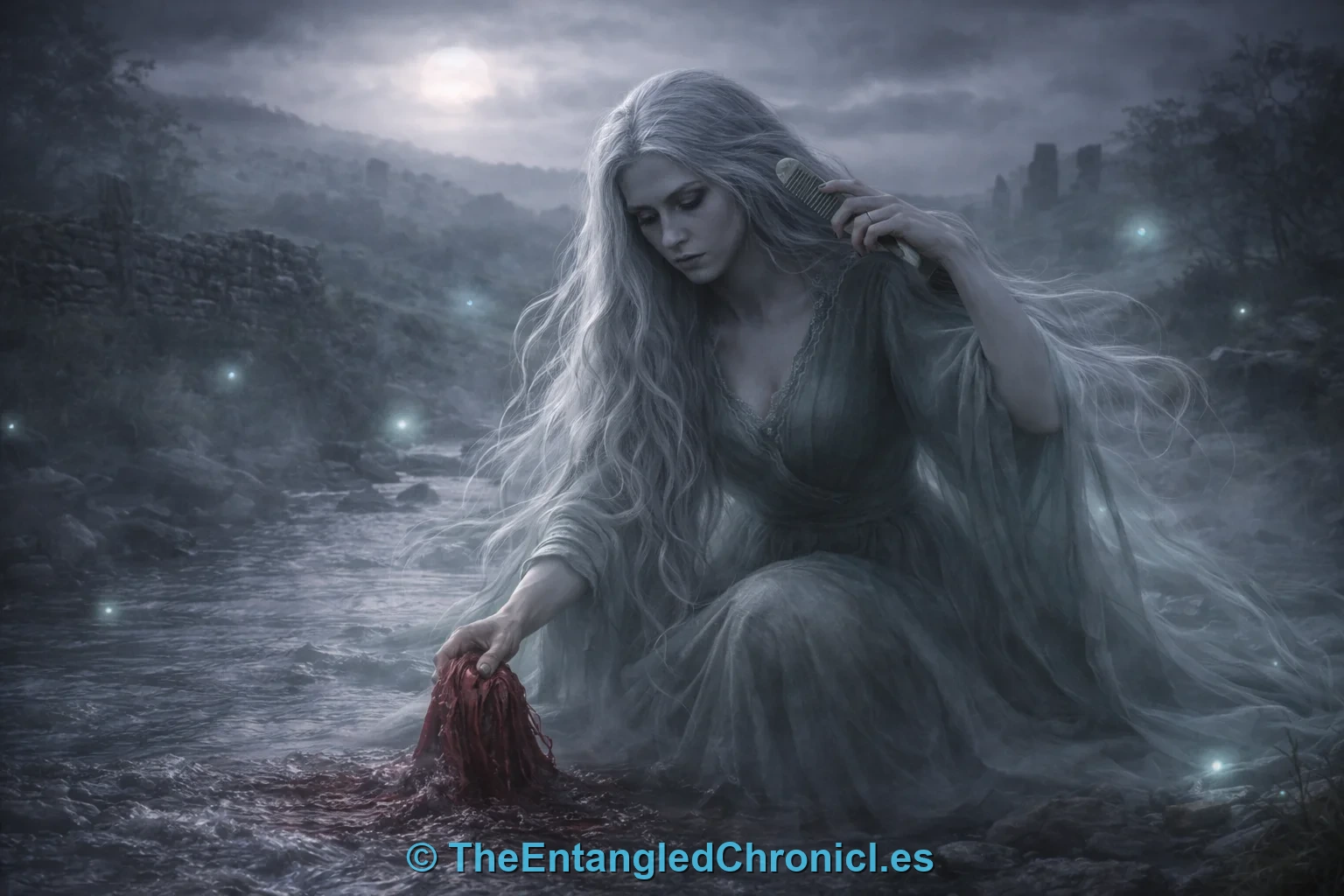
Other regional names reveal different aspects of the tradition. In parts of Leinster, particularly around Dublin and Wicklow, she appears as the bean chaointe—the "keening woman"—directly connecting her to the human tradition of funeral lamentation. In Ulster, the term Badhb (pronounced "bive") surfaces, linking her to the ancient war goddess of the Morrigan triad. The washerwoman variant—bean nighe—is distinctly Scottish Gaelic folklore, though the washing motif does appear in Irish contexts through the Morrigan's manifestation as washer at the ford rather than as a standard banshee form. This distinction matters: in Ireland, the figure washing bloodstained items at rivers typically represents the Morrigan in her death-announcing aspect, not the Bean Sídhe proper.1
A common modern misconception derives the name from bán sí, meaning "white fairy." This false etymology, though linguistically incorrect, persists in popular culture. The actual derivation from sídhe (the mounds) rather than bán (white) is crucial—it establishes her connection not to color but to place, to those sacred hills beneath which the Aos Sí dwell, and by extension to the ancient dead themselves.
Nature and Purpose
The Bean Sídhe occupies a unique position in Irish supernatural folklore, fundamentally different from other fairy beings. Unlike the social daoine sídhe (fairy folk) who live in communities, marry, bear children, and interact frequently with humans in both friendly and hostile ways, the Bean Sídhe exists as an utterly solitary figure. Folklore records no accounts of her dwelling with others of her kind, no tales of her marriage or offspring, no stories of her performing kindnesses for mortals or doing anyone a "kind turn." She is never described as part of a banshee community. Her entire existence centers on a single, inexorable function: announcing death. This profound solitude distinguishes her so sharply from the broader Aos Sí that calling her simply a "fairy woman," though etymologically correct, proves misleading—a point Patricia Lysaght emphasizes in her definitive study.
This fundamental nature distinguishes her sharply from other fairy beings. While the daoine sídhe might trick, help, or harm humans depending on mood and circumstance, the Bean Sídhe operates beyond such capricious behavior. She neither causes death nor prevents it. She simply announces what fate has already decreed. This role places her outside normal categories of benevolent or malevolent—she is neither, or perhaps she is both, depending on perspective. Her appearance brings warning, allowing families time to prepare, to gather, to honor the passing properly. Yet that same warning carries the weight of inevitable loss.
The sound she makes—variously described as wailing, shrieking, keening, or singing—represents the heart of her identity. The Irish term caoineadh (pronounced "kween-uh"), meaning "to weep" or "to lament," gives us the English word "keen." Her cry serves multiple functions: it announces, it mourns, it marks the threshold moment. Those who hear it describe sounds ranging from low, mournful singing to piercing shrieks that seem to shatter the very fabric of night. The variation in description may reflect regional differences, or it may indicate that the Bean Sídhe alters her lament to match circumstances—gentle song for peaceful death, terrible screaming for violent or sudden passing.2
Family Attachments and Ancient Lineages
Traditional lore insists that the Bean Sídhe attaches herself to families of ancient Gaelic lineage—specifically those bearing surnames with the prefixes "Ó" (grandson of) or "Mac" (son of), indicating pure Irish descent from the Milesian stock. Yet this covenant proved more complex than simple bloodline. Cultural adoption through patronage of Irish music and arts could transcend ancestry, as evidenced by the Norman Geraldines—who became "more Irish than the Irish themselves"—and the Anglo-Saxon Bunworth family, both of whom heard the banshee despite lacking ancient Gaelic blood. This selectivity reflected deep cosmological beliefs about blood, land, and supernatural covenant, but ultimately honored cultural allegiance over pure genetics. The O'Briens, O'Neills, O'Gradys, MacCarthys, Kavanaghs, and O'Connors feature most prominently in banshee accounts, their relationships with their particular Bean Sídhe spanning generations.3
The O'Brien family claimed the most distinguished connection. Their Bean Sídhe, named Aibell, was said to rule over twenty-five other banshees who attended her. When an O'Brien of significant status approached death, multiple Bean Sídhe would keen simultaneously—their combined lament marking the passing of someone truly great. This tradition reveals an important principle preserved across Irish folklore: when several banshees appear at once, wailing together, it indicates the death of someone of exceptional importance or holiness. The hierarchy suggested by Aibell's rulership over lesser banshees implies a structured supernatural order, with the queen banshee overseeing death announcements for Ireland's most prominent lineages.
This connection between music and the banshee runs deep. Music and poetry were understood as fairy gifts in Irish tradition, signs of kinship with the Otherworld. Those who possessed such talents demonstrated their connection to the Aos Sí, making them appropriate subjects for supernatural attention regardless of bloodline—hence the Bunworth banshee attending Reverend Charles Bunworth, who patronized Irish musicians. The Bean Sídhe's own method of communication—the keen, itself a highly sophisticated form of vocal music—reinforces this link. She and the musicians she followed shared a common language, the language of sound and emotion transcending ordinary speech.
Regional Variations Across Ireland
Ireland's four provinces each developed distinct traditions surrounding the Bean Sídhe, creating a rich tapestry of regional variation while maintaining the core narrative of the death messenger.
In Munster, the southernmost province, the Bean Sídhe often appears as a stately woman dressed in white or gray, her lament soft and melodic rather than terrifying. Cork and Kerry families speak of her washing bloodstained clothes at river crossings, an image connecting her to the Scottish bean nighe tradition. The Munster banshee sometimes manifests as a beautiful young woman combing her long silver hair with a golden comb—a vision both enchanting and terrible in its implications. This southern tradition emphasizes the Bean Sídhe's connection to water, with rivers and streams serving as her preferred haunting grounds.5
Ulster's northern tradition presents a darker figure. Here she appears as an old woman in rags, sometimes described as having blood-red eyes and disheveled hair. Her cry is sharper, more fragmented—piercing staccato shrieks that fracture the midnight silence. The Ulster Bean Sídhe functions less as gentle warner and more as harbinger of doom, her appearance presaging not just death but often violent or tragic death. Some accounts from this region describe her washing bloody armor and weapons rather than clothing, emphasizing the province's turbulent military history.
Connacht, the western province, knew her in varied forms—sometimes beautiful maiden, sometimes ancient crone. The western Bean Sídhe's keen resonates differently here, described as deep, guttural moans that echo from coastal caves and blend with Atlantic winds. In this wild, remote landscape, her presence seems more elemental, more connected to the raw forces of nature. Galway and Mayo traditions speak of her crying from the tops of cliffs or appearing near ancient stone circles, reinforcing her connection to Ireland's most ancient sacred sites.
Leinster's eastern tradition, influenced by proximity to Dublin and greater English cultural impact, presents a more refined Bean Sídhe. Here she is the bean chaointe par excellence—her wail so piercing it can shatter glass, yet her appearance often dignified, almost noble. Some Leinster accounts describe her as a young woman in flowing white or silver gowns, her long hair unbound, emphasizing her ethereal beauty. This eastern version often appears silent rather than wailing, simply being seen near a house serving as sufficient warning. The Leinster Bean Sídhe seems more closely tied to the professional keening women of medieval Ireland, suggesting the human and supernatural traditions merged more completely in this region.6
The Keening Tradition
To understand the Bean Sídhe, one must first understand caoineadh—the ancient Irish practice of ritual lamentation. From at least the medieval period until the mid-20th century, Irish funerals featured professional mourners called mná caointe (keening women) who vocalized the community's grief through highly stylized songs of lament. These women, often hired for their talent, would sing at wakes and gravesides, their performances blending pre-composed verses with improvised elements praising the deceased and expressing the family's loss.
The keening tradition operated according to specific conventions. The bean chaointe would begin with tuneful, melodic singing that gradually transformed into more chaotic wailing—a raw expression of grief that seemed to come from the depths of the earth itself. The performance included physical movements: rocking, kneeling, sometimes striking the ground or the coffin. The sound itself ranged from beautiful song to primal screaming, encompassing the full spectrum of human mourning.
Patricia Lysaght, the foremost scholarly authority on the banshee, draws explicit parallels between the bean chaointe and the Bean Sídhe in her comprehensive 1986 study. Both serve as transitional figures, shepherding souls from this world to the next. Both employ the same fundamental method—the keen—to mark death's threshold. The key difference lies in timing and origin: the human keener mourns after death has occurred, helping to "sing death out" of the community, while the supernatural banshee appears before death, her lament announcing what approaches. One is human, paid in whiskey and coin; the other is otherworldly, bound by ancient covenant to certain families.
The Church's relationship with keening was complex and ultimately antagonistic. Catholic clergy in Ireland increasingly viewed the practice as pagan, disorderly, and inappropriate—particularly as it centered female voices and gave women spiritual authority at funerals. By the late 19th century, priests actively discouraged keening, and the tradition declined rapidly. Some scholars argue that as the human keening women disappeared, belief in the supernatural Bean Sídhe intensified, as if the community's need for this form of death acknowledgment couldn't be entirely suppressed.7
The few surviving recordings of authentic keening—most notably Cití Ní Ghallchóir's 1950s recording for Alan Lomax and Joe Heaney's traditional caoineadh songs—preserve something of this lost art. These recordings reveal keening's emotional power: not simply crying but a sophisticated musical form capable of expressing layers of grief, memory, honor, and communal loss. Listening to these rare examples helps explain why the banshee's cry was so feared—it represented something primal, something that bypassed rational understanding to strike directly at the heart.
Historical Accounts
The earliest written reference to a Bean Sídhe appears in the Cathreim Thoirdhealbhaigh (Triumphs of Torlough), composed around 1380 by Sean mac Craith. This text, chronicling battles in Thomond during the 13th and 14th centuries, incorporates banshee figures into its historical narrative. It describes several different manifestations: one beautiful woman representing the sovereignty of Ireland itself, and one or two ugly hags embodying despair. These figures appear to military commanders before battles, forewarning doom to both Irish and Norman armies. The commanders ignore the warnings and proceed to their destruction—a pattern suggesting the banshee's prophecy cannot be avoided, only acknowledged or denied.
The next significant historical account emerges from 1649, documented in the memoirs of Lady Ann Fanshawe. During the English Civil War, Lady Fanshawe and her husband stayed at the castle of Lady Honor O'Brien in Cork. Around one in the morning of their first night, Lady Fanshawe awoke to see a woman leaning through the window casement—dressed in white, with red hair and a pale, ghastly complexion. The figure's body appeared "more like a thick cloud than substance." The apparition spoke three times, crying "A horse!" in a tone Lady Fanshawe had never heard before, then vanished "with a sigh more like the wind than breath."
When Lady Fanshawe woke her husband in terror, he explained the local belief: a family member of the O'Briens would soon die. The next morning, a cousin of Lady Honor O'Brien was found dead. What makes this account particularly valuable is its detail and the fact that Lady Fanshawe, an Englishwoman unfamiliar with Irish folklore, recorded the experience without knowing she had encountered the traditional Bean Sídhe. Her phonetic rendering of the cry—"Ahone, Ahone, Ahone"—unknowingly captured ochón, the ancient Irish exclamation meaning "alas," a traditional cry of despair still used in keening songs centuries later. The authenticity of her unfamiliarity adds credibility to an already striking account.8
Later accounts from the 19th and 20th centuries are numerous, many collected by the Irish Folklore Commission in the 1930s and 1940s. These oral histories reveal the banshee's persistence in folk belief well into the modern era. Stories from County Clare, Galway, Kerry, and other regions describe encounters with crying women at crossroads, pale figures seen washing clothes at streams, and most commonly, terrible wailing heard in the night before a family member's death—sometimes even when that death occurred thousands of miles away in America or Australia, suggesting the Bean Sídhe transcends geographical boundaries to maintain her covenant with diaspora families.
Physical Descriptions and Manifestations
No single appearance defines the Bean Sídhe. Instead, tradition presents her in three primary forms, sometimes interpreted as three separate spirits, sometimes as shape-shifting manifestations of a single entity.
The first manifestation appears as a beautiful young woman, often described in the folklore of Munster and Connacht. This version wears flowing gowns of white, silver, or pale green, her long hair unbound and often silver-white despite her youthful face. She may be seen combing her hair with a golden or silver comb—an activity that in some accounts she can only perform while keening. This beautiful Bean Sídhe sometimes represents a young woman of the family who died before her time and has been given the mission by otherworldly powers to serve as death herald to her mortal kin. Lady Wilde's 19th-century collection describes her as having "the form of some sweet singing virgin of the family who died young," transforming personal tragedy into supernatural duty.
The second form appears as a dignified matron—a stately woman of middle years dressed in grey cloaks and green dresses. Her eyes are red from continual weeping, suggesting she genuinely mourns those whose deaths she announces. This version, common in Leinster, carries herself with dignity and sorrow rather than terror. She represents the Bean Sídhe at her most sympathetic—a figure of compassion forced to bear terrible news but doing so with grace.
The third manifestation takes the form of the Cailleach—the hag or crone. This Ulster favorite appears as an ancient woman in ragged clothes or shrouds, her face gaunt and withered, her hair wild and unkempt. Some descriptions emphasize skeletal fingers, hollow eyes, and skin like parchment. This frightening version seems to embody death itself rather than simply announcing it. In some Munster and Ulster accounts, she appears washing bloodstained clothes at river fords—an image that strongly echoes the Morrigan's washer-at-the-ford manifestation, suggesting the two traditions merged in regional folklore. When this washing imagery appears, it typically signals violent death approaching.9
Physical height varies dramatically in accounts. Some describe her as unusually tall, towering over mortal women. Others—particularly those emphasizing her fairy nature—report her as remarkably short, ranging from one to four feet in height. This dramatic size variation may reflect the shapeshifting nature attributed to fairy folk, or it may indicate that different regions preserved different traditions about her physical form.
The most consistent detail across all descriptions concerns her eyes—invariably described as red from weeping, sometimes glowing with an eerie light. This feature appears regardless of whether she manifests as young maiden, stately matron, or ancient hag, suggesting it represents her essential nature. She is one who grieves, who mourns continuously for all the deaths she must announce, who carries the sorrow of centuries in her supernatural gaze.
Connection to the Morrigan
Scholars including Patricia Lysaght and Gearóid Ó Crualaoich have noted striking parallels between the Bean Sídhe and An Morrigan, Ireland's great war and sovereignty goddess. The Morrigan, particularly in her aspect as Badb, appears as a carrion crow on battlefields, announcing death and sometimes appearing as a washer at the ford, cleaning bloody weapons before combat. This washerwoman image—the figure who announces death through the symbolic act of washing bloodstained items—appears in both Morrigan mythology and in certain Bean Sídhe accounts, particularly in Ulster.
The connection may run deeper than surface similarity. The Morrigan represents sovereignty, the feminine spirit of the land itself. She chooses who rules, who lives, who dies. The Bean Sídhe's selective attachment to ancient Irish families—those of "pure Milesian stock"—echoes this sovereignty function. She recognizes and maintains covenant with Ireland's original noble lineages, those families whose right to the land predates foreign invasion. In this reading, the Bean Sídhe becomes a vestige of the ancient sovereignty goddess, her role diminished from choosing kings to simply mourning the passing of noble bloodlines, but still fundamentally concerned with the relationship between specific families and the Irish land itself.
As Christianity displaced older religious practices, the Morrigan's attributes fragmented and transformed. Some aspects merged with Saint Brigid; others persisted in fairy lore. The Bean Sídhe may represent another such fragment—the Morrigan's death-announcing function separated from her war and sovereignty aspects, preserved in folklore as a distinct supernatural being. The fact that some regions use "Badb" as a name for the banshee reinforces this connection, suggesting folk memory retained the link even as the mythology evolved and separated over centuries.
The Banshee in Modern Ireland
Reports of banshee encounters persisted well into the 20th century. The Irish Folklore Commission's extensive collections from the 1930s and 1940s document hundreds of accounts from across Ireland, many from people describing recent experiences. These testimonies reveal the Bean Sídhe as more than historical curiosity—she remained a living presence in rural Ireland's spiritual landscape even as electrification and modernization transformed the countryside.
Contemporary folklore continues to evolve. Some Irish families still claim banshee attachments, and occasional reports surface of unexplained keening heard before deaths. The interpretation has shifted somewhat—where earlier generations accepted the Bean Sídhe as literal supernatural entity, modern believers often understand her as psychic phenomenon, ancestral memory made manifest, or symbolic representation of grief's anticipatory aspects. Yet even skeptics often express discomfort dismissing the tradition entirely, particularly when confronted with firsthand accounts from otherwise reliable witnesses.
The Irish diaspora carried banshee beliefs worldwide. Lady Wilde's 19th-century collection includes an account of an O'Grady family in Canada hearing their Bean Sídhe's cry before a death, suggesting she followed them across the Atlantic. Similar stories emerge from Irish communities in America, Australia, and elsewhere—the supernatural covenant apparently transcending geography. Whether these represent genuine paranormal persistence or cultural memory expressing itself through psychological phenomena remains debated, but the pattern speaks to the tradition's deep psychological and cultural resonance.
Recent years have seen renewed interest in keening as cultural practice and musical form. Contemporary Irish musicians and folklorists have begun recovering and performing traditional caoineadh songs, and some funerals once again feature keening, though now understood as cultural heritage rather than supernatural necessity. Artists like Róisín Elsafty have created modern compositions exploring the keening tradition, connecting ancient practices to contemporary expressions of grief and loss. This revival suggests the Bean Sídhe's cultural function—providing ritualized space for expressing grief and acknowledging death—remains relevant even in secular, modern contexts.
Notes & Variations
Sources & Further Reading
- Lysaght, Patricia – The Banshee: The Irish Supernatural Death-Messenger (1986, reprinted 1996, 1997)
- Wilde, Lady Jane Francesca – Ancient Legends, Mystic Charms, and Superstitions of Ireland (1888)
- Fanshawe, Ann, Lady – Memoirs of Lady Fanshawe (first published 1829)
- Mac Craith, Sean – Cathreim Thoirdhealbhaigh (Triumphs of Torlough) (c. 1380)
- Ó hÓgáin, Dáithí – The Lore of Ireland: An Encyclopedia of Myth, Legend and Romance (2006)
- MacKillop, James – Dictionary of Celtic Mythology (1998)
- Ó Súilleabháin, Seán – Irish Wake Amusements (1967)
- Partridge, Angela – Caoineadh na dTrí Muire: Téama na Páise i bhFilíocht Bhéil na Gaeilge (1983)
- Irish Folklore Commission Collections – National Folklore Collection, University College Dublin
- CELT: Corpus of Electronic Texts (University College Cork) – Primary source materials