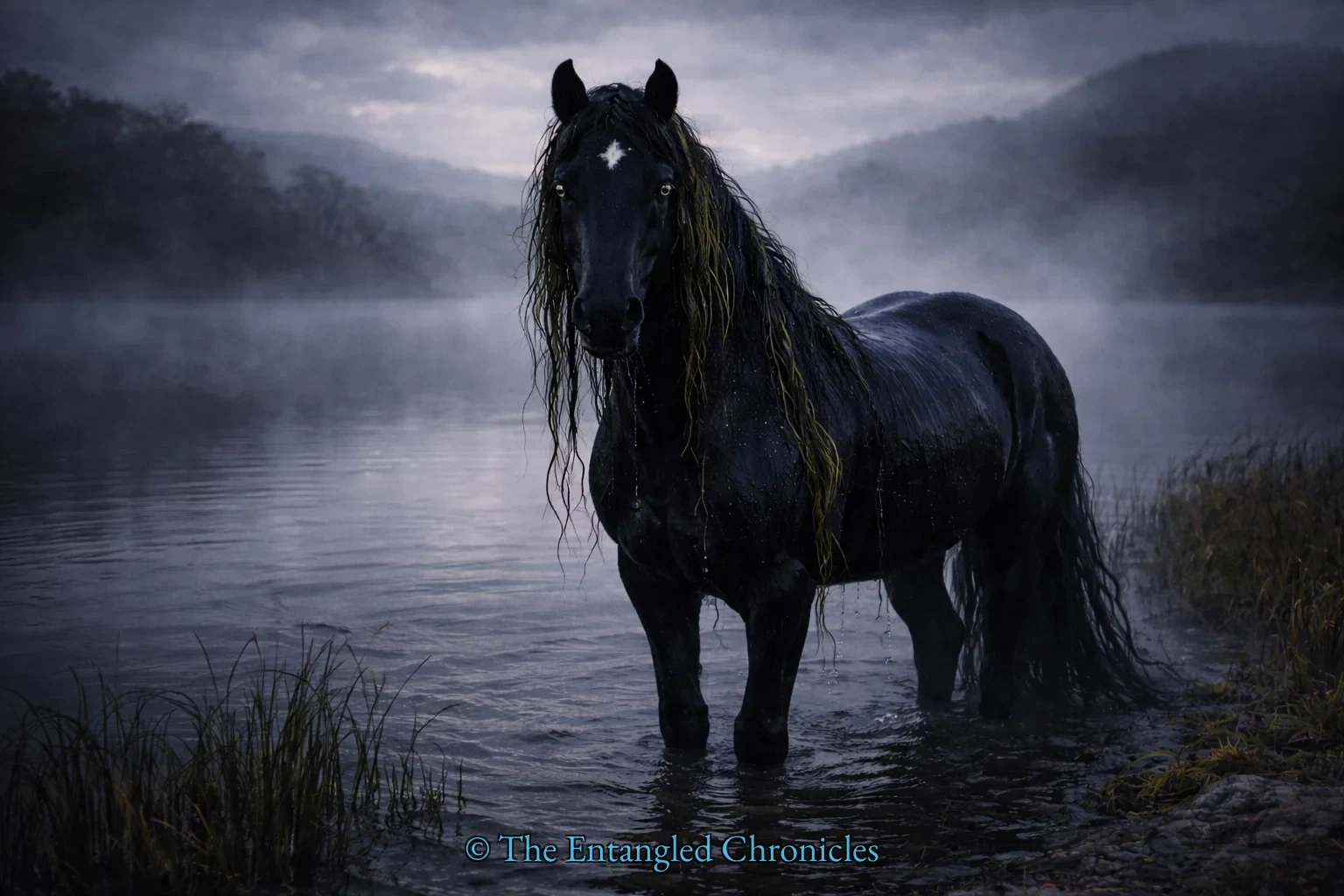
Each-Uisce (pronounced "akh-ISH-ka"), also known as Aughisky, appears in Irish folklore as a shapeshifting water horse that inhabits loughs and coastal waters. While capable of taking human form, it most commonly appears as a beautiful horse that lures victims from deep waters to their death.
Etymology & Names
The name Each-Uisce translates directly from Irish Gaelic as "water horse" (each meaning "horse" and uisce meaning "water"). The creature appears in English texts under various anglicizations, most commonly Aughisky or Ech-Ushkya, though these spellings obscure the authentic Irish pronunciation and etymology.
The Each-Uisce belongs to a broader family of Celtic water horses including the Welsh Ceffyl Dŵr, the Manx Cabbyl-ushtey, and the Scottish Each-Uisge (note the slightly different spelling—Uisge versus Uisce—which reflects dialectical differences in Scottish and Irish Gaelic).1 The Irish creature must be distinguished from the kelpie, which inhabits running water rather than the still loughs and coastal waters preferred by the Each-Uisce.
In Irish tradition, the Each-Uisce should not be confused with the beautiful lake-dwelling horses that the hero Cúchulainn captured and trained, which he returned to their mountain pool when they were mortally wounded. Irish tradition distinguishes these as benevolent creatures of the Otherworld; folklore portrays the Each-Uisce as far more predatory and unpredictable.
A Note on Terminology
The term Each-Uisce as a specific creature category appears primarily in post-medieval folklore collections and English translations. Earlier Irish texts describe various water monsters using terms like péist (serpent/monster), muirdris (sea monster), or cathach (battler), without consistent categorization.
This article treats creatures sharing core Each-Uisce characteristics—shapeshifting water horses that dwell in loughs and coastal waters, often appearing beautiful to lure victims—as part of the same folkloric tradition, while acknowledging that medieval sources used different terminology. Where specific medieval creatures are discussed, their original designations are preserved and the interpretive connection to Each-Uisce traditions is noted.
The unification of these traditions under the "Each-Uisce" label represents modern folkloristic analysis rather than medieval Irish taxonomy. This approach follows scholarly precedent in identifying common patterns across regional and temporal variations while respecting the distinct terminology of original sources.
Physical Description
According to Irish folklore, the Each-Uisce most commonly manifests as an exceptionally beautiful horse—sleek, well-groomed, and alluring in ways that make it nearly irresistible to mount. Irish folklore describes these horses most frequently as black with glossy, wet coats that glisten as though the creature has just emerged from water.2 Accounts from Lough Coirib in County Galway describe a black Each-Uisce "dark as the blackberry" with a bright white star marking on its forehead—a detail that enhanced rather than diminished its appeal.
Folk tradition describes the creature's supernatural nature revealing itself through subtle details that betray its aquatic origins. Its mane flows thick and heavy, perpetually damp, often containing traces of green water weeds or seaweed tangled in the dark strands. Droplets of water run continuously down its neck and flanks. The horse appears to possess almost perfect symmetry and beauty. Accounts describe its eyes as holding a particularly captivating, mesmerizing quality, reflecting light with an otherworldly gleam that seems to pierce through the November mist.
The Each-Uisce is a true shapeshifter, though its transformations remain less elaborate than those of its Scottish cousin. In human form, the creature typically appears as a handsome young man, though certain features inevitably betray its nature—hooves instead of feet, seaweed woven through dark hair, or clothing that drips continuously with water.3 The Irish Each-Uisce does not typically take bird form in traditional folklore. The bird transformation (including enormous birds like the boobrie) appears in Scottish Each-Uisge traditions but is not documented in Irish sources.
Horse Form
Sleek black coat with wet, glistening appearance. White star markings sometimes present. Mane perpetually damp with water weeds tangled in dark strands. Unnaturally perfect and symmetrical beauty.
Human Form
Handsome young man with telltale signs—hooves for feet, seaweed in hair, water-soaked clothing. Captivating eyes that reflect light strangely. More commonly male in Irish traditions.
Telltale Signs
Perpetually wet appearance regardless of weather. Water weeds or seaweed clinging to body. Eyes that gleam with otherworldly quality. Too beautiful, too perfect to be natural.
Behavior & Nature
According to Irish folklore, the Each-Uisce inhabits the liminal spaces between water and land—primarily the shores of Ireland's dark loughs (lakes), though it ventures into coastal waters and occasionally the sea itself. Irish folklorists distinguish the Each-Uisce from the kelpie specifically by habitat: the Each-Uisce prefers still or slow-moving water bodies, while kelpies haunt running streams and rivers.4 Local lore claims that nearly every sizeable body of freshwater in Ireland once harbored its own Each-Uisce, each with its own patterns and peculiarities.
The creature emerges most powerfully during November, the month surrounding Samhain when the barrier between the mortal world and the Otherworld grows thin.5 During this time, Each-Uisce are seen galloping along sandy shores and across fields, their wet manes streaming behind them, actively seeking humans to lure onto their backs. The creature positions itself cunningly—appearing as a riderless horse grazing peacefully near the water's edge, inviting the unwary traveler to mount it for convenient transport.
Irish accounts describe the Each-Uisce as having a notably more unpredictable temperament than its consistently malevolent Scottish cousin. Some accounts describe the creature allowing itself to be used for farm labor, working obediently until the moment its owner makes the fatal mistake of mounting its back. Other tales tell of Each-Uisce that can be tamed and ridden safely—provided they never catch sight or smell of salt water. When properly bridled and kept inland, an Each-Uisce makes the finest of steeds: tireless, obedient, and possessed of supernatural strength and speed.
The Fatal Glimpse
The transformation occurs in an instant. The moment a tamed Each-Uisce catches sight of the sea or smells salt water on the wind, the creature's entire nature shifts. The rider must dismount immediately or face being carried in an unstoppable charge directly into the depths. The Each-Uisce bounds into the water with its helpless passenger clinging to its back, plunging deep beneath the surface where the rider drowns. In some accounts, the creature then devours its victim, leaving only the liver to float to the surface as grim evidence of what transpired.
Unlike the Scottish version with its adhesive skin that traps victims, the Irish Each-Uisce relies more on speed, surprise, and the rider's inability to escape once the creature reaches deep water. Tales exist of clever individuals who escaped—a man who wrenched himself free by bracing his feet against a narrow gateway as the horse charged through, or a boy who cut off his own finger when it stuck to the creature's neck, saving himself while his companions were lost.
Taming & Control
Irish tradition preserves numerous accounts of humans successfully capturing and taming Each-Uisce, transforming these dangerous predators into valuable servants—though always at tremendous risk. The key to control lies in obtaining the creature's magical bridle, an ornate piece of tack that grants power over the Each-Uisce.6 Highland accounts describe these bridles as "richly caparisoned," and folklore emphasizes that if a human could seize this bridle and replace it with a common cow shackle, they would have power over the Each-Uisce for life.
The tamed Each-Uisce makes an extraordinary mount: valiant in battle, tireless in labor, obedient to commands, and possessed of speed and strength far beyond mortal horses. Farmers who successfully captured and controlled an Each-Uisce found themselves with an invaluable asset—a creature that could plow fields with supernatural efficiency, never tiring, never balking at the work.
The critical rule governing all tamed Each-Uisce is absolute: never allow them to see or smell the sea. The creature must be kept strictly inland, far from coastal areas where the scent of salt water might reach them. Even a glimpse of ocean waves on the horizon or the faint smell of brine on a sea breeze can trigger the creature's irresistible compulsion to return to water. Owners who forgot this rule—or who grew complacent after years of the creature's obedience—paid with their lives when they ventured too close to the coast while mounted.
Some traditions describe alternative methods of control or protection. Silver weapons prove effective against Each-Uisce in their human form—a Highland account tells of a man who fired ordinary bullets at a water horse twice without effect, but when he loaded his gun with a silver coin and fired again, the creature retreated howling back into the lough. Sharp metal objects, particularly "cold iron," are said to have protective power, possibly explaining why narrow iron gates and sharp spurs feature in escape tales.
Famous Encounters & Locations
Lough Coirib, County Galway
One of the most detailed Each-Uisce accounts comes from Ceathramhadh Gairbh on the shores of Lough Coirib. A hardworking farmer named Tomás Seóighe, walking early one morning along the lough's edge, witnessed a magnificent black horse emerge from the water—"as black as the blackberry with a bright star on its forehead" (chomh dubh leis an sméar agus réalt gheal ina bhaithis). The creature shook itself, walked up onto the land, and began grazing on the green grass as though it were an ordinary horse. The tale, preserved in the Dúchas Schools' Collection, captures the quintessential Each-Uisce encounter: a creature of devastating beauty appearing precisely where water meets land, in that dangerous liminal threshold.7
The Shannon and Saint Senan's Monster
Medieval Irish hagiographical texts preserve accounts of Saint Senan of County Clare confronting a great water beast at Inis Cathaigh (Scattery Island) in the Shannon estuary. The creature is described in later retellings as something between horse and serpent—massive, with a horse's mane, gleaming eyes, thick feet with iron nails, and a whale's tail.
While not explicitly identified as an "Each-Uisce" in the original medieval texts—which use terms like péist (monster) or bíast (beast)—this account shares core characteristics of Irish water horse traditions: the shapeshifting aquatic predator, the liminal coastal location, and the recurring pattern of Christian saints overcoming pagan water spirits that had terrorized communities for generations.
The description combines equine features with serpentine and cetacean elements—horse's mane, gleaming eyes, thick feet with iron nails, and whale's tail.8
Lough Swilly and Donegal Water Traditions
Donegal traditions associate Saint Colmcille (Columba) with the defeat of water monsters during his time in the region around 1,500 years ago. While specific names and details vary between accounts—some later folklore collections refer to creatures of Lough Swilly using descriptive names like "Suileach" (meaning "many-eyed one")—these stories follow the pattern of Christian saints confronting pre-Christian water spirits that had claimed numerous victims from local communities.
The attribution of Each-Uisce characteristics to these Donegal water monsters represents interpretation of fragmentary sources rather than explicit medieval designation, but the core pattern remains consistent: a water-dwelling predator inhabiting a specific lough, claiming multiple lives, requiring intervention by a powerful Christian saint to end its reign of terror. These accounts, preserved primarily in post-medieval retellings, may represent Each-Uisce traditions adapted into Christian hagiography, maintaining the essential folklore while reframing the narrative around saintly triumph.
Lough Rury and Muirdris
County Down's Lough Rury held the water monster called Muirdris (also known as Sinach), which battled the Ulster king Fergus mac Léti. The encounter left Fergus permanently disfigured, his face twisted and ugly from the creature's venom. His companions hid all mirrors to spare him the knowledge of his transformation, but when he eventually glimpsed his reflection, Fergus returned to fight Muirdris again—this time achieving victory and slaying the beast. The tale emphasizes both the water creature's deadly nature and the courage required to face such a predator a second time after surviving the first encounter. While medieval sources describe Muirdris using various terms for water monsters rather than specifically as an "Each-Uisce," the creature displays characteristic water horse features: inhabiting a specific lough, shapeshifting abilities, and devastating attacks on humans who ventured too close to its territory.
Documented Accounts from Oral Tradition
The Dúchas Schools' Collection, gathered by Irish schoolchildren in the 1930s, preserves numerous Each-Uisce accounts from oral tradition across Ireland. These firsthand testimonies, recorded before modern media homogenized regional folklore, provide valuable insight into how Irish communities understood and interacted with water horse traditions. The following accounts represent verified examples from across the west of Ireland, each preserved with complete archival citations.
Lough Coirib, County Galway (1937-1939)
From Ros Muc school in the Galway Gaeltacht comes an account of a hardworking farmer named Tomás Seóighe who witnessed an Each-Uisce emerge from Lough Coirib at Ceathramhadh Gairbh. Walking early one morning along the lough's edge, he saw a magnificent black horse rise from the water—chomh dubh leis an sméar (as black as the blackberry) with a bright white star on its forehead (réalt gheal ina bhaithis). The creature shook itself, walked onto land, and began grazing on the green grass as though it were an ordinary horse. This quintessential encounter captures the Each-Uisce's devastating beauty appearing precisely where water meets land, in that dangerous liminal threshold.11
Lough Allen, County Leitrim (1937-1939)
The Corderay school collection records two separate sightings from Lough Allen, providing remarkable consistency in description. Mrs. Frances Carroll witnessed a water horse emerge from the lough at Derrinligroe shore, running briefly on the strand before returning to the water. More dramatically, Thomas McGirl encountered an Each-Uisce on the lime kiln bank at Blackrock while traveling to Drumshanbo. When McGirl spoke, the grazing horse raised its head and its mane stood up like the fins on a fish—a unique defensive posture documented nowhere else in the collection. Anger flashed in the creature's eyes as it sprang from the rock into the deep water below the kiln and vanished.12
This fin-like mane detail suggests the Each-Uisce's form may be more fluid than the typical horse appearance, revealing aquatic characteristics when threatened or agitated. The account also emphasizes the creature's instant retreat to deep water when confronted—a survival behavior that likely contributed to the difficulty in capturing or killing these creatures.
Béal Átha na mBreac, County Galway (1937-1939)
Perhaps the most cautionary account comes from Béal Átha na mBreac, recorded in Irish Gaelic by collector Máire Ní Stancháird from her grandmother Eilís Ní Mháille. Two men fishing in a lough captured an Each-Uisce and brought it home to work on their farm. The creature proved valuable, hauling manure and bringing turf home—exactly the kind of labor that made captured water horses so desirable despite the risk.
One day, while one of the men rode the Each-Uisce near the lough, the creature spotted another horse. It immediately leaped into the water, drowning and killing its rider. The account concludes grimly: Deirtear go bhfuil cnámha an fhir le feiscint ina an loch ó shoin—"It is said that the man's bones can still be seen in the lake to this day."13
The account also preserves a crucial folk belief: Má fheiceann eac uisge duine sul má fheiceann duine é tagann mí-ádh éicint ar an duine sin—"If an Each-Uisce sees a person before the person sees it, some misfortune will come to that person." This belief emphasizes the importance of vigilance and recognition, suggesting that spotting the creature first granted some protective advantage or at least forewarning of danger.
Acaill (Aghany), County Mayo (1937-1939)
The most detailed taming account comes from 80-year-old carpenter Thomas Gibbons of Emlagh, County Mayo. A man from the Mac Donnchada family, described as brave and strong, farmed land at Smealloch on the coast west of Acadanna (Aghany). One autumn night, he discovered something was eating his oat crop. The following night he returned to catch the culprit and found an Each-Uisce grazing in the field. He cornered the creature and bridled it with a special bridle he had brought, then led the captured water horse home to his stable.
The Each-Uisce proved to be a large, powerful horse that worked excellently, hauling hay, oats, and other materials. The farmer bred horses (searaigh, young horses/colts) and sold them for good prices—suggesting either the Each-Uisce served as breeding stock or its labor enabled expanded horse-trading operations.
The tale takes its fateful turn when a man from Dubach Mhic Éoin (possibly Doohooma) asked to borrow the horse to haul oats home. A tinker had specifically warned Mac Donnchada never to lend the Each-Uisce to anyone, but he ignored this advice and lent the creature anyway. The account breaks off at this critical moment with the ominous phrase acht rinne sé faillighe ar an gcómhairle sin—"but he was negligent of that advice."14
While the tale's conclusion isn't preserved, the tinker's warning and the emphasis on the owner's fatal error strongly suggest tragedy followed. The specific prohibition against lending the creature indicates that Each-Uisce taming required continuous personal control—the bond between tamer and creature could not be transferred, even temporarily, without catastrophic consequences.
Cultural Significance
The Each-Uisce appears throughout Irish tradition as a water-dwelling predator. Irish communities living near loughs and coastal waters developed extensive folklore about these creatures, reflecting the dangers posed by deep, still waters. The still, dark depths of Irish loughs—often small in surface area but running incredibly deep—held genuine dangers for communities that depended on them for fishing, transportation, and daily water needs.
In Irish folklore, water holds supernatural significance. Sacred wells and seasonal loughs that appear only at certain times were believed to belong to na Daoine Uaisle (the Noble Ones)—the fairy folk and spirits inhabiting the threshold between mortal and Otherworld. The Each-Uisce inhabits these water boundaries in Irish folklore.
Irish tradition associates the Each-Uisce strongly with Samhain and November, when the creatures were said to emerge most powerfully from the water. Many Each-Uisce tales feature Christian saints defeating water monsters, with the saint narratives overlaying older water spirit traditions.
Irish folklore includes accounts of taming the Each-Uisce, unlike the Scottish version which is consistently portrayed as untameable. Folklore describes specific methods: capturing the magical bridle, keeping the creature away from salt water, and maintaining strict control. Accounts warn that those who grew careless faced death. Similar patterns appear throughout Irish fairy lore, where supernatural beings respond to proper treatment and ritual.
Distinguishing the Each-Uisce from the Púca
The Each-Uisce and the púca (pooka) share certain characteristics—both are shapeshifters frequently appearing as horses, both belong to Irish water and fairy traditions, both can carry riders on wild journeys. However, Irish tradition draws clear distinctions between them.
The púca, while dangerous and unpredictable, rarely kills. It delights in giving terrifying rides but typically returns the rider safely to the starting point, shaken but alive. The púca possesses speech and personality, engaging with humans more directly. Most importantly, the púca's essential nature leans toward mischief rather than predation—it may frighten, confound, or test humans, but it does not hunt and devour them as the Each-Uisce does.
The Each-Uisce represents genuine mortal danger—a predator that drowns and sometimes consumes its victims. While it may occasionally be tamed, its fundamental nature remains that of a water-dwelling hunter rather than a trickster spirit. The Each-Uisce belongs specifically to water boundaries, while the púca roams more broadly across the Irish landscape.
Regional Variants & Related Creatures
Scottish Each-Uisge
The Scottish Each-Uisge (note the spelling difference: Uisge rather than Uisce) shares the basic water horse concept but represents a distinctly more malevolent creature. Folklorist Katharine Briggs described it as "perhaps the fiercest and most dangerous of all the water-horses." The Scottish version possesses adhesive skin—once a victim touches the creature, they cannot pull away, becoming trapped as it plunges into deep water. The Scottish Each-Uisge also devours its victims more systematically, consuming every part of the body except the liver, which floats to the surface as grim testimony. While Irish accounts sometimes allow for escape or taming, Scottish tradition portrays a more consistently deadly predator with more elaborate shapeshifting capabilities, including transformation into giant birds or appearing as beautiful women.9
The Kelpie
Often confused with the Each-Uisce, the kelpie represents a related but distinct creature in both Scottish and Irish tradition. The key distinction lies in habitat: kelpies inhabit running water—streams, rivers, waterfalls, and torrents—while the Each-Uisce prefers still or slow-moving water bodies like loughs and sea lochs. Kelpies appear most commonly as grey or white horses rather than the black typically associated with Each-Uisce. Some accounts describe kelpies with reversed hooves or manes of serpents, physical features rarely attributed to the Each-Uisce. The behavioral differences also matter: kelpies often engage in pranks and lesser mischief, while Each-Uisce tend toward more serious predation, though both can be deadly.10
Manx Cabbyl-ushtey
The Isle of Man's Cabbyl-ushtey (sometimes spelled Cabyll-ushtey) shares the water horse nature but with Manx characteristics. Like the Irish Each-Uisce, it emerges from the sea and coastal waters, appearing as a beautiful horse to lure victims. The Manx tradition sometimes conflates the Cabbyl-ushtey with the Glashtyn, another Manx water spirit that takes human form with horse's ears. The Cabbyl-ushtey maintains the ravenous appetite of its Celtic cousins but appears less frequently in surviving folklore, perhaps due to the Isle of Man's smaller size and population.
Welsh Ceffyl Dŵr
The Welsh water horse, called Ceffyl Dŵr, inhabits mountain pools and waterfalls in Welsh tradition. This creature possesses unique capabilities including the ability to fly and to disappear into mists—features less commonly attributed to the Irish or Scottish versions. The Welsh variant maintains the core characteristics of appearing as a beautiful horse to lure travelers, then carrying them to a watery death, but its mountain habitat and aerial capabilities distinguish it from its cousins in Ireland and Scotland.
Protection & Survival
Irish tradition preserved extensive knowledge about avoiding or escaping Each-Uisce encounters, practical wisdom passed down through generations living near dangerous waters:
Recognition
Never mount strange horses found near water, especially in November. Look for telltale signs: wet mane with water weeds, dripping coat on dry days, eyes that reflect light strangely, too-perfect beauty. In human form, check for hooves instead of feet or seaweed in hair.
Escape Methods
If trapped on an Each-Uisce's back, try wrenching yourself free using narrow gates or doorways. Some escaped by cutting off stuck fingers or hands. Keep sharp metal objects—cold iron provides protection. Silver weapons harm them in human form.
Taming Rules
Capture the magical bridle and replace with cow shackle. Never allow tamed Each-Uisce to see or smell salt water. Keep them strictly inland. Never grow complacent—their wild nature remains beneath obedience, waiting for a single glimpse of the sea.
Modern Irish Pagan practitioners continue to emphasize respect when approaching water. Traditional advice includes avoiding taking anything from the water—stones, plants, or objects left on paths may be bait from water spirits. Speaking Irish Gaelic when encountering strange creatures or fairy music provides protection, language serving as a shield. Most importantly: learn the stories, for forgetting them is when danger truly begins.
Literary & Cultural Legacy
Reported sightings of Each-Uisce continued through the 19th and even into the 20th century. The areas around Lough Shanakeever and Lough Brin in particular saw recurring accounts, locations associated with the legendary hero Fionn Mac Cumhaill, who supposedly lost his hunting dog to a water horse. These accounts persisted into the modern era across multiple Irish communities.
The creature appears in various forms throughout Irish literature and art, though often conflated with Scottish kelpies or presented through romanticized Victorian lenses that softened its genuinely predatory nature. Modern fantasy literature has embraced the water horse concept broadly, though contemporary depictions rarely distinguish between the Irish Each-Uisce's particular characteristics and other Celtic water horse traditions. The 2007 film "The Water Horse" drew loosely on Scottish rather than Irish traditions, contributing to ongoing confusion between distinct folklore creatures.
The Each-Uisce appears in contemporary Irish culture. Environmental campaigns in Ireland sometimes reference water horse imagery when discussing water safety and pollution.
Notes & Variations
Sources & Further Reading
- Dúchas Schools' Collection – National Folklore Collection, University College Dublin (1937-1939)
- The Book of Lismore – Medieval Irish manuscript (15th century)
- MacKillop, James – Dictionary of Celtic Mythology (1998)
- O'Brien, Lora – Contemporary Irish Pagan resources and folklore education (irishpagan.school)
- Evans-Wentz, W.Y. – The Fairy-Faith in Celtic Countries (1911)
- Briggs, Katharine – An Encyclopedia of Fairies (1976)
- Briggs, Katharine – The Vanishing People: Fairy Lore and Legends (1978)
- Campbell, John Gregorson – The Gaelic Otherworld (1900, 2005 edition)
- Ó hÓgáin, Dáithí – Myth, Legend & Romance: An Encyclopedia of the Irish Folk Tradition (1990)
- Green, Miranda – Dictionary of Celtic Myth and Legend (1992)
- Spence, Lewis – The Minor Traditions of British Mythology (1948)
- Yeats, W.B. – Fairy and Folk Tales of the Irish Peasantry (1888)
- Lady Wilde – Ancient Legends, Mystic Charms, and Superstitions of Ireland (1888)
- Joyce, Patrick Weston – Old Celtic Romances (1879)
- Gregory, Lady Augusta – Visions and Beliefs in the West of Ireland (1920)
Where to Learn More
For those wishing to explore Irish Each-Uisce folklore more deeply, these starting points offer different pathways into the material:
- For primary sources and oral tradition: The Dúchas Schools' Collection at duchas.ie provides access to thousands of Irish folklore accounts collected in the 1930s, many preserved in original Irish Gaelic.
- For comprehensive Celtic water spirits: Katharine Briggs's An Encyclopedia of Fairies (1976) offers authoritative entries distinguishing between Each-Uisce, Each-Uisge, kelpies, and related creatures.
- For modern Irish Pagan perspective: Lora O'Brien's work on Irish water spirits and fairy faith provides contemporary approaches to traditional beliefs while maintaining respect for authentic sources.
- For academic Celtic mythology: James MacKillop's Dictionary of Celtic Mythology (1998) provides scholarly context for Each-Uisce within broader Irish mythological systems.
- For comparative water horse traditions: The Wikipedia article "Water horse" offers comprehensive overview of Celtic and Nordic variants with extensive citations to primary sources.