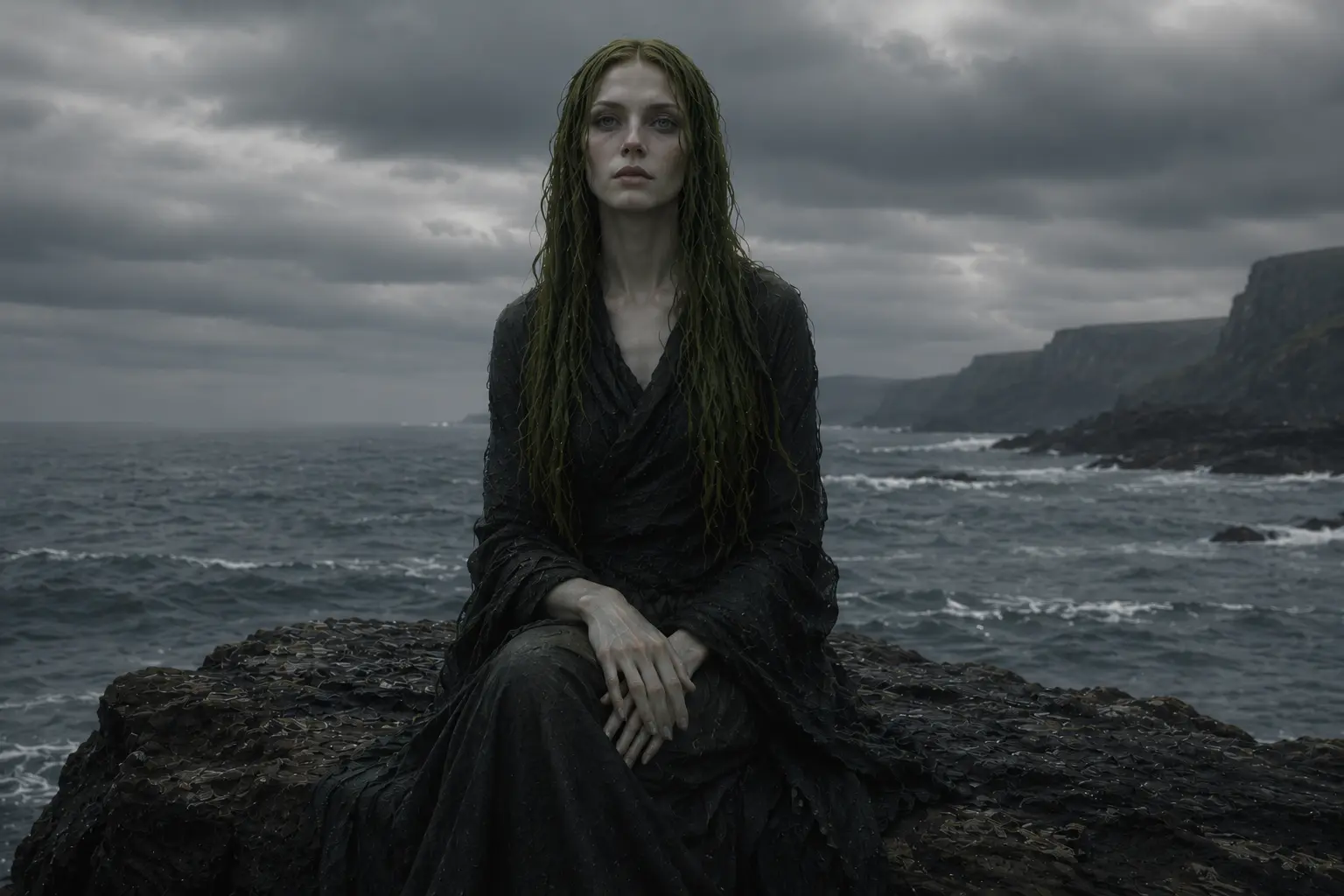
Etymology and Names
The word merrow is anglicised from the Irish murúch, which appears in Middle Irish as murdúchann or murdúchu. Various folk etymologies have been offered — one popular reading breaks it as muir (sea) and oigh (maid or maiden) — though the precise Old Irish derivation is not settled among scholars. What the word carries in all its forms is the sense of something that belongs, fundamentally and completely, to the sea.
Regional variants reflect Ireland's linguistic geography. The creature appears as moruadh, muruach, and murdhuacha in different traditions, all referring to the same being. In Scottish usage, a related form appears as morrough. W.B. Yeats, in his 1888 collection, recorded the name as both Merrow and Moruadh, noting that fishermen on the wilder coasts considered the sighting of one an ill omen — a sign that gales were coming.
The Merrow is distinctly Irish, though her closest folkloric cousins appear across Celtic traditions: the Scottish selkie (who sheds a seal skin to walk on land), the Welsh gwragedd annwn (lake maidens), and the broader European mermaid tradition. What separates her from the classical mermaid of other cultures is specificity — she is tied to particular coastlines, particular communities, particular families, and she operates with a distinct internal logic all her own.
What the Merrow Is
A woman's form from the waist up — green hair, pale skin, sometimes slight webbing between her fingers — and a fish's tail below. Female Merrows are consistently described as beautiful, with the sea-green quality to their eyes that gives them away among humans. Male Merrows are a different matter: grotesque, by all traditional accounts, with green hair and teeth, pig-like eyes, a red nose, and stunted, scaly limbs. The contrast between the two is stark enough that it appears in virtually every source that mentions both.
The Merrow is not a predator in the simple sense. She does not hunt. She surfaces, she watches, she occasionally enters into relationships with humans — bittersweet arrangements that the old stories treat with a kind of clear-eyed melancholy. She is sovereign in her own domain, operating on terms that are entirely hers, and the human world only ever gets to borrow her for a while.1
Fishermen did not regard her as welcome. Her appearance at sea, like certain other omens in Irish coastal tradition, was read as a warning of storms and rough weather ahead. She was respected, not beloved — acknowledged rather than courted.
The Cohuleen Druith
The Merrow's power and her vulnerability are the same thing: a small cap of woven sea-magic called the cohuleen druith, from the Irish cochaillín draíochta, meaning "little magic hood." Sources describe it variously as red, as feathered, as iridescent — a small object that nonetheless contains within it the Merrow's ability to breathe and live beneath the waves. Without it, she cannot return to the deep.
In Irish folklore, a man who steals her cap traps her on land. She may live among humans for years — may marry, may raise children, may by all appearances become part of a community. But she never stops searching. The old stories are consistent on this point: the moment she finds the cap again, she returns to the sea without looking back. Not cruelly, not maliciously — but with the absolute inevitability of something returning to where it belongs. Children, husband, and years of shared life cannot compete with the pull of the deep. She simply goes.2
This dynamic — the hidden cap, the trapped Merrow, the eventual return — appears across multiple recorded tales. The best-known is "The Lady of Gollerus," published in Thomas Crofton Croker's Fairy Legends and Traditions of the South of Ireland (the tale appeared in the 1828 second volume), in which a Kerry man finds a green-haired Merrow's magical red cap on the shore and uses it to win her as his wife. The marriage is happy enough, the story implies, until it isn't.
The Merrow in Irish Tradition
Unlike the Scottish selkie, who sheds a seal skin to take human form, the Merrow's transformation is connected to the cohuleen druith rather than to a garment that replaces her body. The distinction matters: the selkie's skin is her, and its removal is a kind of violence; the Merrow's cap is more like a key, an enabling object that unlocks passage between worlds. Some 19th-century scholars — notably John O'Hanlon — interpreted the Merrow as closer to the selkie tradition, but most accounts from Croker, Yeats, and Lady Wilde distinguish the cap clearly from a skin or a shed form.
Male Merrows appear in the tradition, though far less frequently than females. "The Soul Cages," also from Croker's collection, features a male Merrow called Coomara (meaning "sea-hound") who stores the souls of drowned sailors in lobster pot-like cages at the bottom of the sea. Whether this represents Irish tradition or, as later scholarship suggests, a story partly adapted from Continental sources that happened to map onto genuine local belief is a question the record leaves open.3
The female Merrow occasionally appears in a keening role — a mournful, singing figure at the water's edge — which has led some folklorists to draw connections between Merrow tradition and the Bean Sídhe. Both exist at the boundary between the human world and something beyond it; both carry a quality of elegy. The Merrow's enchanting voice, her songs heard from the water, appears consistently across sources.
Some traditions give the Merrow an additional home: Tír fo Thuinn, "The Land beneath the Waves," a submarine otherworld where sea-beings live in conditions that parallel the world above. Male Merrows were sometimes said to keep the souls of the drowned there, though whether out of pity, loneliness, or something else, the stories disagree.
The Merrow and Human Families
Certain Irish coastal families claimed Merrow ancestry — the MacNamaras of Clare and the O'Sullivans of Kerry appear in different accounts as descended from Merrow unions. The physical sign was said to be slight webbing between the fingers, or scales visible beneath the skin. These were treated in the tradition as marks of lineage rather than abnormality: something to be known about a family, passed down alongside other family history.
The children of Merrow marriages occupied an interesting position in this tradition. They were human — fully human in appearance, fully human in their lives — and yet they carried something of the sea in them. Whether that manifested as an affinity for the water, an unusual ability to navigate by instinct, or simply the knowledge of what their grandmother had been, the tradition kept these stories alive in coastal communities for generations.
Notes & Variations
Sources & Further Reading
- Croker, T. Crofton – Fairy Legends and Traditions of the South of Ireland (1825–1828)
- Yeats, W.B. – Fairy and Folk Tales of the Irish Peasantry (1888)
- Gregory, Lady Augusta – Gods and Fighting Men (1904)
- Ó hÓgáin, Dáithí – The Lore of Ireland: An Encyclopedia of Myth, Legend and Romance (2006)
- MacKillop, James – Dictionary of Celtic Mythology (1998)
- CELT: Corpus of Electronic Texts (University College Cork) – Primary source materials