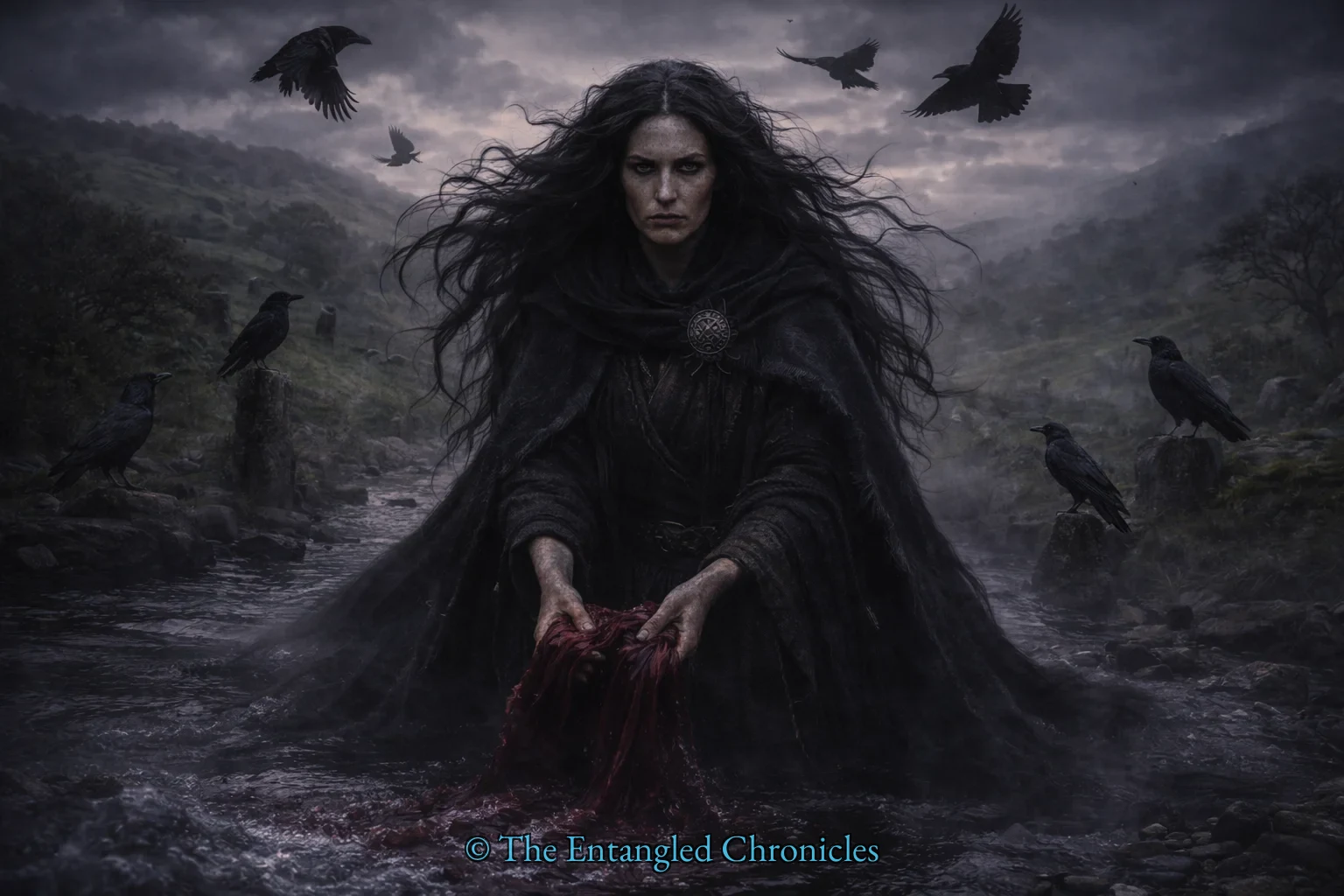
Etymology and Names
The name An Morrigan derives from Old Irish Morrígan, though its precise etymology remains debated among Celtic scholars. The most accepted interpretation breaks the name into mór + rígan: "great queen" or "phantom queen." The element mór carries dual meanings in Old Irish—it can signify "great" in the sense of power, size, or importance, but also connects to mórrígain, meaning "terror" or "nightmare." This linguistic ambiguity perfectly captures her nature: she is simultaneously the Great Queen who commands sovereignty and the Phantom Queen who haunts battlefields and dreams.
Alternative spellings across medieval Irish manuscripts—Morrígu, Mórrígan, Mór-Ríoghain—reflect scribal variations and grammatical cases rather than distinct entities. The definite article "An" (meaning "the") emphasises her uniqueness and importance; she is not merely "a" Morrigan but "The" Morrigan, singular and supreme in her domain. Some texts use "Anand" or "Anu" as alternative names, particularly when emphasising her sovereignty and life-giving aspects, creating connections to the earth goddess Danu and the Paps of Anu in County Kerry.
The names of her associated aspects or sisters—Badb ("crow," "scald-crow," or "battle"), Macha (possibly "plain" or connected to territorial sovereignty), and Nemain ("frenzy," "panic," or "battle fury")—each illuminate different facets of the war goddess's nature. These aren't always distinct beings but rather manifestations or aspects of a unified divine force, the boundaries between them remaining deliberately fluid in Irish mythological tradition. Some scholars argue for a triad of separate goddesses; others see them as faces of one complex deity. The Irish sources themselves refuse to resolve this ambiguity, suggesting ancient Irish understanding accepted both interpretations simultaneously.
One critical distinction requires emphasis: An Morrigan bears no etymological or mythological relationship to Morgan le Fay of Arthurian legend, despite centuries of confusion. The Welsh "Morgan" derives from *Mori-gena or *Morigenos, connecting to sea-related roots entirely distinct from the Irish goddess's name. Scholar Rosalind Clark definitively demonstrated that the superficial similarity in names represents pure coincidence—two unrelated traditions accidentally sharing similar-sounding words. The Irish sovereignty goddess and the Welsh enchantress developed in separate cultural contexts, and conflating them obscures the distinct characteristics of each tradition.
Regional variations in pronunciation and emphasis reflect Ireland's linguistic geography. In Munster, the name often appears as "Morríghan," while Ulster traditions favor "Morrígu." These variations don't signify different goddesses but rather demonstrate how oral tradition preserved the core concept while adapting to local dialect patterns. The consistency of her attributes across these regional variations—shapeshifting, battle prophecy, sovereignty connection—confirms the underlying unity despite surface linguistic diversity.
The Nature of An Morrigan
Irish tradition presents An Morrigan as defying simple categorization—neither wholly benevolent nor malevolent, but existing beyond human moral frameworks as something ancient, powerful, and fundamentally Other. Her name translates as "Great Queen" or "Phantom Queen," and both interpretations capture essential truths about her nature. She is great in power and influence, commanding respect and fear across Ireland. She is phantom in her ability to appear and vanish at will, to shift forms, to exist simultaneously in the mortal world and the Otherworld.
In contrast to later retellings that softened goddess figures, Irish sources present An Morrigan as embodying raw, primal forces: the chaos of battle, the inexorable march of fate, the sovereignty of the land itself. She doesn't comfort or console. She tests, challenges, and judges. To encounter her is to face something that operates entirely on its own terms, answering to no mortal authority and bound by no human understanding of justice or mercy.
Most commonly, she manifests as a crow or raven—the hooded crow particularly, with its grey and black plumage. This form connects her to death and prophecy, the carrion bird that haunts battlefields and sees what others cannot. But her shapeshifting abilities extend far beyond this single form. She appears as a beautiful woman offering love and sovereignty, as a hag washing bloodstained armor at a river ford, as an eel tripping warriors in combat, as a wolf driving cattle into stampede. Each form serves a purpose in her inscrutable designs.1
Irish sources consistently connect her across all forms to three intertwined concepts: war, fate, and sovereignty. According to Irish mythology, she doesn't merely observe battles—she shapes their outcomes. She doesn't simply foretell the future—she determines who lives and dies. In the deepest mythological sense, she doesn't just symbolize Ireland—she is Ireland, the land made animate and demanding.
Ancient Origins and the Life-Death Cycle
Archaeological evidence suggests An Morrigan's roots extend far deeper than medieval Irish texts indicate. Archaeological evidence points to worship of a bird goddess—featuring prominent breasts and crow or vulture characteristics—dating to the Copper Age around 3000 BC. Stone stelae across Spain, France, Portugal, and England display her eyes, her beak, sometimes her vulva, parts hidden and revealed as one examines the carvings. The earliest recorded mention of her name appears in texts from 750 BC, but scholars recognize these as transcriptions of much older oral traditions stretching back into Ireland's prehistoric past.
This ancient bird goddess embodied a crucial paradox: she was simultaneously goddess of death and goddess of life's renewal. Her breasts didn't merely nourish the living but also regenerated the dead, symbolizing the eternal cycle of birth, death, and rebirth that governed both human existence and the agricultural year. Two hills in County Kerry preserve this ancient symbolism—Dá Chích Anann, "the Paps of Anu," named for the breast-shaped peaks said to be formed by her body, nourishing the land itself.
Some modern interpretations focus primarily on An Morrigan's war goddess aspect, though this represents only part of her significance in Irish tradition. She encompasses fertility and barrenness, creation and destruction, birth and death. Her association with Macha connects her explicitly to childbirth and motherhood; her coupling with the Dagda at Samhain links her to agricultural abundance and the turning of seasons. She cannot be understood through war alone but must be recognized as a goddess of totality—the full cycle of existence from womb to tomb and back again.4
The Triple Goddess
Irish tradition frequently presents An Morrigan as a triple goddess, though the exact composition of this trinity varies across sources. Most commonly, she appears alongside Badb and Macha, sometimes with Nemain replacing one of these sisters. Some scholars interpret these as three distinct goddesses who are sisters; others view them as three aspects or manifestations of a single deity; still others see them as separate beings who nonetheless function as a unified force.2
Badb, whose name means "crow" or "scald-crow," embodies the terror and frenzy of battle. She flies over combat as a shrieking crow, her cries driving warriors to greater ferocity or paralyzing them with dread. Macha connects to sovereignty, kingship, and the land itself, with the ancient royal site of Emain Macha named in her honor. She also embodies the maternal and fertility aspects, linking childbirth to the cycles of creation and destruction. Nemain represents the psychological horror of warfare—panic, confusion, the breakdown of order when violence erupts. Her terrifying shriek could kill warriors outright; the Táin Bó Cúailnge records that one hundred men died of fright at her cry alone, their hearts stopping before a single blow was struck.5
Scholars interpret this triple nature as reflecting something fundamental about Irish cosmology: important spiritual forces manifest in threes, embodying completeness while acknowledging complexity. An Morrigan in her triple aspect can be in multiple places simultaneously, can embody contradictory qualities, can operate across different realms of influence. She is singular in identity yet multiple in manifestation—a paradox that medieval Irish tradition seemed entirely comfortable accepting.
War and Prophecy
An Morrigan's most famous role connects her to warfare and its outcome. She appears before, during, and after battles, her presence signaling which warriors are marked for death and which side will triumph. Medieval Irish texts describe her flying over combat as a crow, her shadow falling upon those destined to fall. Warriors learned to read these signs—the appearance of the crow, the washing woman at the ford, the wolf among the cattle—as omens requiring response.
But she does more than predict outcomes; she actively shapes them. She inspires courage in chosen warriors, strikes terror into enemies, creates confusion and chaos when it serves her purposes. The texts describe her "battle frenzy"—a supernatural state she could induce in fighters, making them capable of impossible feats while simultaneously blinding them to danger. This wasn't mere metaphor but described as actual divine intervention, the goddess reaching into mortal affairs to bend events toward her chosen resolution.
Her prophecies extended beyond individual battles to encompass the fate of kingdoms and peoples. The most famous of these appears at the end of the Second Battle of Mag Tuired, where she delivers a verse foretelling both blessing and doom for Ireland—prosperity and peace, but also the eventual end of the world. This dual prophecy captures her essential nature: she offers no false comfort, no promises of eternal victory or happiness, but rather the hard truth that all things rise and fall, prosper and perish.
The Second Battle of Mag Tuired
One of An Morrigan's most significant appearances occurs before the Second Battle of Mag Tuired, when the Tuatha Dé Danann faced their greatest test against the monstrous Fomorians. The Dagda, father-god and champion of his people, sought her out for prophecy and aid. He found her at the River Unius in Connacht, straddling the river with one foot on each bank—a posture emphasizing her liminal nature, her existence between categories and worlds.
Their coupling at this threshold moment—between peace and war, between the old year and new (for it occurred at Samhain)—sealed the alliance between masculine and feminine divine principles. She prophesied victory for the Tuatha Dé Danann but warned that triumph would come at terrible cost, drenched in blood and requiring sacrifice. True to her word, she fought in the battle itself, using magic and fury to help secure victory against seemingly impossible odds.
The battle's aftermath produced her most famous prophecy, delivered in verse that captured both blessing and doom. She foretold prosperity and peace for Ireland, abundance and good harvests—but also the eventual end of all things, the world's destruction in fire and flood, the final unraveling of the cosmic order. This prophecy encapsulates her essential nature: she offers no false comfort, no promises of eternal happiness, but rather the hard truth that all things rise and fall, that victory and defeat dance in eternal cycle, that even gods and worlds must eventually pass away.
Sovereignty and the Land
Perhaps An Morrigan's deepest significance lies in her connection to sovereignty—the concept of rightful rule and the mystic bond between king and land. In Irish tradition, a king didn't simply inherit authority through lineage; he had to be accepted by the land itself, personified as a goddess. An Morrigan serves as one manifestation of this sovereignty goddess, testing kings and heroes to determine their worthiness.
The pattern appears repeatedly: she approaches a warrior or king, often in the form of a beautiful woman, offering love and sovereignty. If he accepts her appropriately—recognizing her true nature, treating her with proper respect—he gains her favor and with it, success in battle and legitimate rule. If he rejects her, as Cú Chulainn famously did, she becomes his nemesis, working to ensure his downfall.3
This isn't petty vengeance but rather the working out of a fundamental principle: those who would rule Ireland must accept Ireland on its own terms, including its fierce, uncompromising, sometimes terrifying aspects. An Morrigan doesn't offer sovereignty to the merely ambitious or strong, but to those who can embrace the full reality of what they seek to rule—the blood-soaked earth, the hard winters, the constant struggle for survival that characterized ancient Irish life.
Her most significant coupling occurs with the Dagda, the "Good God" and father figure of the Tuatha Dé Danann. Their union at Samhain symbolizes the joining of male and female principles, the seasonal cycle of death and renewal, the necessity of embracing both light and dark aspects of existence. From this coupling comes the promise of victory in the coming battle, prosperity for the land, but also the acknowledgment of cycles—what is won will eventually be lost, what dies will be reborn.
Sacred Sites and the Otherworld
An Morrigan's connection to specific Irish locations reveals her nature as a territorial deity, bound to the land itself rather than existing as an abstract concept. The most significant of these sites is Oweynagat, the Cave of Cats, near Cruachán in County Roscommon. Irish tradition identifies this cave as one of the entrances to the Otherworld, and particularly as An Morrigan's dwelling place.
Every Samhain, when the veil between worlds grows thinnest, the cave supposedly releases supernatural beings into Ireland—and An Morrigan emerges to meet with the Dagda at the nearby River Unius. This liminal moment, between summer and winter, between the old year and new, between worlds, aligns with her nature in Irish tradition as existing between categories. She is neither fully of the mortal world nor entirely Otherworldly, but rather moves freely between both realms.
Other sites preserve her memory across Ireland: places named for Badb and Macha, battlefields where she appeared, rivers where she was seen washing armor and weapons. Boa Island in County Fermanagh takes its name from Badb, while Armagh town itself means "Macha's height." Two hills in County Armagh bear the name Dá Chích na Morrigna—"the two breasts of the Morrigan"—echoing the Kerry peaks and emphasizing her embodiment of the land's fertility. In County Louth, a field called Gort na Morrighan preserves the tradition that the Dagda himself gifted this land to her after their coupling.
Irish tradition preserves these geographic connections in place names, folklore collections, and local accounts. Folk belief holds that the land remembers; Irish tradition maintains the stories are written into geography itself; certain places are believed to remain charged with supernatural significance because of what occurred there in mythic time. To walk these sites today is to walk where the veil remains thinner, where the goddess's presence can still be felt by those attuned to such things.
The Tale of Cú Chulainn
The most detailed account of An Morrigan's interaction with a mortal hero appears in the Ulster Cycle, particularly the Táin Bó Cúailnge. Here she encounters Cú Chulainn, Ulster's greatest champion, as he single-handedly defends his province against the armies of Queen Medb.
She first approaches him as a beautiful young woman, offering her love and assistance in battle. Cú Chulainn, focused entirely on combat and unaware of her true identity, rejects her advances brusquely. Irish tradition presents this rejection as triggering her transformation from potential ally to active adversary—interpreted by scholars as not merely wounded pride, but as his failure of a fundamental test. He cannot recognize the divine when it stands before him; he cannot accept what is offered on terms other than his own.
She attacks him during his next battle, first as an eel that trips him in the river ford, then as a wolf that stampedes cattle toward him, finally as a red heifer leading the herd. Each time, Cú Chulainn manages to wound her while still fighting his human opponents, demonstrating his prowess but also compounding his offense. He has now not only rejected the sovereignty goddess but injured her in three forms.
Later, she appears as an old woman milking a cow, bearing the three wounds he inflicted. When Cú Chulainn blesses her three times in exchange for drinks of milk, he unknowingly heals her—and binds himself to the fate she has chosen for him. This interaction demonstrates her nature as both vengeful and bound by certain rules: once the proper forms are observed, once respect is finally shown, even if unknowingly, the relationship shifts again.
The tale concludes with Cú Chulainn's death, and An Morrigan settles on his shoulder in crow form as he dies standing, tied to a pillar stone, still facing his enemies. The tale concludes with An Morrigan in crow form settling on Cú Chulainn's shoulder as he dies standing, tied to a pillar stone.
An Morrigan in Later Tradition
As Christianity gradually displaced older religious practices in Ireland, An Morrigan's nature evolved in folk memory. She became associated with the banshee—the wailing woman whose cries foretell death in certain families. The connection appears logical within Irish tradition: both serve as death omens, both are portrayed as existing between worlds, both manifest the ancient Irish understanding that death deserves acknowledgment and respect rather than simple fear or denial.
The figure of the bean nighe or washer at the ford preserves another aspect of her mythology. This supernatural woman, seen washing bloodstained armor and clothing at rivers and fords, announces approaching death. Those who encounter her and show proper respect may receive prophecy or warning; those who respond with disrespect or violence ensure their own doom. The parallels to An Morrigan's role as battle prophet and fate-determiner remain clear.
In modern Ireland and the broader Celtic diaspora, An Morrigan has experienced a remarkable revival. Contemporary pagans and druids honor her as a goddess of war, transformation, and female power. Feminist scholars and artists reclaim her as a figure of female sovereignty and agency, rejecting centuries of attempts to domesticate or demonize her. The Cave of Cats has become a pilgrimage site again, with visitors leaving offerings and seeking connection to the ancient goddess.
Contemporary pagans and druids cite her associations with war, transformation, sovereignty, and female power in their worship practices. In an age that often demands softening sharp edges and making everything palatable, she remains fierce, demanding, and utterly herself. Contemporary pagans and feminists interpret her as representing the possibility of power that doesn't apologize, of feminine divinity that needs no male approval, of spiritual force that operates beyond human moral categories.
An Morrigan is not historically related to Morgan le Fay of Arthurian legend, despite superficial similarities that have led to modern conflation. The Morrígan is an ancient Irish goddess, while Morgan le Fay is a medieval literary character from Welsh/Breton tradition. Scholars like Rosalind Clark have demonstrated that the names derive from entirely different linguistic roots...Morgan le Fay of Arthurian legend, despite superficial similarities in name and magical abilities. Scholars like Rosalind Clark have demonstrated that the names derive from entirely different linguistic roots—Welsh "Morgan" connects to sea-related words, while Irish "Morrígan" stems from concepts of terror or greatness. The coincidental resemblance has led to centuries of conflation, but the Irish sovereignty goddess and the Welsh enchantress represent distinct mythological traditions that should not be merged.
Notes & Variations
Sources & Further Reading
- Gregory, Lady Augusta – Gods and Fighting Men (1904)
- Hennessy, W.M. – The Ancient Irish Goddess of War (1870)
- Ó hÓgáin, Dáithí – The Lore of Ireland: An Encyclopedia of Myth, Legend and Romance (2006)
- MacKillop, James – Dictionary of Celtic Mythology (1998)
- Clark, Rosalind – The Great Queens: Irish Goddesses from the Morrígan to Cathleen Ní Houlihan (1991)
- Gantz, Jeffrey (translator) – Early Irish Myths and Sagas (1981)
- Kinsella, Thomas (translator) – The Táin (1969)
- CELT: Corpus of Electronic Texts (University College Cork) – Primary source materials