Etymology and Names
The name Púca derives from Old Irish púca, a term with deep roots in Celtic linguistic tradition. The word likely connects to the early Irish poc, meaning "he-goat," which explains the creature's strong association with goat forms in certain regions, particularly Kerry's Puck Fair tradition. This etymological link between the shapeshifter and the goat reflects the animal's liminal status in Irish culture—neither fully wild nor fully domesticated, neither purely helpful nor purely destructive.
The English "Puck"—as in Shakespeare's mischievous sprite from A Midsummer Night's Dream—derives from the same Celtic root, carried to Britain through cultural exchange and preserved in Middle English as "pouke" or "pook." This linguistic journey suggests how the Irish Púca's influence extended beyond Ireland, likely influencing English fairy traditions about shapeshifting tricksters. Shakespeare's Puck, with his pranks and transformations, his service to the fairy king yet his fondness for mortals, echoes the Irish original's complex moral character.
Regional variations in spelling reflect the name's journey through Irish dialects and anglicisation. "Pooka," "Phouka," "Pwca" (in Welsh), and "Bucca" (in Cornish) all represent the same basic concept—a supernatural shapeshifter associated with liminal times and places. The consistency of the core sound across Celtic languages may suggest an ancient, shared tradition predating the linguistic fragmentation of the Celtic peoples. Some scholars note intriguing parallels with Old Norse púki, referring to a mischievous nature spirit, raising questions about possible cultural exchange during the Viking period or even deeper Indo-European linguistic roots.
The Púca's various spellings in Irish sources—púca, phúca (lenited form), and occasionally púcán (diminutive)—follow standard Irish grammatical patterns, with the initial consonant changing based on grammatical context. This linguistic flexibility mirrors the creature's shapeshifting nature, the name itself transforming according to its syntactic environment just as the being transforms according to its needs and whims.
The Nature of the Púca
Irish folklore portrays the Púca as both helpful and harmful. Sources describe it helping farmers with their harvest one night and leading travelers on wild rides the next. The creature appears consistently in folklore accounts across centuries as neither wholly benevolent nor malevolent.
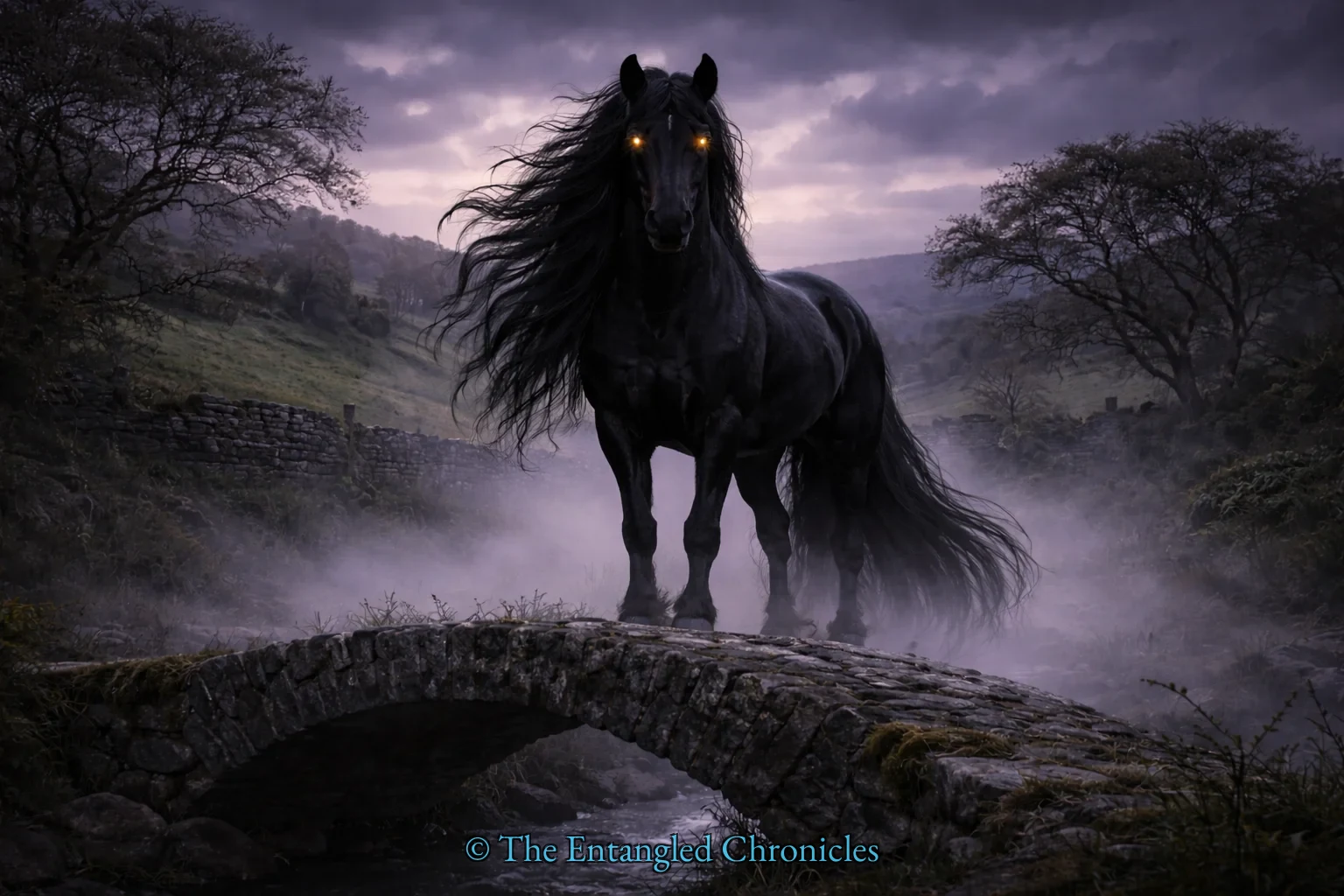
Shapeshifting forms the core of the Púca's identity. Most commonly, it manifests as a sleek black horse with wild mane and blazing golden eyes that reflect like fire in moonlight.1 But the Púca's repertoire extends far beyond this single form—goat, rabbit, enormous dog, raging bull, eagle with vast wingspan, even humanoid figures that retain unsettling animal characteristics like tails, hooves, or pointed ears. Regardless of form, certain features persist: jet-black colouring, those distinctive golden or crimson eyes, and most remarkably, the power of human speech.
This ability to communicate sets the Púca apart from mere beasts. Old traditions speak of people seeking counsel from the Púca at hilltops and high places, receiving prophecies and advice that proved uncannily accurate. The creature loves conversation, "shooting the breeze" as some accounts describe it, though its words often carry double meanings and its truths arrive wrapped in riddles. The Púca's ability to speak while in animal form appears consistently in Irish folklore accounts.
Yet for all its supernatural power, the Púca shares a common vulnerability with other fairy folk: cold iron. Silver spurs, iron bridles, and other sharp metal implements can control or repel the creature, offering humans a rare defence against its mischief. This weakness to cold iron appears consistently across regional accounts throughout Ireland.
Regional Variations Across Ireland
Ireland's provinces each developed their own understanding of the Púca, creating a tapestry of local traditions that reveals how communities adapted the folklore to their particular landscape and needs.
Leinster, particularly around Dublin and Wicklow, knew the Púca as a mischievous night-rider. Here, the creature would appear as a black horse at twilight, inviting the unwary—especially those leaving pubs after too much drink—onto its back. What followed was a wild ride through the darkness, the Púca leaping impossible obstacles, racing through thorny hedgerows, defying all natural laws of motion. Come grey dawn, the rider would find themselves deposited miles from home, disheveled and trembling but physically unharmed.2
Ulster traditions paint a darker picture. Here, the Púca emerged as harbinger rather than trickster, its appearance presaging misfortune or significant change. The creature's prophetic aspect intensified in these northern counties, where encounters carried weight and consequence.
In Munster and Kerry, the Púca's agricultural significance emerges strongly. Farmers left portions of their harvest after Samhain as "the Púca's share," believing this offering ensured the creature's benevolence for the coming year.3 The he-goat form appears most prominently in these regions, with Kerry's annual Puck Fair celebrating this association in a tradition that survives to modern times.
Waterford and Wexford knew the Púca in its aerial form—a massive eagle with wingspan vast enough to cast shadows across entire valleys. W.B. Yeats immortalized this regional variant in verse, capturing the creature's connection to high places and storm winds. Here, the Púca ruled the skies rather than the roads, a harbinger glimpsed against grey clouds before significant weather changes.
In Donegal's northern reaches, locals recognised the Púca's mark on the landscape itself. Certain mushrooms appearing overnight were called "Púca-piles," fairy rings the creature had laid during its nocturnal wanderings. An account from 1911 records an old woman explaining: "They're what you call Púca-piles. They say the Púca lays them!" This connection to fungal growth—itself a liminal form of life, neither plant nor animal—reinforced the creature's association with transformation and the boundaries between natural categories.
Samhain and the Thin Veil
The Púca's strongest association connects to Samhain, the ancient Celtic festival marking summer's end and winter's beginning. During this liminal period—the crack between seasons when one year dies and another is born—the veil between worlds grows thinnest, and the Púca's power intensifies.
November 1st belonged to the Púca as its feast day. After this date, any crops remaining in fields were considered "puka"—touched by fairies and dangerous to harvest. Blackberries, abundant in Irish hedgerows, became taboo after Samhain, as folk belief held that the Púca had spat upon them, rendering them poisonous.4 This wasn't mere superstition but practical wisdom ensuring communities completed harvests before winter's arrival.
The Legend of Brian Boru
Only one human, according to Irish legend, ever successfully mastered a Púca: Brian Boru, the High King who defeated the Vikings at Clontarf in 1014. The tale speaks to both the creature's power and the extraordinary nature required to control it.
Brian Boru, through unknown means, acquired three hairs from a Púca's tail. From these he wove an eldritch bridle—a magical object that gave him power over the creature. Mounting the Púca in horse form, the king rode it relentlessly until the creature collapsed from exhaustion. Even then, Brian refused to dismount, maintaining his dominance until the Púca made solemn promises: never again to torment Christians, and to do no harm to any Irishman unless that person was drunk or engaged in mischief.5
The legend establishes the terms of the Púca's promise to Brian Boru: the creature would harm no Irish Christians except those who were drunk or engaged in mischief. The tale emphasizes the king's exceptional status—only Ireland's High King possessed the power to master such a creature.
The Púca in Modern Ireland
Remarkably, the Púca survives in Irish consciousness beyond historical curiosity. The Puck Fair continues as an annual celebration in Killorglin, County Kerry. Place names throughout Ireland preserve the creature's memory—Poul-a-phooka in Wicklow, multiple Carraig phookas (Pooka's rocks) in Cork, Clochán a Phúca on the Aran Islands.
Contemporary accounts still surface occasionally, usually describing encounters with humanoid figures bearing animal characteristics—goat-headed beings glimpsed in mountain passes, fox-eared creatures seen at twilight. Contemporary accounts continue to surface in Ireland, with witnesses describing humanoid figures bearing animal characteristics in remote areas. The Púca remains present in Irish cultural consciousness through place names, annual festivals, and ongoing folklore tradition.
Notes & Variations
Sources & Further Reading
- Yeats, W.B. – Fairy and Folk Tales of the Irish Peasantry (1888)
- Wilde, Lady Jane – Ancient Legends, Mystic Charms & Superstitions of Ireland (1888)
- Ó hÓgáin, Dáithí – The Lore of Ireland: An Encyclopedia of Myth, Legend and Romance (2006)
- MacKillop, James – Dictionary of Celtic Mythology (1998)
- Rolleston, T.W. – Celtic Myths and Legends (1911)
- IrishMyths.com – Comprehensive digital resource for Celtic folklore
- CELT: Corpus of Electronic Texts (University College Cork) – Primary source materials