The Name and What It Means
The name tine sídhe means "fire of the sídhe" — the otherworldly fire, the fairy fire, the flame that belongs not to the human world but to whatever exists alongside it. Tine is the Irish word for fire; sídhe refers to the fairy mounds, the ancient burial places understood in Irish tradition as gateways to the Otherworld, and by extension to the beings who inhabit them.
The more common Irish term in older recorded usage is tine ghealáin — "flashing fire" or "flash of fire" — which reflects the quality of the lights as they appear: sudden, cold, sourceless, gone before you can be sure you saw them. Seán na Gealaí (Jack of the Moon) is another traditional Irish name, connecting to the same folkloric figure that gave rise to the English "jack-o'-lantern" — originally not a carved pumpkin but a wandering light over a bog, the spirit of a man condemned to walk between worlds carrying an ember he could never warm himself with.1
In English these lights are known as will-o'-the-wisp — "Will with the wisp," Will carrying a bundle of straw alight — and as ignis fatuus in Latin, meaning "foolish fire." The Latin name makes a moral judgment: the fire is foolish because it leads the foolish. Irish tradition is less interested in judging the light than in being absolutely clear about what happens to those who follow it.
The Folklore
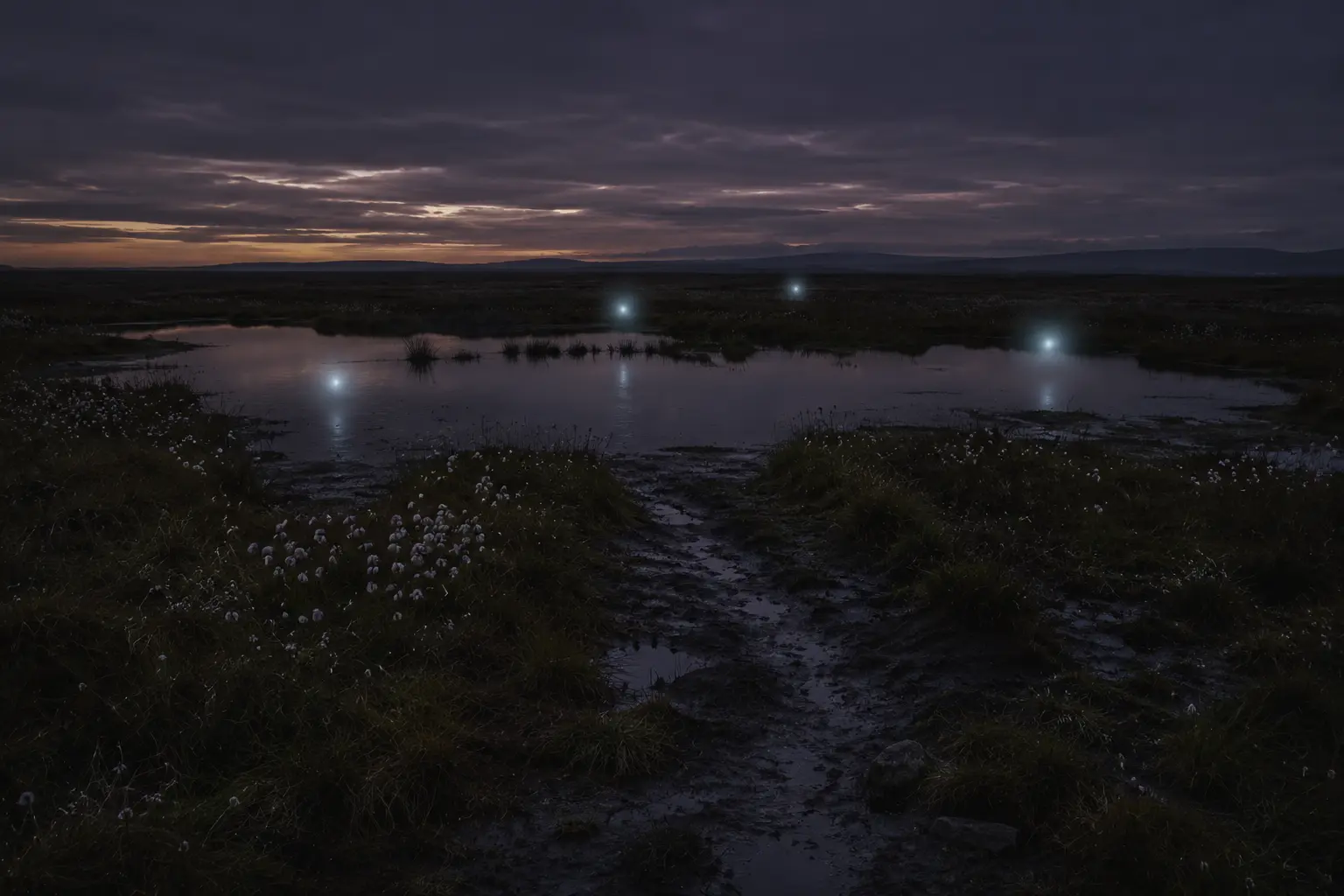
The tradition of following mysterious lights to one's doom is older than recorded history in Ireland. The lights appear at dusk over lakes, bogs, and marshland — cold points of light, drifting without wind. They do not actively pursue. They simply move, and human curiosity does the rest.
The old advice was consistent across regions and centuries: do not follow the lights. When they appear over water, they are especially dangerous — the bog between you and them is not solid, not safe, and the lights have no interest in whether you get there or not. They are not hunting you. They do not need to be hunting you to destroy you.
Lady Gregory, collecting folklore in Connacht at the turn of the twentieth century, recorded multiple accounts of people who had encountered the lights and survived by refusing to follow — by throwing themselves face-down on the ground, by reciting prayers, by turning their coats inside out (a traditional confusion tactic against fairy influence), by some instinct that held them back from the water's edge. The accounts that do not survive, by their nature, were not recorded.
Why They Appear
Irish tradition offers several explanations, none of which cancel each other out. They are the mischief of the sídhe — fairy beings using light to lure travelers off safe paths and into bogland. They are the souls of unbaptised children, denied heaven but not condemned to hell, wandering in between. They are the spirits of people who in life were neither good enough for one destination nor bad enough for the other — caught, as the bog itself is caught, between solid and liquid, between one thing and another.2
All of these explanations share an understanding that the lights exist in a liminal category. They are not living, not dead. They are not natural, not entirely supernatural. They belong to the spaces between — the dusk, the bog, the edge of the water — and their appearance signals that the boundary between the ordinary world and whatever lies beyond it has, for a moment, become permeable.
The scientific explanation — that the lights may be produced by methane and diphosphane gases rising from decomposing organic matter in peatland, spontaneously igniting on contact with oxygen — was unknown to those who encountered them. Some researchers still debate whether this mechanism can reliably produce the sustained, drifting lights described in the accounts. What the people who saw the lights knew was simpler: they appeared, they moved, and people who followed them did not come back.
Threshold Times and Places
Like most phenomena in Irish supernatural tradition, the fairy lights are strongest at liminal moments. Dusk and dawn, when the day is neither one thing nor another. The turn of the tide. The eves of the great seasonal festivals — Samhain especially, when the lights appear most frequently, when the nights have lengthened and the veil between worlds is at its thinnest.
The bogland itself is a liminal landscape. It is neither water nor dry land; it looks solid and is not; it preserves what falls into it without ever quite letting it go. The great Irish bogs of the midlands and west — Ballycumber, Clonmacnoise, the Bog of Allen — were understood as places where the ordinary rules of the world did not reliably apply. The Tuatha Dé Danann retreated into the earth after their defeat; the bogs, with their strange preservation of the ancient and their hostility to the living, were precisely the kind of landscape where such beings might linger.3
Folk tradition across all four provinces records the lights with particular intensity along the western seaboard and in the midland boglands — not because they appeared only there, but because those landscapes made them most visible and their danger most legible. In the cities, the lights have nowhere to lead you. In the boglands, they have everything.
The Same Light Elsewhere
The lights appear in the traditions of nearly every culture that has lived near bogland, marsh, or standing water. In Wales, the light was carried by a pwca — the Welsh cousin of the Irish Púca — a small goblin-like being that led travelers off paths and extinguished the flame once they were lost. In Germany, the lights are Irrlicht — will-lights, error-lights, the fire that leads you wrong. In Sweden, irrbloss; in the Netherlands, dwaallicht (wandering light). In Latin, ignis fatuus — foolish fire. In French, feu follet — mad fire.
The universality of the phenomenon across cultures that developed their explanations independently of each other suggests two things: that the lights are real, in the sense of being a genuine observable phenomenon; and that the human response to them — wariness, story, the building of a tradition that says do not follow — is also universal. The folklore is not decoration. It is instruction, preserved across generations because the instruction needed preserving.
Notes & Variations
Sources & Further Reading
- Gregory, Lady Augusta – Visions and Beliefs in the West of Ireland (1920)
- Yeats, W.B. – Fairy and Folk Tales of the Irish Peasantry (1888)
- Wilde, Lady Jane – Ancient Legends, Mystic Charms and Superstitions of Ireland (1887)
- Ó hÓgáin, Dáithí – The Lore of Ireland: An Encyclopedia of Myth, Legend and Romance (2006)
- MacKillop, James – Dictionary of Celtic Mythology (1998)
- CELT: Corpus of Electronic Texts (University College Cork) – Primary source materials