The Changing Face of the Firedrake: Forms Through Time
The firedrake did not spring fully formed from ancient imagination. Like all mythological creatures that endure across centuries, it evolved—shaped by cultural contact, religious transformation, and the endless human need to make monsters comprehensible. What began as a limbless serpent of the pre-Christian North transformed gradually into the four-legged, winged dragon familiar to modern fantasy. Understanding this evolution is essential to understanding the creature itself.
Pre-Christian Era (Before ~800 AD): The Primordial Serpent
In its earliest form, the firedrake was not fire-breathing at all. Germanic peoples knew it as ormr—simply "worm" or "serpent"—a massive, limbless creature more snake than dragon. These ancient terrors breathed not flame but atter: a poisonous, venomous miasma that could kill at a distance. The Nine Herbs Charm, an Anglo-Saxon medical text, describes protective magic against the "flying venom" of wyrms, emphasizing poison rather than fire as the primary threat.1
Archaeological evidence supports this serpentine form. Viking Age runestones depicting dragons show long, sinuous bodies with no legs, no wings—pure serpent scaled to monstrous proportions. Jörmungandr, the World Serpent encircling Midgard, represents this primordial form perfected: endless coils, crushing strength, venomous breath capable of poisoning the sky itself during Ragnarök.
Viking Age (800-1100 AD): The Linnorm Emerges
As Norse culture flourished, the linnormr (ensnaring serpent) developed as a distinct type. Most remained limbless, but some accounts begin describing powerful forelegs tipped with curved talons—though never hind legs, leaving the creature to drag its serpentine bulk across stone. This two-legged form appears in some runestone carvings and later became formalized in Scandinavian heraldry as the "lindworm."2
The Viking Age also produced the flogdrake (Swedish: "fly-dragon"), a uniquely Scandinavian variant that defied conventional dragon anatomy. The flogdrake possessed neither wings nor legs yet flew through the night sky as a streak of fire or golden light, resembling a shooting star or meteor. When not soaring overhead, these creatures burrowed deep into mountains, creating drakarör ("dragon tubes")—long tunnels where they dwelled and hoarded treasure.3
Fire-breathing began appearing during this period, though venomous breath remained common. The sagas describe Fáfnir—the dwarf transformed into dragon—as having breath so foul it could kill, though whether from poison, fire, or both varies by source. The Völsunga Saga and Poetic Edda present Fáfnir as fundamentally serpentine, though with suggestions of shoulders or limbs in some passages.
Some accounts describe linnorms with a terrifying defensive ability: swallowing their own tail and rolling like a wheel at tremendous speed, crushing anything in their path—a form that made them nearly impossible to evade in narrow mountain passes.
Medieval Christian Influence (1100-1400 AD): Wings and Legs Appear
Christianization brought dragons into contact with continental European traditions, where the Latin draco—a four-legged, often winged creature—had become standard religious iconography. The Old Norse word dreki, borrowed from this Latin root, began replacing older terms. With the new word came new anatomy.
Níðhöggr, the ancient root-gnawing serpent, gained wings and feathers in later versions of the Völuspá, likely reflecting Christian apocalyptic imagery. This creature dwells at the roots of Yggdrasil in Niflheim, gnawing at the World Tree while feasting on the corpses of oath-breakers, adulterers, and murderers—one of the few beings prophesied to survive Ragnarök. The German Nibelungenlied (circa 1200) describes its dragon as a lintrache ("lin-drake" or lindworm) but with features suggesting a more complex body structure than pure serpent. Four-legged dragons with bat-like wings began appearing in church carvings and manuscript illuminations throughout Scandinavia.
Fire-breathing became the dominant characteristic during this period, perhaps influenced by biblical dragons and Christian hellfire imagery. Poison breath didn't disappear—many accounts mention both—but flame became the primary terror associated with dragons.
Late Medieval & Early Modern (1400-1700 AD): Regional Variations Persist
Despite standardization in church art and learned texts, folk traditions preserved older forms. Rural Scandinavians continued reporting encounters with limbless serpents in remote forests and mountains. The Norwegian term lindorm and Swedish lindorm could refer to any serpentine dragon, from pure snake-form to four-legged beast, depending on the teller and the tale.
Olaus Magnus's Historia de Gentibus Septentrionalibus (1555) attempted to document Norwegian and Swedish dragons as natural history, describing massive sea serpents off Bergen's coast alongside land-dwelling treasure guardians. His illustrations show variety: some wingless and serpentine, others with legs and wings, suggesting the forms coexisted in contemporary belief.4
Heraldry formalized specific types: the lindworm in British and German heraldry became strictly defined as wingless with two forelegs and serpentine body, while the four-legged dragon was a separate category. Scandinavian heraldry adopted similar distinctions.
Modern Folklore & Literary Revival (1700-Present): Memory and Reinvention
Remarkably, belief in literal lindorms persisted in parts of Sweden into the late 19th century. Folklorist Gunnar Olof Hyltén-Cavallius collected eyewitness accounts from Småland residents who claimed to have seen giant serpents, sometimes with flowing manes of coarse hair. His 1884 offer of a substantial reward for a captured specimen (dead or alive) attracted attention but no dragons, and the tradition rapidly faded under scientific scrutiny.5
The 20th century saw literary resurrection. J.R.R. Tolkien's Smaug (1937) drew directly from Fáfnir's legend, synthesizing the four-legged, winged, fire-breathing form with the psychological corruption of dragon-sickness. This literary version—powerful, intelligent, malevolent—became the template for modern fantasy dragons, overshadowing the older serpentine forms in popular consciousness.
Today, the term "firedrake" in fantasy literature typically means a four-legged, winged, fire-breathing dragon, while the original limbless ormr is largely forgotten outside academic circles. The flogdrake—the flying streak of light—survives mainly in Finnish folklore (as lohikäärme) and obscure Swedish sources.
What we call "the firedrake" is therefore not one creature but many—a shape-shifting concept that adapted to each culture's needs and fears. The following descriptions draw primarily from Viking Age and early medieval sources, presenting the linnorm in its most common Scandinavian forms while acknowledging the variations that emerged across centuries of belief and telling.
Physical Description: The Many Forms
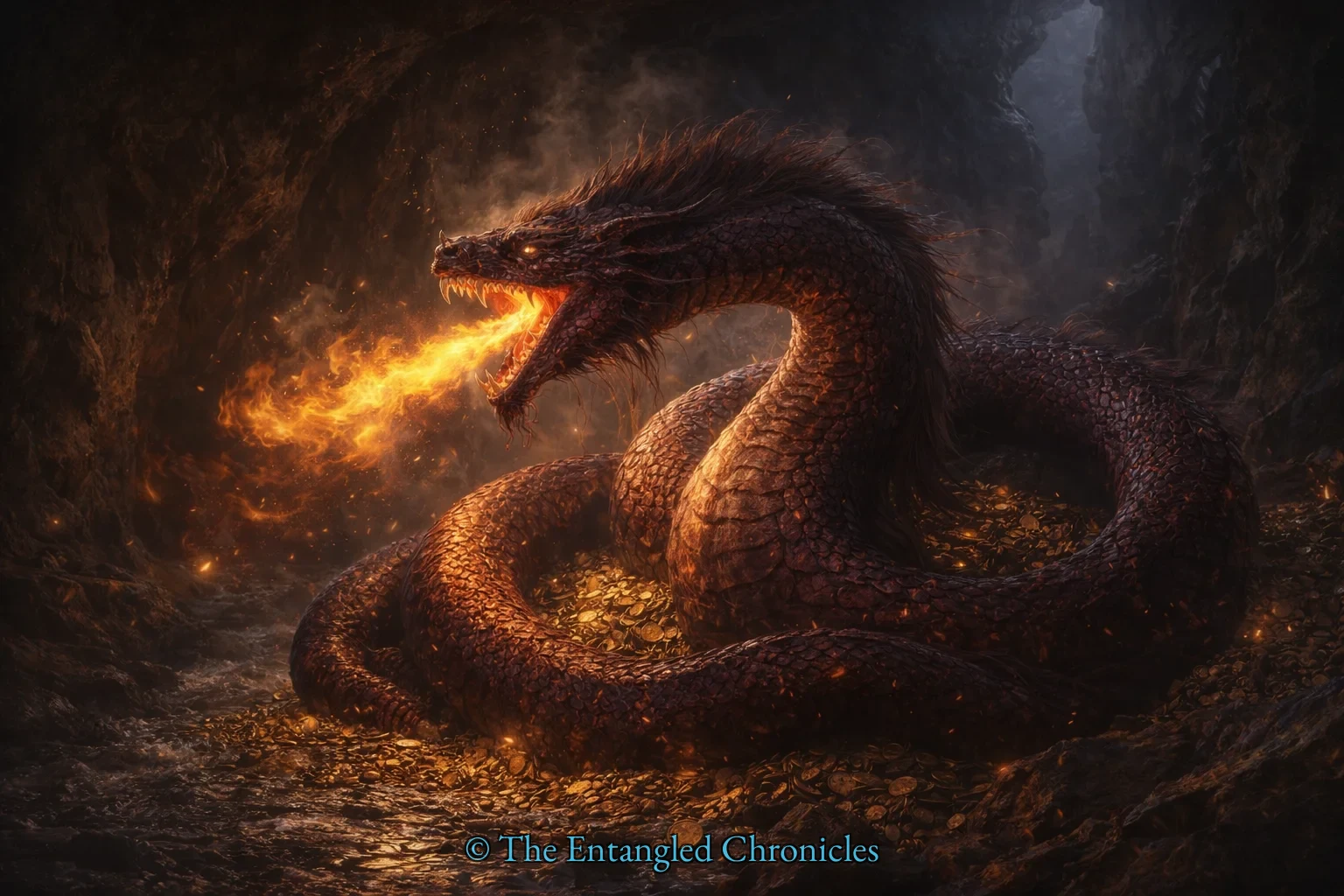
The most common Scandinavian firedrakes were completely limbless serpents—massive creatures thirty to sixty feet in length, with bodies as thick as ancient oak trunks. They moved through pure serpentine undulation, their tremendous muscular power allowing them to crush prey or drag their bulk across mountain stone with terrifying speed. Covered in overlapping scales that gleamed like molten metal—sometimes black as volcanic glass, sometimes deep crimson or rust-red—these creatures embodied serpent nature perfected to monstrous scale.
Many accounts emphasize a distinctive mane of coarse, horse-like hair running from skull down spine—not soft or flowing, but bristling and sharp like iron wire. This feature appears consistently across regional descriptions, suggesting it served some biological or magical purpose. Practical theories propose heat dissipation, as the dragon's internal fire would require venting like a bellows, or sensory capability, detecting vibrations through stone to hunt in lightless caves. Symbolic interpretations see the horse-like mane as a bridge between reptile and mammal—the dragon as a perversion of natural order, possessing features that shouldn't coexist in a single creature.
A secondary form, particularly noted in later Viking Age accounts and formalized in heraldry, possessed powerful forelegs tipped with curved talons like those of eagles. These bipedal linnorms still lacked hind legs, dragging their serpentine bulk across ground using muscular undulation aided by the foreclaws. This form became the standardized "lindworm" of European heraldry—wingless, two-legged, serpentine.
The head structure remained consistent across variations: broad and dragon-like with a wide mouth full of recurved teeth, glowing eyes that burned like coals in darkness—amber, crimson, or baleful yellow—and small horns or bony ridges protecting the skull. Some accounts describe frills or spines around the head and neck, giving the creature an even more formidable appearance when roused to fury.
What truly defined the firedrake across all its forms was neither limbs nor wings but breath. In earliest accounts, this was atter—poison or venom that could kill at a distance, a foul miasma that rotted flesh and corrupted blood. Later traditions shifted emphasis to elemental fire: torrents of flame pouring forth as naturally as exhalation, not mere heat but fire itself made manifest. Some sources describe both—poison and flame combined in breath so foul it ignited the very air.6
The Flogdrake: Fire Across the Sky
Among all firedrake variants, the flogdrake stands most apart from conventional dragon anatomy. This uniquely Scandinavian creature possessed neither legs nor wings, yet it flew—not through mechanical means but as if embodying fire itself, soaring across night skies as a streak of brilliant golden light.
Witnesses described the flogdrake as resembling a shooting star or meteor, but moving with clear purpose rather than falling—crossing the heavens horizontally, sometimes circling mountain peaks, occasionally diving toward earth before vanishing into cave entrances. Within the streak of fire and light, observers sometimes glimpsed hints of serpentine form: a dragon's head, the suggestion of coils, all composed of pure flame rather than flesh.
When not soaring through darkness, flogdrakes dwelled in drakarör—"dragon tubes"—long tunnels they burrowed deep into mountains through means unexplained by natural geology. These tunnels often connected to massive chambers where treasure hoards accumulated, the gold multiplying through the same magical property that affected all firedrake-brooded wealth: "That which lies under a linnorm will grow at the rate of the snake."7
The flogdrake's flight without wings suggests it existed partly outside physical law, a creature as much magical phenomenon as biological entity. Some scholars theorize it represented a transitional form—a firedrake in the process of becoming pure elemental fire, shedding physical body entirely. Others argue it was always a different species, related to but distinct from ground-dwelling linnorms, perhaps the result of treasure-corruption taken to its ultimate extreme.
Treasure, Corruption, and the Nature of Greed
The firedrake's relationship with treasure transcends mere guarding. Old Scandinavian wisdom holds: "That which lies under a linnorm will grow at the rate of the snake." Gold brooded upon by a firedrake multiplies, expanding with the creature's growth, creating hoards of impossible vastness. But this proliferation comes with a curse—the treasure becomes corrupted, infused with the creature's essence, carrying the seed of the same transformation that created the firedrake itself.
This connection between dragon and hoard represents something deeper than protection or avarice. The creature does not guard treasure so much as become inseparable from it, existing in a symbiotic relationship where the gold shapes the dragon as much as the dragon shapes the gold. In mountain caves throughout Norway where these beings lair, the very stone grows warm from proximity to their treasure-warped forms, creating an environment that feels fundamentally wrong—mineral-damp air thick with ancient smoke, the weight of accumulated greed making each breath labored.
To claim firedrake treasure is to invite the corruption that created the guardian. The gold carries transformation in its very substance, passing from hoard to holder like a disease—subtle at first, then consuming, until the new possessor finds themselves isolated, suspicious, hoarding what was taken, becoming in spirit if not body what the firedrake already is in flesh.
The Transformation of Fáfnir
The most famous account of firedrake transformation comes from the Völsunga Saga, preserved in 13th century Iceland but recounting far older Norse traditions. Fáfnir began not as a monster but as a dwarf, son of the wealthy king Hreiðmarr—a being of craft and cunning, not serpentine terror. When the gods Odin and Loki killed Fáfnir's brother Otr—mistaking the shapeshifting otter for prey—they paid compensation: enough gold to fill and cover the otter's skin so no fur remained visible.8
This was no ordinary gold. The hoard had been taken from the dwarf Andvari, who placed upon it a terrible curse before surrender. Fáfnir, gazing upon the gleaming pile, felt something awaken within him—a hunger that went beyond desire into obsession. He murdered his father, seized the treasure, and fled into the Gnitaheiðr, the glittering heath where mountains meet dark forest.
There, brooding upon his stolen hoard, Fáfnir underwent a transformation chronicled in Norse accounts with disturbing precision. His body lengthened, taking serpentine form. Scales erupted across his skin, harder than dwarf-forged mail. Venom or fire kindled in his belly—sources disagree which came first—transforming breath into weapon. He became linnormr: not merely dragon-like, but dragon itself, reshaped by the very gold he sought to possess.
The saga describes him as having "a very terrible lair" and being "grim and huge," with a hide so thick that the hero Sigurd could only pierce it by digging a pit and striking upward as the creature passed overhead. What makes Fáfnir's story particularly significant is its implication: firedrakes are not born but made. The corruption that creates them can affect any being—dwarf, human, perhaps even more ancient entities—if exposed to cursed treasure and consumed by greed.9
Regional Scandinavian Accounts
Scandinavian traditions preserved distinct accounts of firedrakes across different regions, each adapted to local geography and cultural memory. The Bergen region, with its deep fjords and coastal caves, knew dragons that emerged from rifts in the stone to terrorize fishing communities and merchant vessels. The 16th-century Swedish scholar Olaus Magnus recorded detailed accounts of a serpent "from 200 feet to 400 feet long, and 20 feet wide" that resided in caves outside Bergen, emerging on bright summer nights to devour livestock before retreating back to its subterranean lair.
In Småland, Sweden, persistent into the 19th century, farmers reported encounters with massive serpents equipped with long manes, creatures matching linnorm descriptions from sagas written six centuries earlier. The folklorist Gunnar Olof Hyltén-Cavallius collected approximately fifty eyewitness accounts in the mid-1800s, sufficiently convinced of their veracity to offer a substantial cash reward for a captured specimen in 1884—a reward never claimed, leading to the dismissal of lindorm existence among scholars, though belief persisted in rural communities for decades afterward.
Mountain regions developed their own firedrake traditions, often centered on specific peaks or passes where travelers would disappear during winter storms. These accounts emphasised the creatures' role as "keepers of the mountain," guardians of ancient burial mounds and forgotten treasure caches left by vanished kingdoms. The Gesta Danorum records the legendary Danish king Frotho I encountering such a dragon on an island, finding it nested in a mountain cave atop an immense hoard, killing it through cunning rather than strength.10
What unites these regional variations is the firedrake's fundamental isolation. Unlike trolls or other Scandinavian supernatural beings, linnorms do not form communities or maintain territories through cooperation. Each exists alone with its hoard, having severed all connections to previous existence through the transformative power of cursed gold. They are creatures of absolute solitude, their lairs serving as both prison and kingdom.
Symbolism and Meaning
According to Norse sources, the firedrake embodies themes fundamental to Old Norse understanding of existence: the corrupting nature of unchecked desire, the danger of isolation from community bonds, and the way greed literally transforms reality. Unlike later Christian interpretations that cast dragons as purely evil, Scandinavian traditions present firedrakes as tragic figures—beings who chose treasure over connection and paid with their essential nature.
The creature's relationship with gold appears to serve as a warning preserved through centuries of oral tradition. The linnorm's treasure multiplies not as blessing but as curse, each coin another scale of armor separating the creature from its former self. The gold's proliferation mirrors the growth of obsession, expanding endlessly while providing no real sustenance or satisfaction. To brood upon treasure is to become treasure-like—cold, hard, isolated, valued only for what can be extracted from you.
This symbolism connects to the Old Norse concept of níð—loss of honour and social standing, the reduction of a person to villain status. The term appears in Níðhöggr's name, the great dragon that gnaws at Yggdrasil's roots, and suggests firedrakes exist in a state of fundamental dishonor, having violated the bonds of kinship and community that defined Norse social structure. To become firedrake is to place treasure above tribe, personal wealth above communal good, individual appetite above collective survival.
Yet early accounts portray firedrakes as almost elemental—a suggestion they serve necessary functions in the cosmic order, however terrible. Fire purifies as it destroys. Dragons redistribute hoards when slain, releasing accumulated wealth back into circulation. The terror they inspire reminds communities that some boundaries must not be crossed, some treasures must not be claimed. They are cautionary tales made flesh and flame.
Slaying the Firedrake
If firedrakes represent corruption made manifest, their slayers embody the opposite principle—heroes who resist the very temptation that created the monster. The saga of Sigurd Völsung, who killed Fáfnir, demonstrates this dynamic with remarkable clarity. Guided by the dwarf Regin (Fáfnir's brother, himself seeking the hoard), Sigurd dug a pit beneath the dragon's regular path to water and waited with sword ready.11
This approach—striking from below, targeting the vulnerable underbelly—appears consistently across firedrake accounts. The creatures' serpentine bodies create a weakness: no matter how thick the scales on back and sides, the belly where the linnorm must press against stone remains comparatively soft. But reaching this vulnerability requires courage bordering on madness, as the hero must lie prone beneath tons of serpentine muscle and scale, trusting that the killing blow lands true before crushing weight or flame ends the attempt.
Another famous linnorm slaying demonstrates the importance of protective equipment and ingenuity when facing dragon-kind. Ragnar Sigurdsson (later known as Ragnar Lodbrok, "Shaggy-Breeches") faced a lindworm that had grown to monstrous size while guarding the treasure of King Herraud of Sweden. The king offered both his daughter Thora's hand and the treasure to anyone who could kill the beast. Where others had died from the creature's poisonous breath and bite, Ragnar devised a solution: he had a coat and trousers made of shaggy fur, boiled them in tar, then rolled himself in sand before the coating hardened.12
This improvised armor protected him from both the lindworm's poison and its crushing coils. Ragnar successfully killed the dragon and won both bride and treasure—but more importantly, he earned his famous epithet "Lodbrok" from those strange, life-saving garments. The story emphasizes that defeating firedrakes requires not just courage but ingenuity, finding unexpected solutions to seemingly impossible challenges.
What happens after the slaying matters as much as the killing itself. When Sigurd tasted Fáfnir's blood (accidentally licking it from his burned fingers while cooking the creature's heart), he suddenly understood the speech of birds, who warned him that Regin planned to betray him for the hoard. The dragon's blood granted wisdom, but also passed on the curse—Sigurd would eventually die because of the very treasure he claimed from Fáfnir's corpse, the gold's corruption following him across kingdoms and years.
This pattern repeats throughout Germanic dragon-slaying traditions: the hero gains glory and wealth but rarely escapes the hoard's inherent curse. Beowulf, oldest recorded example, kills a firedrake that had been roused from centuries of peaceful brooding by a single stolen cup—and the victory costs the aged king his life, poison from the dragon's bite claiming him even as the creature expires. The message remains consistent: firedrake treasure corrupts all who touch it, victor and victim alike.13
The Firedrake in Modern Memory
Remarkably, belief in firedrakes persisted in parts of Scandinavia far longer than most supernatural creatures, with credible eyewitness accounts continuing into the late 19th century, particularly in Sweden's Småland region. The specific term lindorm remained current in Swedish and Norwegian rural vocabulary, referring not to mythological abstractions but to real creatures glimpsed in remote forests and mountain passes.
This persistence may suggest something deeper than simple folklore—perhaps a cultural memory of something once encountered, or a metaphor so powerful it maintained psychological reality across centuries. The linnorm's characteristics—isolated, treasure-obsessed, transformed by greed—resonated with experiences every generation could recognize, even as belief in the literal creature faded among educated classes.
Contemporary scholars have noted how firedrake imagery influenced later literary traditions, most famously J.R.R. Tolkien's Smaug, whose "dragon-sickness" for gold draws directly from Fáfnir's curse. Some scholars argue this literary preservation also transformed aspects of the original tales—the terror of transformation, the understanding that greed doesn't merely corrupt character but can literally reshape reality, turning person into monster through the alchemy of obsessive desire.
Place names throughout Norway preserve the linnorm's memory: mountain caves still called drakehull (dragon holes), valleys named for serpents long since vanished or slain. These toponyms serve as warnings written into landscape itself—reminders that the boundaries between human and monster, between noble aspiration and devouring appetite, remain thinner than comfortable civilization prefers to acknowledge.
Notes & Variations
Sources & Further Reading
- Snorri Sturluson – Prose Edda (13th century), particularly Gylfaginning and Skáldskaparmál
- Völsunga Saga – Anonymous Icelandic saga (13th century)
- Poetic Edda – Collection of Old Norse poems, particularly Fáfnismál, Grímnismál, and Völuspá
- Ragnars saga loðbrókar – Icelandic saga of Ragnar Lodbrok (13th century)
- Saxo Grammaticus – Gesta Danorum (early 13th century)
- Olaus Magnus – Historia de Gentibus Septentrionalibus (1555)
- Beowulf – Old English epic poem (8th-11th century manuscript)
- Nibelungenlied – Middle High German epic poem (circa 1200)
- Nine Herbs Charm – Anglo-Saxon medical/magical text (10th century)
- Hyltén-Cavallius, Gunnar Olof – Wärend och Wirdarne (1863-68)
- Orchard, Andy – A Critical Companion to Beowulf (2003)
- Rauer, Christine – Beowulf and the Dragon: Parallels and Analogues (2000)
- Byock, Jesse L. – The Saga of the Volsungs (translation, 1990)
- Lindow, John – Norse Mythology: A Guide to Gods, Heroes, Rituals, and Beliefs (2001)
- Acker, Paul – Revising Oral Theory: Formulaic Composition in Old English and Old Icelandic Verse (1998)
- MacKillop, James – Dictionary of Celtic Mythology (1998)
Where to Learn More
For those wishing to explore Scandinavian firedrake folklore more deeply, these starting points offer different pathways into the material:
- For Old Norse texts in translation: Jesse Byock's The Saga of the Volsungs (1990) provides accessible English versions with helpful context.
- For dragon symbolism and meaning: Christine Rauer's Beowulf and the Dragon: Parallels and Analogues (2000) traces Germanic dragon traditions across cultures.
- For Germanic dragon evolution: The Wikipedia article "Germanic dragon" offers a comprehensive overview with extensive citations.
- For Norse mythology context: John Lindow's Norse Mythology: A Guide to Gods, Heroes, Rituals, and Beliefs (2001) provides essential background.
- For primary sources: The Poetic Edda (particularly Fáfnismál) and Snorri Sturluson's Prose Edda contain the foundational Norse dragon accounts.